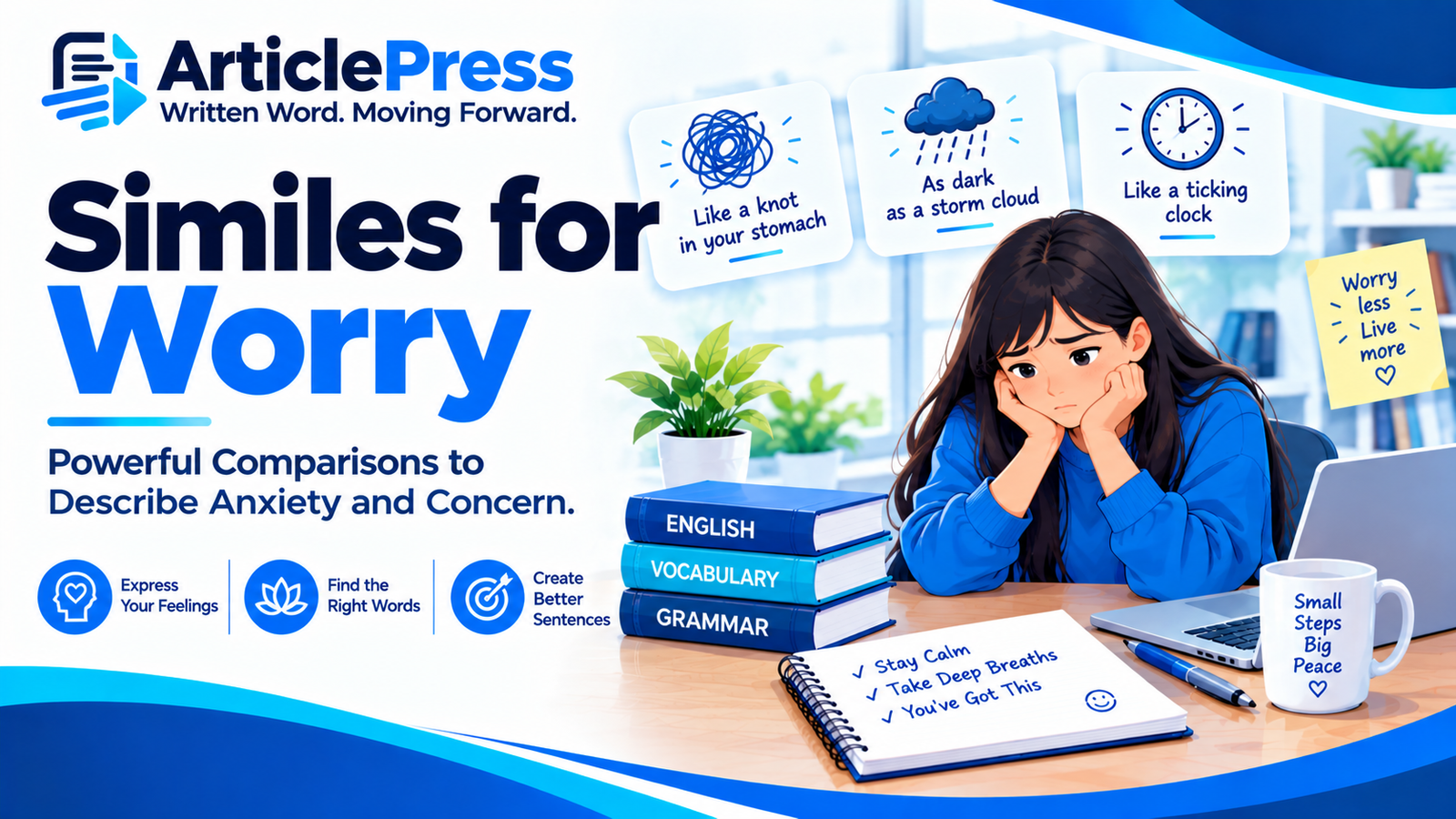
Worry can feel like a storm gathering in the distance, a clock ticking in a silent room, or a knot tightening in your stomach. The best similes for worry help readers picture anxious thoughts, nervous anticipation, and the uneasy feeling that something might go wrong.
This collection includes simple, creative, emotional, and powerful comparisons for describing worry. Each simile includes a meaning and an example sentence so you can use it naturally in a story, poem, essay, or school assignment. Whether you want to describe mild concern or overwhelming uncertainty, these examples will help you express the feeling more vividly.
What Is a Simile for Worry?
A simile for worry compares anxious feelings or thoughts to something recognizable, using words such as like or as. For example, “Her worry was like a storm cloud following her” compares persistent concern to a cloud that seems impossible to escape.
Similes make abstract emotions easier to imagine. A tight knot can represent tension, a ticking clock can suggest anxious waiting, and a restless sea can capture thoughts that refuse to settle.
45 Best Similes for Worry With Meanings and Examples
These comparisons cover different kinds of worry, from a small concern that lingers in the background to intense anxiety before an important event.
Simple Similes for Worry
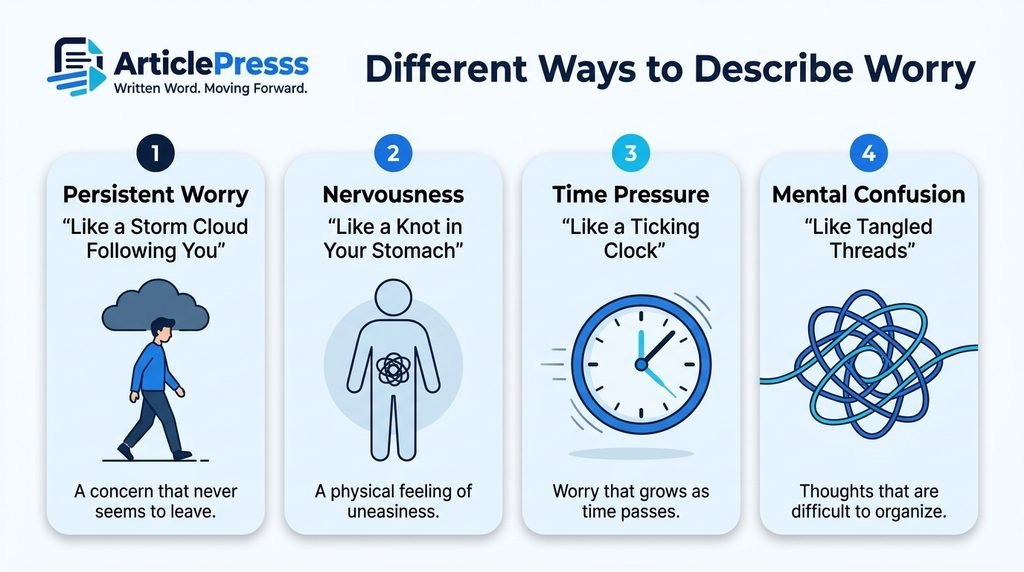
These easy-to-understand examples work well for students, everyday writing, and short descriptive paragraphs.
1. Like a storm cloud following you
Meaning: A persistent worry that stays with someone throughout the day.
Example: A storm cloud seemed to follow Maya as she waited for the exam results.
2. Like a knot in your stomach
Meaning: A physical feeling of nervousness or uneasiness.
Example: I felt a knot in my stomach like a tangled piece of string when my father was late coming home.
3. Like a ticking clock
Meaning: Worry that grows as time passes and an important moment approaches.
Example: The deadline hung over Daniel like a ticking clock, reminding him that he had little time left.
4. Like a shadow that never leaves
Meaning: A concern that follows someone everywhere.
Example: Her worry about the future followed her like a shadow that never left.
5. As restless as a caged bird
Meaning: Unable to relax because of nervous thoughts.
Example: He was as restless as a caged bird while waiting outside the interview room.
6. Like a buzzing fly
Meaning: A small but irritating worry that keeps returning to the mind.
Example: The thought of forgetting her speech buzzed around her head like a fly.
7. Like a pebble in your shoe
Meaning: A minor concern that becomes difficult to ignore.
Example: His unfinished assignment felt like a pebble in his shoe throughout the weekend.
8. Like a heavy backpack
Meaning: Worry that feels like a burden someone must carry.
Example: Keeping the family secret felt like carrying a heavy backpack everywhere she went.
9. As uneasy as a boat on rough water
Meaning: Feeling uncertain and unsettled when circumstances are unpredictable.
Example: Liam felt as uneasy as a boat on rough water when he heard rumors about the company’s future.
10. Like a puzzle with missing pieces
Meaning: Worry caused by incomplete information or an unclear situation.
Example: The unexplained phone call left her mind feeling like a puzzle with missing pieces.
Creative Similes for Worry
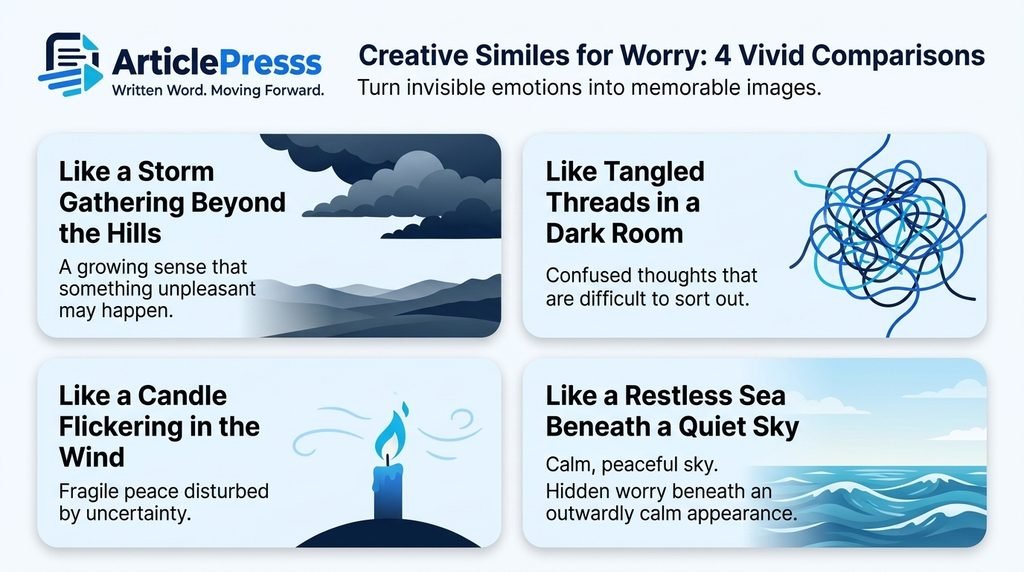
These imaginative comparisons can make emotional descriptions more vivid in fiction, poetry, and personal writing.
11. Like a storm gathering beyond the hills
Meaning: A growing sense that something unpleasant may happen.
Example: An uneasy silence settled over the room like a storm gathering beyond the hills.
12. Like tangled threads in a dark room
Meaning: Confused thoughts that are difficult to sort out.
Example: His worries about money, work, and family twisted together like tangled threads in a dark room.
13. Like a candle flickering in the wind
Meaning: A fragile sense of peace disturbed by uncertainty.
Example: Her confidence flickered like a candle in the wind as the audience began asking questions.
14. Like a door that will not quite close
Meaning: A concern that never feels completely resolved.
Example: The argument with his brother remained in his mind like a door that would not quite close.
15. Like rain tapping on a window all night
Meaning: Repeated thoughts that interrupt rest and make it difficult to relax.
Example: Thoughts about the upcoming surgery tapped at Elena’s mind like rain on a window all night.
16. Like a thread slowly tightening
Meaning: Anxiety that gradually becomes more intense.
Example: With every unanswered message, the worry tightened around him like a thread being pulled.
17. Like a maze with no clear exit
Meaning: Feeling trapped in a problem without knowing how to solve it.
Example: Choosing between two uncertain job offers felt like walking through a maze with no clear exit.
18. Like a radio stuck between stations
Meaning: A restless mind that cannot settle on one clear thought.
Example: Her thoughts crackled like a radio stuck between stations as she tried to fall asleep.
19. Like a restless sea beneath a quiet sky
Meaning: Hidden worry beneath an outwardly calm appearance.
Example: He smiled at his friends, but his mind was like a restless sea beneath a quiet sky.
20. Like a clock with no hands
Meaning: Anxiety caused by uncertainty about when something will happen or how long the wait will last.
Example: Waiting for news without knowing when it would arrive felt like staring at a clock with no hands.
Similes for Nervousness and Anticipation
Use these when someone is worried about a test, interview, performance, difficult conversation, or important decision.
21. As nervous as a first-time performer
Meaning: Feeling anxious before doing something unfamiliar in front of others.
Example: I was as nervous as a first-time performer before stepping onto the stage.
22. Like standing on the edge of a cliff
Meaning: Feeling uncertain before a major decision or potentially life-changing event.
Example: Submitting her application felt like standing on the edge of a cliff, unsure of what lay below.
23. Like waiting for a storm to break
Meaning: Expecting an uncomfortable or difficult event to happen.
Example: The students sat in silence, like people waiting for a storm to break, as the teacher handed out the results.
24. As jumpy as a cat near a loud noise
Meaning: Easily startled because of nervousness.
Example: He was as jumpy as a cat near a loud noise while waiting for the doctor to call his name.
25. Like a drum beating too fast
Meaning: Nervous anticipation that makes the heart seem to race.
Example: Her heart pounded like a drum beating too fast when she heard her name announced.
26. Like walking on thin ice
Meaning: Feeling anxious because one mistake could create a problem.
Example: After their disagreement, Mark felt like he was walking on thin ice whenever he spoke to his manager.
27. As tense as a tightly wound spring
Meaning: So nervous that even a small event could trigger a strong reaction.
Example: She sat as tense as a tightly wound spring while waiting for the final interview question.
28. Like holding your breath underwater
Meaning: Waiting anxiously for relief, news, or an outcome.
Example: The family waited for the phone call like someone holding their breath underwater.
29. Like a leaf trembling in the breeze
Meaning: Feeling delicate, nervous, or frightened in an uncertain situation.
Example: His voice shook like a leaf trembling in the breeze as he began his speech.
30. Like a runner waiting for the starting gun
Meaning: Feeling tense and alert just before an important event begins.
Example: Before the competition, Priya felt like a runner waiting for the starting gun.
Powerful Similes for Deep Worry
These comparisons communicate heavier concerns, persistent uncertainty, or a feeling of being overwhelmed.
31. Like carrying a mountain on your shoulders
Meaning: Feeling burdened by serious responsibilities or concerns.
Example: With bills piling up and work becoming uncertain, he felt as though he were carrying a mountain on his shoulders.
32. Like a cage closing around you
Meaning: Feeling trapped by circumstances or repeated worries.
Example: Every new financial problem made her worry feel like a cage slowly closing around her.
33. Like a shadow stretching across the day
Meaning: A concern that affects even otherwise pleasant moments.
Example: The uncertainty surrounding his job stretched across the day like a long shadow.
34. Like a river breaking through its banks
Meaning: Worry that becomes too intense to contain easily.
Example: After weeks of keeping quiet, her fears poured out like a river breaking through its banks.
35. Like a thousand doors slamming in your mind
Meaning: A rush of alarming thoughts that makes it hard to concentrate.
Example: When she realized she had lost her passport, possibilities slammed through her mind like a thousand doors.
36. Like walking through fog without a map
Meaning: Feeling worried because the future is unclear and the next step is uncertain.
Example: Starting his own business felt like walking through fog without a map.
37. Like a weight pressing against your chest
Meaning: A heavy emotional sense of concern or dread.
Example: The unresolved disagreement sat over him like a weight pressing against his chest.
38. Like a fire smoldering beneath the ashes
Meaning: Worry that appears quiet but remains active underneath the surface.
Example: Although she stopped talking about the problem, her concern remained like a fire smoldering beneath the ashes.
39. Like a thread fraying under tension
Meaning: Feeling close to one’s emotional limit after prolonged stress.
Example: After days of conflicting demands, his patience felt like a thread fraying under tension.
40. Like a shadow growing at sunset
Meaning: A concern that becomes more noticeable as time passes or circumstances worsen.
Example: As the deadline approached, her worry grew like a shadow at sunset.
Gentle and Subtle Similes for Worry
Not every worry is overwhelming. These comparisons suit quiet concern, uncertainty, and the small doubts that appear during ordinary life.
41. Like a cloud passing over the sun
Meaning: A brief concern that interrupts an otherwise happy mood.
Example: The thought of tomorrow’s meeting passed over her happiness like a cloud over the sun.
42. Like a small stone in a still pond
Meaning: A minor concern that disturbs inner peace.
Example: His unexpected comment dropped into her thoughts like a small stone in a still pond.
43. Like a whisper behind a closed door
Meaning: A quiet, uncertain concern that is difficult to identify clearly.
Example: She could not explain her uneasiness, but it lingered like a whisper behind a closed door.
44. Like mist settling over a garden
Meaning: A gentle but persistent uncertainty that clouds one’s outlook.
Example: Doubts about the move settled over her plans like mist over a garden.
45. Like a distant bell in the night
Meaning: A faint warning or concern that keeps calling attention to itself.
Example: The possibility that he had made the wrong choice echoed in his mind like a distant bell in the night.
Quick-Reference Table: Choosing the Best Simile for Worry
Use this table to find a comparison that matches the feeling you want to express.
| Simile | Meaning | Best used for |
| Like a storm cloud following you | Persistent concern | Stories and essays |
| Like a knot in your stomach | Physical nervousness | Everyday descriptions |
| Like a ticking clock | Pressure as time runs out | Deadlines and exams |
| Like tangled threads | Confused thoughts | Emotional writing |
| Like a candle in the wind | Fragile confidence | Poetry and fiction |
| Like walking on thin ice | Fear of making a mistake | Work and relationships |
| Like a tightly wound spring | Intense tension | Character descriptions |
| Like carrying a mountain | A heavy emotional burden | Serious situations |
| Like a cloud over the sun | A brief concern | Gentle emotional writing |
| Like fog without a map | Uncertainty about the future | Decisions and life changes |
How to Use Similes for Worry in Writing
The strongest simile does more than name an emotion. It helps readers experience the situation through an image they can recognize.
1. Match the simile to the intensity
Choose a gentle comparison for a small concern and a stronger one for overwhelming worry.
- Mild worry: A small stone in a still pond.
- Growing worry: A thread slowly tightening.
- Intense worry: A river breaking through its banks.
For example, “She worried about the meeting” communicates the basic feeling. “Her worry tightened around her like a thread being pulled” makes the emotion more vivid and gradual.
2. Use physical sensations for nervousness
Worry often appears through a character’s actions and bodily reactions. Similes involving knots, trembling leaves, pounding drums, and tightly wound springs can communicate nervousness without repeatedly using the word anxious.
Example: “His hands shook like leaves in the breeze as he waited for the interview to begin.”
This comparison helps the reader picture the character’s nervousness.
3. Use nature to describe uncertainty
Storms, fog, clouds, rivers, and restless seas work well when the situation feels unpredictable.
Example: “The uncertainty surrounding their move hung over the family like a storm gathering beyond the hills.”
Nature-based comparisons are particularly useful in descriptive essays, novels, and poetry because they connect an abstract emotion with a visible scene.
4. Avoid mixing too many images
A sentence becomes confusing when it compares worry to several unrelated things at once.
Overloaded: Her worry was a storm, a buzzing fly, a mountain, and a river.
Clearer: Her worry followed her like a storm cloud that refused to pass.
One well-chosen comparison usually creates a stronger impression than several competing images.
5. Make the simile fit the character
A child’s worry, a student’s exam anxiety, and an adult’s concern about an uncertain future may require different language.
- For children: “I felt a knot in my stomach.”
- For a student: “The deadline ticked in my mind like a clock.”
- For a fictional character facing uncertainty: “Her doubts gathered like storm clouds beyond the hills.”
Choose words that match the character’s age, situation, and voice.
Frequently Asked Questions
1. What is a good simile for worry?
A good simile is “worry is like a storm cloud following you.” It describes a concern that stays with someone throughout the day. Another effective option is “like a knot in your stomach,” which captures the physical feeling of nervousness.
2. What is a strong simile for deep worry?
“Like carrying a mountain on your shoulders” is a strong simile for deep worry because it presents emotional concern as a heavy burden. It works well when a character faces serious responsibilities, difficult decisions, or several problems at once.
3. What is an easy simile for worry for kids?
“Worry is like a buzzing fly” is an easy simile for children to understand. It compares a distracting thought to a fly that keeps returning. “Like a knot in your stomach” is another simple option for describing nervousness before a test or performance.
4. How do you describe worry in a poem?
Use sensory images and comparisons that fit the poem’s mood. For example, “My worry was a candle flickering in the wind” suggests fragile peace, while “My thoughts were like waves beneath a restless sky” creates a more unsettled atmosphere. Keep the image consistent with the poem’s tone.
5. What is the difference between a simile for worry and a metaphor for worry?
A simile compares two things using like or as, such as “Her worry was like a storm cloud.” A metaphor makes a direct comparison, such as “Her worry was a storm cloud.” Both can communicate emotion, but they use different structures.
6. Can I use similes for worry in an essay?
Yes. Similes can strengthen descriptive and personal essays by making feelings easier to understand. For formal academic writing, use them selectively and ensure that they clarify the point rather than distract from your argument.
Practice: Test Your Understanding
Complete these five exercises to practice recognizing and using similes for worry.
- Complete the simile: “My stomach felt like a ______ before the exam.”
- Which simile best describes uncertainty about the future: “like fog without a map” or “like a sunny afternoon”?
- What does “as tense as a tightly wound spring” suggest?
- Rewrite this sentence using a simile: “She worried while waiting for the results.”
- Create your own simile for a small worry that keeps returning.
Answers
- A knot.
- Like fog without a map.
- Intense nervousness and tension.
- Example: “She waited for the results with worry ticking in her mind like a clock.”
- Example: “My worry was like a tiny pebble in my shoe.”
The final two exercises allow different answers. A comparison works well when its meaning is clear and appropriate to the situation.
For related comparisons, see similes for terrified, similes for sadness and similes for encouragement.
Final Thoughts
Similes for worry help turn an invisible emotion into something readers can picture and understand. A ticking clock can express pressure, a tangled thread can suggest confused thoughts, and a storm cloud can represent persistent concern. The best comparison depends on how intense the worry feels and what causes it.
When writing your own similes, begin with the emotion you want to communicate, choose an image that naturally fits it, and place the comparison in a clear sentence. Whether you’re writing a school assignment, a poem, or a story, a thoughtful simile can make worry feel more real without overexplaining it.

The ArticlesPress editorial team writes and reviews every guide on similes and figurative language, with clear meanings and example sentences for students, teachers and writers.