Good similes for sadness help readers understand an emotion by comparing it to something familiar, such as a rainy sky, a heavy stone, or an empty room. These comparisons make feelings easier to imagine and give descriptive writing more depth.
Some similes express quiet disappointment, while others describe deep sorrow, loneliness, or heartbreak. The best choice depends on the emotion you want to convey and the situation surrounding it. Below are 35 good similes for sadness, complete with meanings and example sentences.
What Is a Simile for Sadness?
A simile for sadness compares a sad feeling to another person, object, experience, or natural phenomenon using words such as like or as. For example, “Her sadness hung over her like a dark cloud” compares an emotional state to gloomy weather.
Writers use these comparisons to help readers picture emotions that are otherwise difficult to describe. A gentle simile can communicate disappointment, while a stronger comparison can convey grief or heartbreak.
35 Good Similes for Sadness
1. Simple Similes for Sadness
These easy-to-understand comparisons are useful for schoolwork, everyday communication, and beginner creative writing.
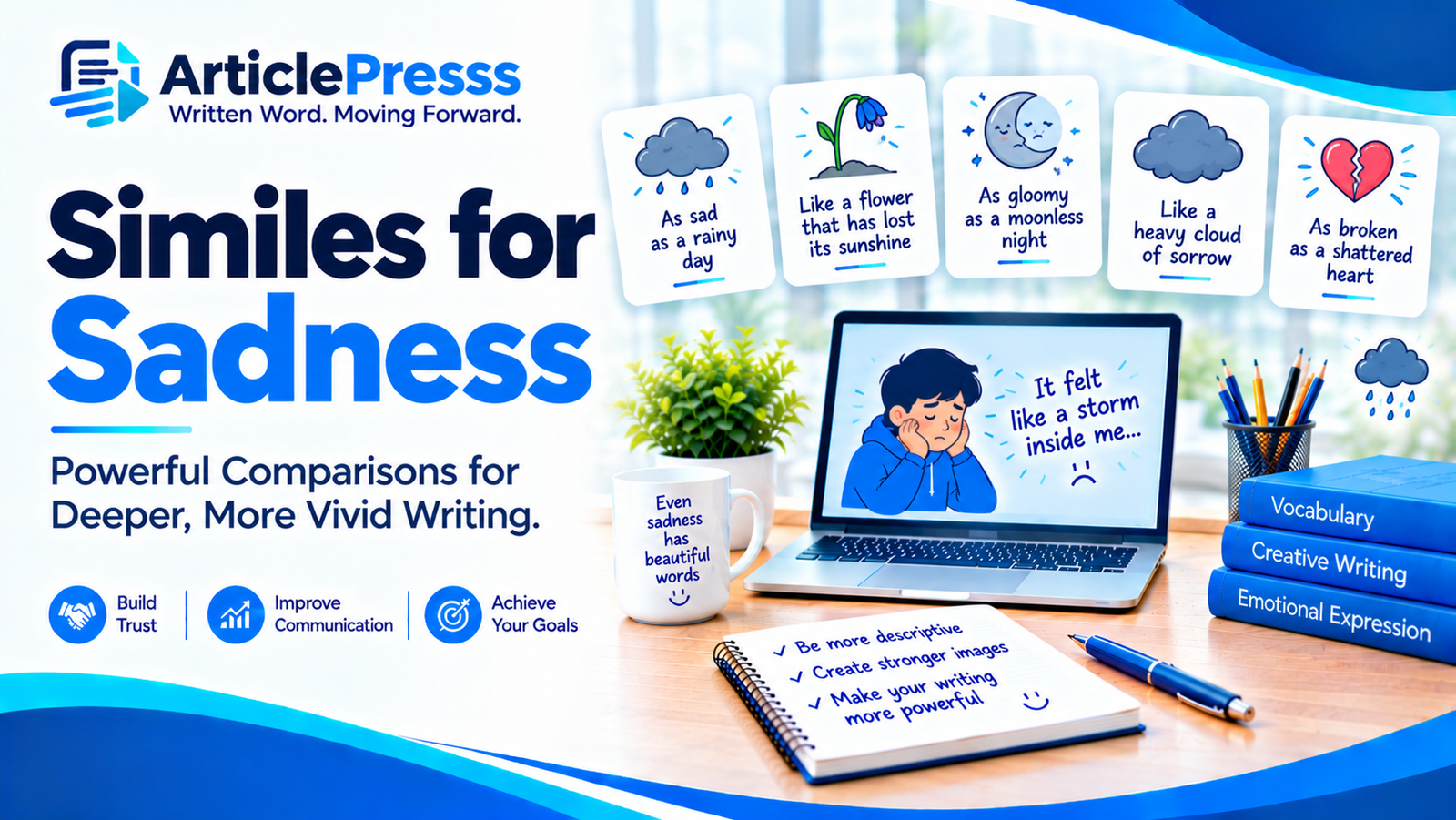
1. As sad as a rainy day
Meaning: Feeling gloomy, unhappy, or emotionally low.
Example: Liam felt as sad as a rainy day after his best friend moved away.
2. Like a flower without sunlight
Meaning: Feeling lifeless or discouraged without something that brings happiness.
Example: Without her family’s support, Maya felt like a flower without sunlight.
3. As gloomy as a cloudy sky
Meaning: Feeling downhearted, with little hope or excitement.
Example: His mood was as gloomy as a cloudy sky after he failed the exam.
4. Like a song in a minor key
Meaning: Carrying a gentle, sorrowful feeling, similar to music that sounds melancholy.
Example: Her memories of childhood felt like a song in a minor key.
5. As quiet as an empty room
Meaning: Experiencing a silence that makes sadness or loneliness more noticeable.
Example: After everyone left, the house felt as quiet as an empty room.
2. Similes for Deep Sadness
Use these comparisons when a character experiences powerful sorrow, a painful loss, or a difficult emotional moment.
6. Like a stone resting on the heart
Meaning: Feeling emotional pain that seems heavy and difficult to escape.
Example: The news of his grandfather’s death felt like a stone resting on his heart.
7. As heavy as a rain-soaked blanket
Meaning: Feeling weighed down by sadness and struggling to find energy.
Example: After weeks of disappointment, exhaustion settled over her as heavy as a rain-soaked blanket.
8. Like a storm trapped inside
Meaning: Experiencing intense emotions that cannot easily be expressed.
Example: He smiled at the gathering, but inside he felt like a storm trapped inside.
9. As dark as a moonless night
Meaning: Feeling surrounded by sorrow, uncertainty, or hopelessness.
Example: The days following the terrible news seemed as dark as a moonless night.
10. Like a river overflowing its banks
Meaning: Feeling so overwhelmed by emotion that tears or words become difficult to control.
Example: When she finally spoke about her loss, her grief flowed like a river overflowing its banks.
3. Similes for Loneliness and Emptiness
These comparisons focus on the sadness that can come from separation, isolation, or missing someone important.
11. Like a house with no lights on
Meaning: Feeling empty or abandoned when familiar warmth and companionship are missing.
Example: After his children left for college, the family home felt like a house with no lights on.
12. As lonely as a lighthouse in a fog
Meaning: Feeling isolated while surrounded by uncertainty or emotional distance.
Example: Standing among strangers at the crowded event, she felt as lonely as a lighthouse in a fog.
13. Like a chair left empty at the table
Meaning: Feeling the absence of someone who once played an important role in daily life.
Example: During the holiday dinner, her father’s absence felt like a chair left empty at the table.
14. As empty as a dried-up well
Meaning: Feeling emotionally drained, with little happiness or comfort left to give.
Example: After months of caring for everyone else, she felt as empty as a dried-up well.
15. Like a bird searching for its lost nest
Meaning: Feeling unsettled and alone after losing a familiar place or sense of belonging.
Example: After moving to a new country, Daniel felt like a bird searching for its lost nest.
4. Similes for Heartbreak and Missing Someone
These similes work well for stories, poems, and personal writing about separation, lost relationships, and memories.
16. Like a photograph fading in sunlight
Meaning: Feeling that precious memories or a once-close relationship are slowly slipping away.
Example: Their childhood friendship seemed like a photograph fading in sunlight.
17. As fragile as glass after a crack
Meaning: Feeling emotionally vulnerable after a painful experience.
Example: Following the breakup, his confidence was as fragile as glass after a crack.
18. Like a letter that never reached its reader
Meaning: Feeling that love, regret, or important words have been left unexpressed.
Example: Her apology remained like a letter that never reached its reader.
19. As cold as an unanswered goodbye
Meaning: Feeling hurt by a separation that offers no explanation or emotional closure.
Example: His sudden departure felt as cold as an unanswered goodbye.
20. Like an echo in an abandoned hall
Meaning: Feeling the lingering presence of someone who is no longer there.
Example: Her favorite song sounded like an echo in an abandoned hall after the relationship ended.
5. Similes for Disappointment and Regret
These comparisons are useful when sadness comes from failure, missed opportunities, broken promises, or choices a person wishes they could change.
21. Like a balloon slowly losing air
Meaning: Feeling excitement, confidence, or hope gradually disappear.
Example: As the final rejection arrived, his optimism faded like a balloon slowly losing air.
22. As disappointing as a gift box with nothing inside
Meaning: Feeling let down when an anticipated reward or experience brings nothing meaningful.
Example: The long-awaited announcement was as disappointing as a gift box with nothing inside.
23. Like a candle going out in the wind
Meaning: Watching hope or happiness disappear because of an unexpected setback.
Example: Her hopes of winning the competition vanished like a candle going out in the wind.
24. As bitter as an unfinished promise
Meaning: Feeling hurt or resentful when someone fails to keep their word.
Example: His disappointment was as bitter as an unfinished promise after years of waiting.
25. Like a road ending before its destination
Meaning: Feeling frustrated or sad when progress stops before reaching an important goal.
Example: Losing the scholarship felt like a road ending before its destination.
6. Creative and Poetic Similes for Sadness
These more imaginative comparisons can add atmosphere, symbolism, and emotional depth to fiction and poetry.
26. Like autumn leaves drifting from a bare branch
Meaning: Feeling that something precious is gradually slipping away.
Example: As her children grew older, she watched their childhood pass like autumn leaves drifting from a bare branch.
27. As soft as rain on a forgotten window
Meaning: Describing a quiet, reflective sadness that arrives without a dramatic display.
Example: A gentle sadness settled over him, as soft as rain on a forgotten window.
28. Like a shadow following every step
Meaning: Feeling that sadness remains present even during ordinary activities.
Example: Since the loss, sorrow had followed her like a shadow following every step.
29. As distant as a star behind thick clouds
Meaning: Feeling separated from happiness, comfort, or a person who once seemed close.
Example: During his darkest days, happiness seemed as distant as a star behind thick clouds.
30. Like a garden waiting for spring
Meaning: Experiencing a quiet period of sadness while hoping for better days.
Example: After months of uncertainty, she felt like a garden waiting for spring.
7. Short Similes for Sadness
These brief comparisons fit easily into simple sentences, school assignments, captions, and short descriptive passages.
31. As sad as a lost child
Meaning: Feeling vulnerable, confused, or in need of comfort.
Example: He looked as sad as a lost child when his family drove away.
32. Like a fading sunset
Meaning: Feeling that a happy moment or relationship is coming to an end.
Example: Their final conversation felt like a fading sunset.
33. As cold as winter rain
Meaning: Feeling an unpleasant, penetrating sadness.
Example: Her disappointment felt as cold as winter rain.
34. Like a broken melody
Meaning: Feeling that something once beautiful or harmonious has been damaged.
Example: After their argument, their friendship felt like a broken melody.
35. As still as a frozen lake
Meaning: Feeling emotionally numb, silent, or unable to express sadness.
Example: He sat as still as a frozen lake while he tried to understand the news.
Quick Reference: Choosing the Right Simile for Sadness
| Simile | Emotion or Situation | Best Used For |
|---|---|---|
| As gloomy as a cloudy sky | Low mood | Everyday descriptions |
| Like a stone resting on the heart | Heavy sorrow | Emotional stories |
| Like a chair left empty at the table | Missing someone | Family and grief writing |
| Like a balloon slowly losing air | Fading hope | Disappointment |
| Like a shadow following every step | Lasting sadness | Character development |
| Like a garden waiting for spring | Sadness with hope | Reflective writing |
| Like a broken melody | Damaged connection | Poetry and fiction |
| As still as a frozen lake | Emotional numbness | Quiet, serious scenes |
How to Use Similes for Sadness in Writing
The most effective simile does more than tell readers that someone feels sad. It gives them an image that helps them understand the character’s experience.
1. Match the simile to the emotion
Not every kind of sadness feels the same. Choose a comparison that fits the situation.
- Mild disappointment: “His excitement faded like a balloon slowly losing air.”
- Loneliness: “She felt like a house with no lights on.”
- Deep grief: “The news rested on his heart like a heavy stone.”
- Quiet sadness: “A gentle sorrow fell over her like rain on a forgotten window.”
These differences help readers recognize the intensity and nature of the emotion.
2. Use similes to show instead of tell
A plain sentence communicates information, but a vivid comparison can create a more memorable image.
Plain: She was sad after her friend moved away.
Improved: Her sadness followed her like a shadow after her friend moved away.
The second sentence makes the emotion feel persistent rather than temporary.
3. Avoid using too many comparisons together
One well-chosen simile is usually stronger than several competing images in the same sentence.
Overloaded: His sadness was like a storm, a broken mirror, a dark cloud, and a sinking ship.
Improved: His sadness gathered like a storm on the horizon.
The revised version gives the reader one clear image to imagine.
4. Create your own original similes
You can develop fresh comparisons by thinking about what sadness feels like physically or emotionally. Ask yourself whether it feels heavy, cold, empty, distant, or slow.
For example:
- Heavy sadness can resemble a backpack filled with stones.
- Loneliness can resemble a bench in an empty station.
- Fading hope can resemble a lamp running out of power.
- Quiet grief can resemble mist settling over a field.
Choose an image that fits the character and setting. The comparison should feel natural rather than unusual just for the sake of originality.
Common Mistakes When Writing Similes About Sadness
- Choosing an image that does not fit: A cheerful or energetic image may weaken a scene about grief unless the contrast is intentional.
- Repeating familiar phrases: Expressions such as “sad as a rainy day” are easy to understand, but a fresh image can make a passage more distinctive.
- Confusing a metaphor with a simile: “Sadness was a storm” is a metaphor. “Sadness was like a storm” is a simile.
- Overexplaining the emotion: Let the comparison work. You do not need to explain every detail after using a strong image.
- Ignoring context: A simile suitable for a children’s story may feel too simple for a serious poem or adult novel.
Conclusion
Good similes for sadness make difficult emotions easier to picture and understand. Comparisons involving rain, shadows, empty rooms, fading light, and broken melodies can express different forms of sorrow, from mild disappointment to deep grief. Choose an image that matches the situation rather than using the same comparison for every sad moment. For stronger writing, combine a clear simile with meaningful details about a character’s actions, surroundings, or thoughts. You can also create your own comparisons by asking what the sadness feels like and which familiar image best captures that experience.

James Wilson writes about similes, metaphors, figurative language, and descriptive writing at ArticlesPress. He creates practical examples and explanations to help students, teachers, and creative writers understand language techniques and use vivid comparisons in stories, poems, and essays