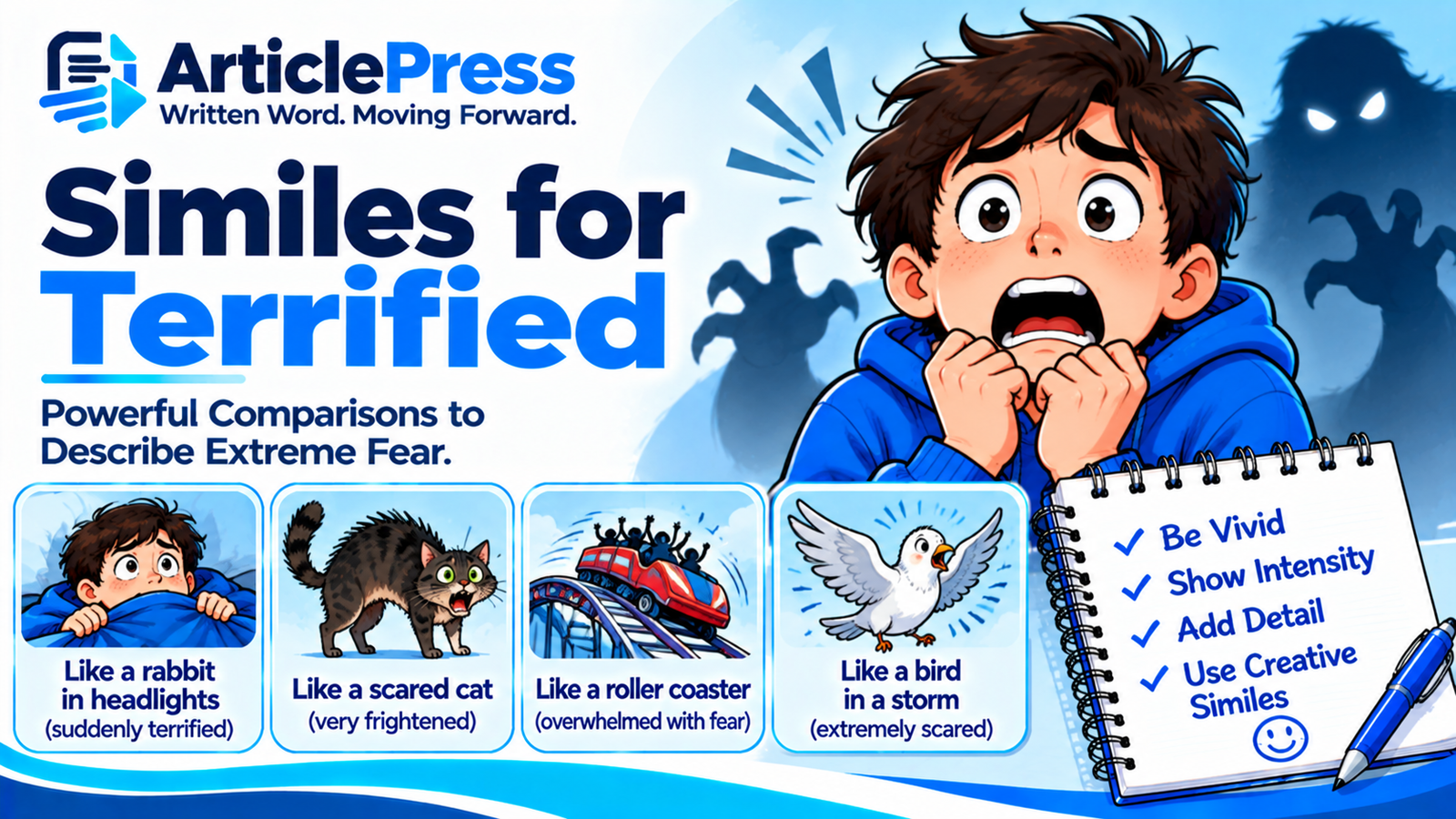
Similes for terrified help you describe intense fear in a vivid, memorable way. A terrified person might shake like a leaf in a storm, freeze like a statue, or stare like a rabbit caught in headlights. These comparisons show how fear affects someone’s body, thoughts, and behavior rather than simply stating that the person is scared.
This collection features 45 similes for terrified, with clear meanings and natural example sentences. You’ll find simple comparisons, powerful descriptions of panic, and creative expressions for suspenseful stories, poems, school assignments, and character development. Whether you’re describing someone who hears a strange noise in the dark or faces an immediate danger, you can choose a simile that matches the intensity of the moment.
What Does Terrified Mean in a Simile?
A simile for terrified compares a person, reaction, or frightening experience to something that communicates extreme fear. It uses words such as like or as to help readers imagine the emotion.
For example, “She trembled like a leaf in a storm” compares a person’s shaking to a leaf moving violently in strong wind. The comparison makes her fear easier to picture.
Terrified is stronger than simply nervous or worried. It suggests overwhelming fear, sometimes accompanied by trembling, a racing heartbeat, silence, or the urge to escape. The most effective similes capture these reactions without repeatedly using the word scared.
45 Best Similes for Terrified With Meanings and Examples
These similes range from familiar expressions to original comparisons. Some emphasize physical reactions, while others convey helplessness, sudden panic, or the atmosphere of a frightening scene.
Simple Similes for Terrified

These easy-to-understand comparisons are useful for students, everyday descriptions, and beginner writing.
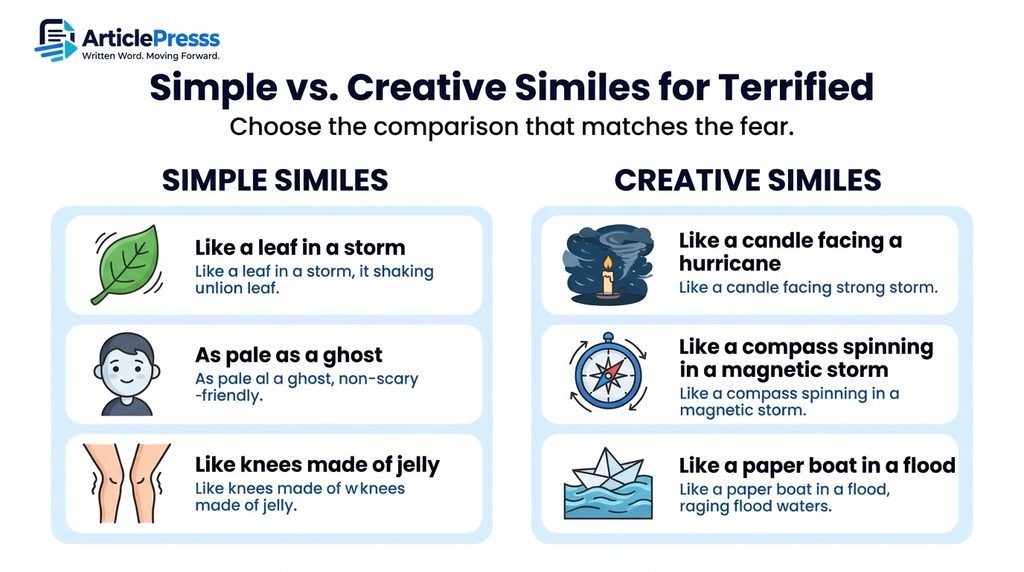
1. Like a Leaf in a Storm
Meaning: Trembling uncontrollably because of fear.
Example: She shook like a leaf in a storm when she heard footsteps outside her bedroom.
2. Like a Rabbit Caught in Headlights
Meaning: So frightened or surprised that you cannot move or react.
Example: When the enormous dog charged toward him, Leo stood like a rabbit caught in headlights.
3. As Pale as a Ghost
Meaning: Looking extremely frightened, with a face that has lost its usual color.
Example: He turned as pale as a ghost when the mysterious voice called his name.
4. Like a Deer in the Headlights
Meaning: Frozen with fear when confronted with something unexpected or threatening.
Example: The student looked like a deer in the headlights when the teacher suddenly called on him to explain the mistake.
5. As Still as a Statue
Meaning: Remaining completely motionless because of fear.
Example: She stood as still as a statue when she noticed someone watching her through the window.
6. Like a Mouse Facing a Cat
Meaning: Feeling small, helpless, and frightened in the presence of something threatening.
Example: The lost kitten crouched like a mouse facing a cat when the unfamiliar dog entered the room.
7. As Nervous as a Cat in a Room Full of Rocking Chairs
Meaning: Extremely uneasy and alert in a situation that feels dangerous or unpredictable.
Example: Waiting alone in the unfamiliar house, Ben felt as nervous as a cat in a room full of rocking chairs.
8. Like a Child Lost in a Crowd
Meaning: Feeling helpless, overwhelmed, and frightened without safety or guidance.
Example: Separated from her family at the crowded station, Mia looked like a child lost in a crowd.
9. As Quiet as a Mouse
Meaning: Making almost no sound because of fear or a desire not to be noticed.
Example: The children became as quiet as mice when they heard heavy footsteps approaching the hiding place.
10. Like a Bird Trapped in a Cage
Meaning: Feeling frightened and desperate to escape.
Example: He paced like a bird trapped in a cage as the locked-room clock ticked toward midnight.
Powerful Similes for Extreme Fear
Use these comparisons when a character experiences overwhelming terror, sudden danger, or an intense physical reaction.
11. Like a Heartbeat Racing Down a Highway
Meaning: Experiencing a rapid heartbeat because of intense fear.
Example: Her heart pounded like a heartbeat racing down a highway as the footsteps grew louder.
12. Like a Candle Flickering in a Gale
Meaning: Appearing fragile and unsteady under overwhelming fear.
Example: His confidence flickered like a candle in a gale when the stranger stepped into the light.
13. As Shaky as a Bridge in an Earthquake
Meaning: Trembling so much that it is difficult to remain steady.
Example: My knees felt as shaky as a bridge in an earthquake when I reached the edge of the cliff.
14. Like Ice Cracking Beneath Your Feet
Meaning: Feeling suddenly unsafe, as though danger could strike at any moment.
Example: When the stranger mentioned her secret, her confidence broke like ice cracking beneath her feet.
15. Like a Match About to Burn Out
Meaning: Feeling fragile and close to losing the ability to cope with fear.
Example: After hours of hiding in the cellar, Daniel felt like a match about to burn out.
16. As Frozen as a Pond in Winter
Meaning: Being unable to react because fear has taken over.
Example: She stood as frozen as a pond in winter when the door slowly opened by itself.
17. Like a Wire Pulled Too Tight
Meaning: Being so tense with fear that even a small disturbance feels unbearable.
Example: He sat like a wire pulled too tight, waiting for the sound of the approaching footsteps.
18. Like a Storm-Tossed Ship
Meaning: Feeling overwhelmed and unable to find stability during a frightening experience.
Example: After hearing the alarming news, she felt like a storm-tossed ship struggling against enormous waves.
19. As Fragile as Glass Under a Hammer
Meaning: Feeling vulnerable, with the sense that one more shock could overwhelm you.
Example: His courage seemed as fragile as glass under a hammer when the threatening message arrived.
20. Like a Runner Hearing Footsteps Behind Them
Meaning: Feeling pursued, threatened, and desperate to get away.
Example: He hurried down the empty alley like a runner hearing footsteps behind him.
Creative Similes for Terrified
These more imaginative comparisons work well in suspense, horror, fantasy, and descriptive fiction.
21. Like a Shadow Afraid of the Light
Meaning: Acting as though even a small revelation or exposure is frightening.
Example: The secretive figure moved like a shadow afraid of the light whenever someone entered the room.
22. Like a Clock Ticking Inside a Coffin
Meaning: Experiencing suffocating suspense while feeling trapped and aware that time is passing.
Example: In the sealed chamber, every passing second felt like a clock ticking inside a coffin.
23. Like a Match Struck in a Dark Forest
Meaning: Feeling suddenly exposed and vulnerable in a threatening place.
Example: Standing alone beneath the trees, she felt like a match struck in a dark forest, small against the surrounding darkness.
24. Like a Candle Facing a Hurricane
Meaning: Feeling powerless against a danger much greater than yourself.
Example: The frightened child felt like a candle facing a hurricane as the angry waves battered the boat.
25. Like a Compass Spinning in a Magnetic Storm
Meaning: Feeling confused, disoriented, and unable to decide what to do.
Example: When the alarm sounded, his thoughts spun like a compass caught in a magnetic storm.
26. Like a Snowflake on a Hot Stove
Meaning: Feeling extremely vulnerable when confronted with something overwhelming.
Example: Facing the enormous creature, the tiny explorer felt like a snowflake on a hot stove.
27. Like a Whisper Lost in a Thunderstorm
Meaning: Feeling insignificant and powerless in the presence of something frightening.
Example: Her attempt to call for help sounded like a whisper lost in a thunderstorm as the crowd panicked.
28. Like a Paper Boat in a Flood
Meaning: Feeling helpless and unable to control events during a frightening situation.
Example: With the river rising around the campsite, the stranded family felt like a paper boat in a flood.
29. Like a Candle Cast Adrift at Sea
Meaning: Feeling alone, vulnerable, and uncertain in a frightening situation.
Example: After losing sight of his companions, the young sailor felt like a candle cast adrift at sea.
30. Like a Locked Door Trembling in Its Frame
Meaning: Appearing barely able to withstand mounting pressure or fear.
Example: He waited behind the bedroom door like a locked door trembling in its frame as someone tried the handle.
Similes for the Physical Signs of Terror
These comparisons focus on trembling, breathing, facial expressions, and the body’s response to fear.
31. As Cold as Ice
Meaning: Feeling intensely cold or emotionally chilled by fear.
Example: Her hands were as cold as ice when she reached for the phone to call for help.
32. Like a Drum Beating Inside the Chest
Meaning: Having a pounding heartbeat during a frightening moment.
Example: His heart sounded like a drum beating inside his chest as he waited for the announcement.
33. Like Knees Made of Jelly
Meaning: Having weak, unsteady legs because of fear.
Example: My knees felt like jelly when I looked down from the high observation platform.
34. Like a Fish Out of Water
Meaning: Feeling deeply uncomfortable, confused, or helpless in an unfamiliar and intimidating situation.
Example: Alone in the strange building, Omar felt like a fish out of water and longed to find the exit.
35. As Breathless as a Runner at the Finish Line
Meaning: Struggling to catch your breath after a frightening or stressful experience.
Example: She arrived at the safe house as breathless as a runner at the finish line after sprinting through the dark streets.
36. Like a Bell Shaken by an Invisible Hand
Meaning: Trembling or reacting nervously to a threat that cannot be seen.
Example: His voice quivered like a bell shaken by an invisible hand when he heard his name whispered from the empty hallway.
37. Like a Puppet With Tangled Strings
Meaning: Moving awkwardly because fear disrupts normal coordination.
Example: Too frightened to think clearly, he stumbled like a puppet with tangled strings toward the open door.
38. As Rigid as a Board
Meaning: Holding the body stiffly because of intense tension or fear.
Example: She lay as rigid as a board when she heard something scratching at the window.
Similes for Terror in Stories and Frightening Situations
Use these examples to build atmosphere, suspense, and a character’s sense of danger.
39. Like a Lantern Going Out in a Cave
Meaning: Feeling hope or courage disappear in a frightening, uncertain place.
Example: When the last light failed, his courage vanished like a lantern going out in a cave.
40. Like a Rabbit Hearing a Wolf Howl
Meaning: Feeling suddenly vulnerable when a threat becomes apparent.
Example: The campers exchanged terrified glances like rabbits hearing a wolf howl from the woods.
41. Like a Ship Drifting Toward Sharp Rocks
Meaning: Feeling powerless as danger approaches and escape seems difficult.
Example: Watching the threatening figure come closer, she felt like a ship drifting toward sharp rocks.
42. Like a Door Left Open in a Haunted House
Meaning: Seeming exposed, vulnerable, and inviting danger into a supposedly safe place.
Example: With the cellar entrance swinging open, the farmhouse felt like a door left open in a haunted house.
43. Like a Candle Surrounded by Darkness
Meaning: Feeling small and vulnerable when fear seems to surround you.
Example: The frightened child sat beside the dim lamp like a candle surrounded by darkness.
44. Like a Footstep Echoing Through an Empty Tunnel
Meaning: Feeling exposed and uneasy in a silent, threatening environment.
Example: Each movement sounded like a footstep echoing through an empty tunnel as she crossed the abandoned station.
45. Like a Leaf Caught in a Whirlwind
Meaning: Feeling tossed around by overwhelming fear without control over what happens next.
Example: When the emergency sirens began, he felt like a leaf caught in a whirlwind, unable to decide where to go.
Quick-Reference Table: Choosing the Right Simile for Terrified
Use this table to select a comparison based on the reaction or atmosphere you want to communicate.
| Simile | Meaning | Best used for |
| Like a leaf in a storm | Trembling | Physical fear |
| Like a rabbit caught in headlights | Frozen by shock | Sudden danger |
| As pale as a ghost | Looking frightened | Facial description |
| Like a bird trapped in a cage | Desperate to escape | Confinement |
| Like ice cracking beneath your feet | Feeling unsafe | Suspense |
| Like a wire pulled too tight | Extreme tension | Anticipation |
| Like a compass spinning in a magnetic storm | Mental confusion | Panic |
| Like knees made of jelly | Physical weakness | Nervous reactions |
| Like a candle facing a hurricane | Feeling powerless | Overwhelming danger |
| Like a leaf caught in a whirlwind | Losing control | Chaotic situations |
How to Use Similes for Terrified in Writing
The best simile for terrified depends on what your character experiences. A person who hears a strange noise may freeze, while someone fleeing danger may tremble or struggle to breathe. Choose a comparison that fits the character’s reaction and the mood of the scene.
1. In Stories and Novels
Use physical reactions to make a character’s fear believable.
Plain sentence: Emma was terrified when the door opened.
Improved sentence: Emma stood as still as a statue when the door creaked open, her eyes fixed on the darkness beyond it.
The comparison gives readers a visible reaction instead of simply naming the emotion.
2. In Horror and Suspense Writing
Choose comparisons that create uncertainty, vulnerability, or a sense of approaching danger.
Example: Every footstep sounded like a warning bell in an empty cathedral, and Daniel’s heart pounded like a drum inside his chest.
Combining two different types of imagery can build suspense, but avoid stacking too many similes into one sentence.
3. In Poems and Descriptive Writing
Use compact comparisons with strong images, sounds, or movements.
Example: I trembled like a leaf beneath the moon, while silence pressed against the walls.
This style connects physical fear with the atmosphere surrounding the character.
4. In School Assignments
Choose familiar comparisons that clearly communicate the meaning.
Example: The little boy shook like a leaf when he heard thunder rumble outside.
This sentence is simple, easy to understand, and appropriate for classroom descriptive writing.
5. In Character Descriptions
Select a simile based on how the character responds to fear.
- A character who freezes: As still as a statue.
- A character who trembles: Like a leaf in a storm.
- A character who feels trapped: Like a bird trapped in a cage.
- A character who feels overwhelmed: Like a leaf caught in a whirlwind.
- A character who appears frightened: As pale as a ghost.
These distinctions help different characters respond to fear in different ways.
How to Create Your Own Similes for Terrified
You can create original similes by identifying a physical reaction, then comparing it to something readers can easily imagine.
- Choose a reaction: trembling, freezing, gasping, hiding, or losing confidence.
- Find a vivid image: a shaking branch, a stalled engine, a flickering candle, or a boat in rough water.
- Connect the ideas: use like or as to make the comparison.
- Check the meaning: make sure the image communicates fear rather than a different emotion.
- Read the sentence aloud: remove anything that sounds forced or distracts from the scene.
For example, start with “His hands trembled.” Compare the movement to a fragile object in strong wind, then write: “His hands shook like branches in a winter gale.”
The comparison works because both images suggest repeated, uncontrollable movement.
Frequently Asked Questions
1. What is a good simile for terrified?
“Shaking like a leaf in a storm” is a good simile for someone experiencing intense fear. It creates a clear image of uncontrollable trembling. For a character who cannot move because of shock, “as still as a statue” may be more appropriate.
2. What is a strong simile for extreme fear?
“Like a candle facing a hurricane” is a strong, creative comparison for someone who feels powerless against an overwhelming threat. It emphasizes vulnerability rather than just nervousness.
3. What is an easy simile for terrified for kids?
“As pale as a ghost” is an easy simile for children to understand. Another simple option is “shaking like a leaf.” Both comparisons help young writers describe visible signs of fear.
4. How do you describe someone who is terrified using a simile?
Compare the person’s reaction to a familiar image. You might write, “Her knees felt like jelly,” to describe weakness, or “He stood like a deer in the headlights” to show that someone is too frightened to react.
5. What is the difference between similes for scared and terrified?
Scared can describe mild or moderate fear, while terrified usually communicates much more intense fear. A simile such as “uneasy like a cat in an unfamiliar room” can suggest nervousness, whereas “frozen like a statue as danger approached” conveys a more intense reaction.
6. Can I use similes for terrified in essays and poems?
Yes. Similes can make descriptive essays, poems, and stories more vivid. In formal essays, use them when descriptive language supports your purpose. In poems and fiction, you can use more imaginative comparisons to build emotion and atmosphere.
7. What is the difference between a simile and a metaphor for terror?
A simile makes a comparison using words such as like or as, as in “He shook like a leaf.” A metaphor makes a direct comparison, as in “Fear was a storm inside him.” Both can communicate intense emotion, but they use different structures.
Writers working on similar scenes often use similes for sadness, similes for encouragement or similes for being lost as well.
Final Thoughts
The best similes for terrified show readers what intense fear looks and feels like. Comparisons such as “shaking like a leaf in a storm,” “as still as a statue,” and “like a bird trapped in a cage” communicate different reactions, from physical trembling to helplessness. Choose a simile that matches the character, setting, and level of fear you want to express. For suspenseful fiction, you can create more imaginative comparisons; for schoolwork, simpler expressions may be clearer. Above all, use similes purposefully. One precise, memorable comparison often creates a stronger impression than several competing images.

The ArticlesPress editorial team writes and reviews every guide on similes and figurative language, with clear meanings and example sentences for students, teachers and writers.