Being lost can mean more than not knowing where you are. It can describe someone wandering through unfamiliar streets, struggling to make a decision, feeling disconnected from others, or searching for direction in life. Similes for being lost help express these experiences through comparisons with things such as ships without compasses, travelers without maps, and leaves carried by the wind.
Some comparisons describe physical confusion, while others capture emotional uncertainty or a lack of purpose. Below, you’ll find 25 similes with simple meanings, explanations, and example sentences to help you choose the right expression for your writing.
What Does Being Lost Mean in a Simile?
In a simile, being lost can be compared to something that has no clear direction, cannot find its destination, or struggles to understand its surroundings.
For example, “He wandered through the city like a traveler without a map.” This comparison suggests that he has no idea where to go or how to reach his destination.
Writers can also use similes to describe emotional experiences. Someone who feels uncertain about life might be compared to a ship sailing without a compass. The comparison makes an invisible feeling easier for readers to imagine.
25 Best Similes for Being Lost
Here are 25 descriptive comparisons for expressing confusion, wandering, uncertainty, and feeling directionless.
1. Like a ship without a compass
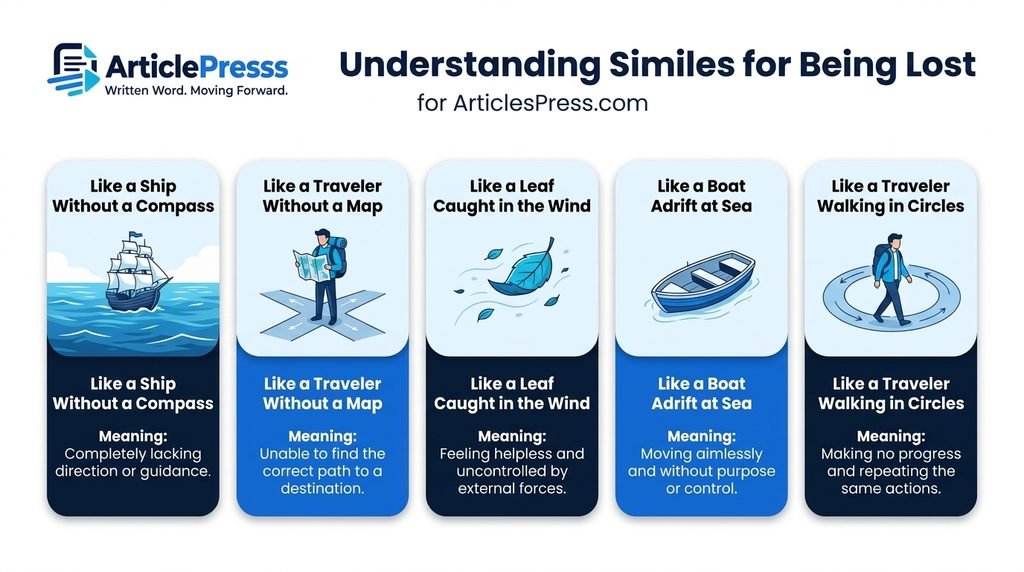
Meaning: Completely unsure of which direction to take.
Why It Works: A compass helps a ship navigate its journey. Without one, the ship struggles to find the right course. This makes it a strong comparison for someone who has lost their sense of direction.
Example: After losing his job, Daniel felt like a ship without a compass, unsure of what to do next.
2. Like a traveler without a map
Meaning: Unable to find the right path or destination.
Why It Works: A traveler depends on a map to understand where to go. Without it, every road can become confusing.
Example: I wandered through the unfamiliar town like a traveler without a map.
3. As lost as a needle in a haystack
Meaning: Extremely difficult to find or locate something.
Why It Works: A tiny needle is almost impossible to spot among thousands of pieces of hay. This familiar comparison emphasizes how difficult finding something can be.
Example: Without the address, finding the little cottage was as difficult as searching for a needle in a haystack.
4. Like a leaf caught in the wind
Meaning: Having no control over where life is taking you.
Why It Works: A leaf moves wherever the wind carries it. It cannot choose its direction, making this comparison suitable for someone feeling helpless or uncertain.
Example: After everything changed so suddenly, she felt like a leaf caught in the wind.
5. As confused as a tourist in a foreign city
Meaning: Unable to understand unfamiliar surroundings or directions.
Why It Works: A tourist in an unfamiliar city may struggle with strange streets, signs, and languages. The image captures everyday confusion.
Example: Without GPS, we were as confused as tourists in a foreign city.
6. Like a blindfolded person in a maze
Meaning: Completely unable to understand which direction to take.
Why It Works: A maze is already difficult to navigate, but a blindfold makes finding the exit even harder. This comparison creates a powerful picture of helpless confusion.
Example: With so many unanswered questions, he felt like a blindfolded person in a maze.
7. As directionless as a boat adrift at sea
Meaning: Having no clear destination, plan, or purpose.
Why It Works: A boat drifting across the sea without a destination represents a person who does not know what comes next.
Example: After graduating, she felt as directionless as a boat adrift at sea.
8. Like a stranger in your own neighborhood
Meaning: Feeling unfamiliar or disconnected in a place that should feel comfortable.
Why It Works: A neighborhood is usually familiar, but seeing it as a stranger creates a sense of emotional and physical disorientation.
Example: After returning home years later, he felt like a stranger in his own neighborhood.
9. As lost as a puppy in a crowded market
Meaning: Feeling overwhelmed and unable to find your way in a busy place.
Why It Works: A small puppy surrounded by unfamiliar people and activity may struggle to recognize its surroundings. This is a gentle, memorable comparison.
Example: The little boy looked as lost as a puppy in a crowded market.
10. Like a traveler walking in circles
Meaning: Repeatedly trying to find a solution without making progress.
Why It Works: Walking in circles means covering the same ground without reaching a destination. It describes someone stuck in confusion.
Example: I spent the entire afternoon trying to solve the problem, feeling like a traveler walking in circles.
11. As uncertain as a compass near a magnet
Meaning: Unable to trust your sense of direction or make a clear decision.
Why It Works: A nearby magnet can interfere with a compass’s direction. This comparison works particularly well for someone whose judgment is being affected by conflicting information.
Example: With everyone giving me different advice, I felt as uncertain as a compass near a magnet.
12. Like a cloud drifting across an empty sky
Meaning: Moving without a clear purpose or destination.
Why It Works: A cloud can float freely without following a visible path. It creates a quiet image of wandering and uncertainty.
Example: Since leaving college, he had been drifting through life like a cloud across an empty sky.
13. As lost as a key in a dark room
Meaning: Unable to locate something important despite searching for it.
Why It Works: Finding a small key in a dark room is difficult because you cannot see where it might be. This comparison expresses frustration and confusion.
Example: I felt as lost as a key in a dark room when I tried to understand the complicated instructions.
14. Like a passenger on the wrong train
Meaning: Being on a journey that is taking you somewhere you never intended to go.
Why It Works: A passenger on the wrong train may not realize the mistake until the journey is already underway. This makes the simile useful for describing regret or poor life decisions.
Example: After accepting the wrong job, Mark felt like a passenger on the wrong train.
15. As confused as a puzzle with missing pieces
Meaning: Unable to understand a situation because important information is missing.
Why It Works: A puzzle cannot be completed when essential pieces are missing. Similarly, someone may feel lost when they cannot see the whole picture.
Example: Without knowing the truth, I felt as confused as a puzzle with missing pieces.
16. Like a lighthouse without a light
Meaning: Lacking guidance or the ability to find direction.
Why It Works: A lighthouse normally guides ships through dangerous waters. Without its light, it cannot perform its purpose. This comparison can describe someone who has lost their source of guidance.
Example: Without his mentor’s advice, he felt like a lighthouse without a light.
17. As helpless as a fish out of water
Meaning: Feeling uncomfortable, confused, or unable to function in an unfamiliar situation.
Why It Works: A fish needs water to survive and move naturally. Outside its environment, it struggles. This simile is useful for describing someone who feels out of place.
Example: On my first day at the new school, I felt as helpless as a fish out of water.
18. Like a traveler searching for a road that doesn’t exist
Meaning: Trying to find a solution or destination that may not be possible to reach.
Why It Works: Searching for a nonexistent road represents wasted effort and uncertainty. It can describe someone who is following the wrong approach.
Example: He kept chasing impossible dreams like a traveler searching for a road that didn’t exist.
19. As lost as a message without an address
Meaning: Having no clear destination or way to reach the intended person.
Why It Works: A message needs an address to reach its recipient. Without one, it cannot find its way.
Example: Her plans felt as lost as a message without an address.
20. Like a shadow wandering through the fog
Meaning: Moving through an uncertain situation without knowing what lies ahead.
Why It Works: Fog hides the surroundings, while a shadow has no independent direction. Together, they create a mysterious image of uncertainty.
Example: He walked through the difficult years like a shadow wandering through the fog.
21. As bewildered as a newcomer in a maze
Meaning: Feeling completely overwhelmed by an unfamiliar situation.
Why It Works: A newcomer does not know the layout of a maze and may struggle to find the exit. This comparison emphasizes unfamiliarity and confusion.
Example: Starting her new position without training, she felt as bewildered as a newcomer in a maze.
22. Like a star hidden behind thick clouds
Meaning: Feeling unable to see your purpose, potential, or direction.
Why It Works: A star remains in the sky even when clouds cover it. The image suggests that someone’s direction or confidence may be temporarily hidden.
Example: During those difficult months, his dreams felt like stars hidden behind thick clouds.
23. As stranded as a sailor on a deserted island
Meaning: Feeling isolated, abandoned, or unable to move forward.
Why It Works: A sailor stranded on an island has limited resources and no clear way home. This comparison expresses loneliness and helplessness.
Example: After moving away from his friends, he felt as stranded as a sailor on a deserted island.
24. Like a clock with broken hands
Meaning: Feeling unable to move forward or understand what comes next.
Why It Works: A clock with broken hands cannot properly show the time. This unusual comparison suggests a person whose plans or sense of progress have stopped working.
Example: After years of uncertainty, she felt like a clock with broken hands.
25. As aimless as a wandering traveler
Meaning: Moving through life without a clear goal or destination.
Why It Works: A wandering traveler may enjoy the journey but have no specific place to reach. This comparison works well when describing someone without a clear plan.
Example: He spent his early twenties feeling as aimless as a wandering traveler.
Simple Similes for Being Lost
Sometimes, a short and familiar comparison communicates confusion better than a complicated description. These simple similes are particularly useful for students, everyday conversations, and beginner-level writing.
| Simile | Meaning | Best Used For |
| Like a ship without a compass | Having no direction | Life uncertainty |
| Like a traveler without a map | Not knowing where to go | Physical confusion |
| Like a leaf in the wind | Having little control | Uncertainty |
| Like a fish out of water | Feeling out of place | Unfamiliar situations |
| Like a boat adrift at sea | Having no destination | Lack of purpose |
| Like a passenger on the wrong train | Following the wrong path | Regret |
| Like a traveler walking in circles | Making no progress | Repeated mistakes |
Creative Similes for Feeling Lost in Life
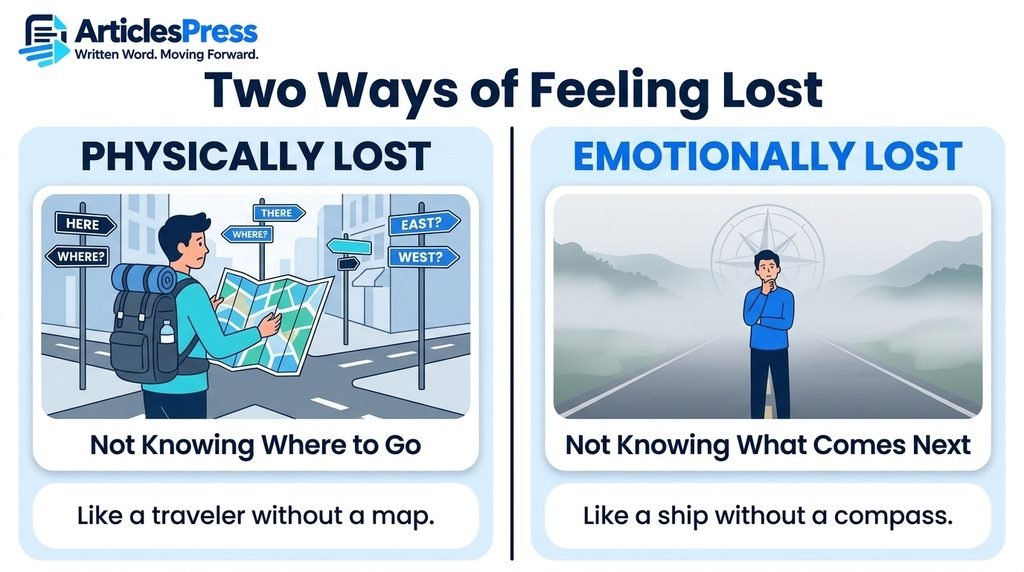
Being lost does not always mean being unable to find a street or location. Sometimes, people feel lost because they are uncertain about their future, relationships, identity, or personal goals.
These more imaginative comparisons help describe that emotional experience.
- Like a book with its final chapter missing: Feeling unable to understand how your story will end.
- Like a bird searching for a home in an endless sky: Wanting somewhere to belong but not knowing where to go.
- Like a candle flickering in a storm: Struggling to maintain hope during difficult circumstances.
- Like a road disappearing into the mist: Facing a future whose outcome is impossible to see.
- Like a song playing without a melody: Feeling disconnected from the things that once gave life meaning.
Example in creative writing:
After leaving everything familiar behind, she felt like a bird searching for a home in an endless sky. Every new place offered possibilities, but none seemed to belong to her.
Similes for Being Physically Lost
When a character cannot find a location, these comparisons help readers picture the confusion and uncertainty of the situation.
- Like a tourist without a guide: Unable to navigate an unfamiliar place.
- Like a child separated from a group: Feeling confused and anxious about where to go.
- Like a boat drifting through unfamiliar waters: Moving without knowing the destination.
- Like a traveler trapped in a maze: Unable to find an exit.
- Like a stranger following unfamiliar roads: Exploring a place without knowing its layout.
Example:
The forest seemed endless, and Daniel wandered between the trees like a traveler trapped in a maze. Every path looked familiar, yet none led him back to the campsite.
How to Use Similes for Being Lost in Writing
Choosing the right comparison depends on what kind of lost feeling you want to communicate. A person who cannot find a street experiences something different from someone who has lost confidence in life.
Here are some ways to use these comparisons effectively.
1. In Stories and Fiction
Use physical comparisons to make a character’s surroundings easier to imagine.
Example: The streets twisted in every direction, and Emma wandered like a tourist without a map.
2. In Poems
Choose imaginative comparisons that communicate emotion through imagery.
Example: Like a leaf beneath a restless sky, I drifted without knowing where to land.
3. In School Essays
Use familiar comparisons that communicate the idea clearly without making your writing unnecessarily complicated.
Example: After changing schools, I felt as lost as a fish out of water.
4. In Character Descriptions
Use similes to reveal how a character responds to unfamiliar situations.
Example: He stood silently in the crowded room, looking like a newcomer who had forgotten why he came.
5. In Personal Writing
Use emotional comparisons when describing uncertainty, difficult decisions, or changes in life.
Example: After the unexpected news, my future seemed like a road disappearing into the mist.
How to Choose the Best Simile for Being Lost
Not every comparison communicates the same kind of confusion. Consider the situation before choosing one.
| Situation | Recommended Simile | Why It Fits |
| Cannot find a location | Like a traveler without a map | Shows physical confusion |
| Unsure about the future | Like a ship without a compass | Shows lack of direction |
| Feeling out of place | Like a fish out of water | Communicates discomfort |
| Emotionally disconnected | Like a leaf caught in the wind | Suggests helplessness |
| Stuck in a difficult situation | Like a traveler walking in circles | Shows lack of progress |
| Feeling isolated | Like a sailor on a deserted island | Emphasizes loneliness |
| Missing important information | Like a puzzle with missing pieces | Shows incomplete understanding |
Writing tip: Match the intensity of your simile to the situation. A simple comparison such as “like a tourist without a map” works for everyday confusion. A more dramatic expression such as “like a blindfolded person in a maze” creates a stronger feeling of helplessness.
FAQ: Similes for Being Lost
1. What is a good simile for being lost?
A good simile for being lost is “like a ship without a compass.” It describes someone who has no clear direction or idea of what to do next. It works especially well when describing uncertainty about life, decisions, or the future.
2. What is a simile for feeling lost in life?
“Like a boat adrift at sea” is an effective simile for feeling lost in life. It suggests that someone is moving forward without a clear destination, purpose, or plan.
3. What is a simple simile for being lost?
“Like a traveler without a map” is a simple and easy-to-understand comparison. It describes someone who does not know where to go or how to reach the right destination.
4. What is a creative simile for feeling confused?
“Like a puzzle with missing pieces” is a creative way to describe confusion. It suggests that important information is missing, making it difficult to understand a situation completely.
5. How do you describe someone who is lost using a simile?
You can compare the person to something that cannot find its direction, such as a ship without a compass, a leaf caught in the wind, or a traveler walking in circles.
For example: “He looked like a traveler searching for a road that didn’t exist.”
6. What is a simile for being lost and alone?
“Like a sailor stranded on a deserted island” is a strong comparison for someone who feels both lost and lonely. It communicates isolation, helplessness, and the desire to find a way home.
7. Can similes for being lost be used in poetry?
Yes. Similes are useful in poetry because they turn abstract emotions into recognizable images. Comparisons involving fog, drifting leaves, distant stars, and empty roads can communicate uncertainty and emotional wandering.
For related comparisons, see similes for bravery, similes for loyalty and similes for being different.
Final Thoughts
Similes for being lost help transform confusion and uncertainty into images readers can easily understand. Whether someone feels like a ship without a compass, a traveler without a map, or a leaf caught in the wind, each comparison communicates a slightly different experience.
For physical confusion, choose comparisons involving unfamiliar roads and missing directions. For emotional uncertainty, explore images of drifting, fog, and distant destinations. The best simile is one that reflects the situation naturally and helps readers understand exactly what the person is experiencing.

The ArticlesPress editorial team writes and reviews every guide on similes and figurative language, with clear meanings and example sentences for students, teachers and writers.