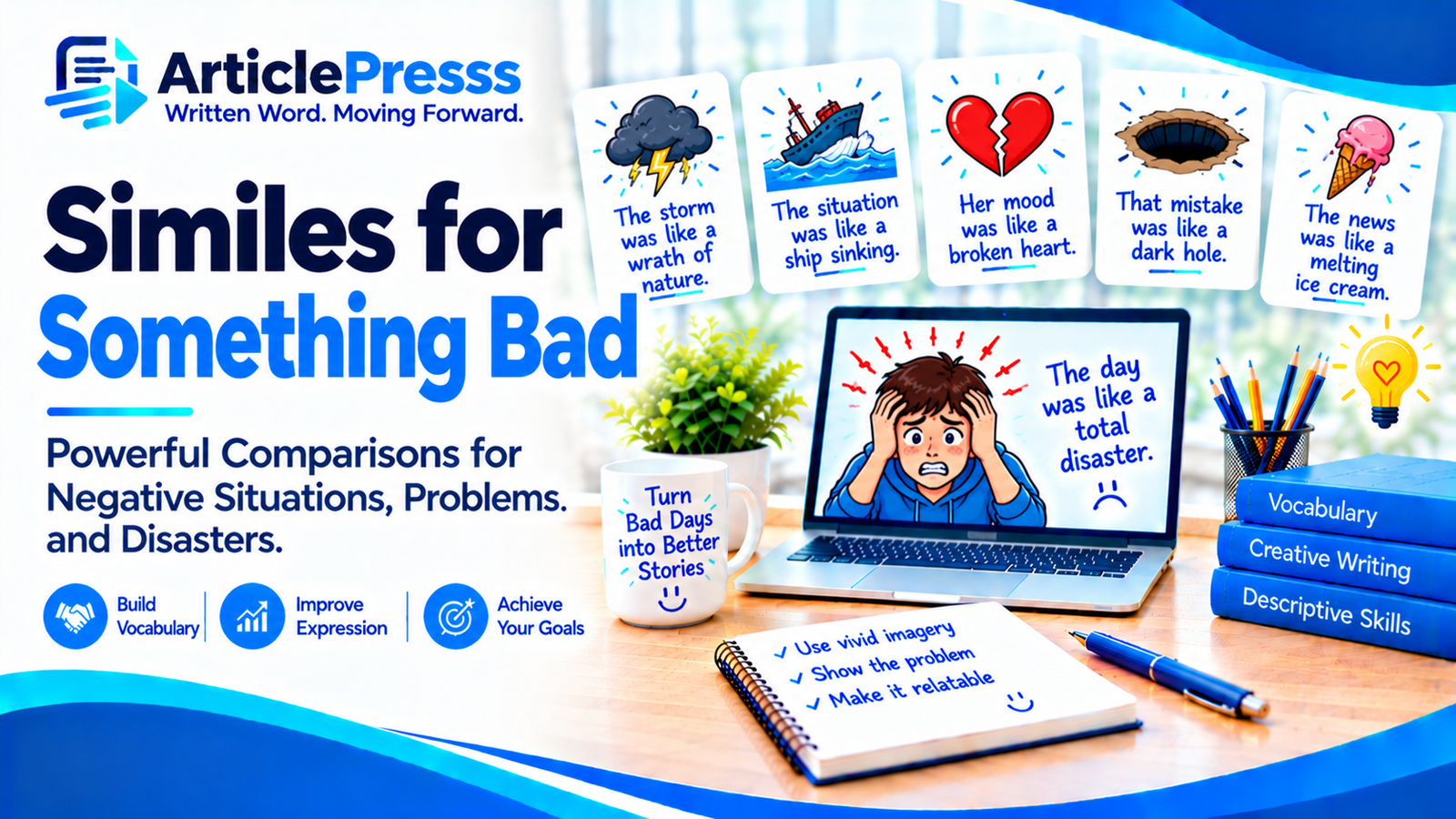
Looking for similes for something bad? You can describe a bad experience as like a nightmare, a terrible situation as like a sinking ship, or an unpleasant surprise as like a bucket of cold water. These comparisons help readers understand how unpleasant, harmful, disappointing, or difficult something feels.
The best simile depends on what makes the situation bad. Some comparisons express discomfort, others suggest danger or failure, and some describe poor quality or negative behavior. Below, you’ll find 35 similes for something bad, complete with meanings, natural example sentences, and tips for using them in stories, essays, and everyday writing.
What Does a Simile for Something Bad Mean?
A simile for something bad compares an unpleasant thing, experience, behavior, or situation with something that readers can easily imagine. It typically uses the words like or as to make the comparison.
For example, “The meeting was like a slow-moving traffic jam” compares an unproductive meeting to a frustrating delay. The comparison helps readers picture the experience rather than simply being told that the meeting was bad.
Depending on the context, a negative simile can communicate disappointment, danger, discomfort, poor performance, or emotional distress.
35 Similes for Something Bad With Meanings and Examples
These similes cover different kinds of negative experiences, from minor annoyances to serious setbacks. Choose one that matches the situation rather than using the strongest comparison every time.
1. Simple Similes for Something Bad
These straightforward comparisons are easy to understand and work well in everyday conversation, school assignments, and general descriptive writing.
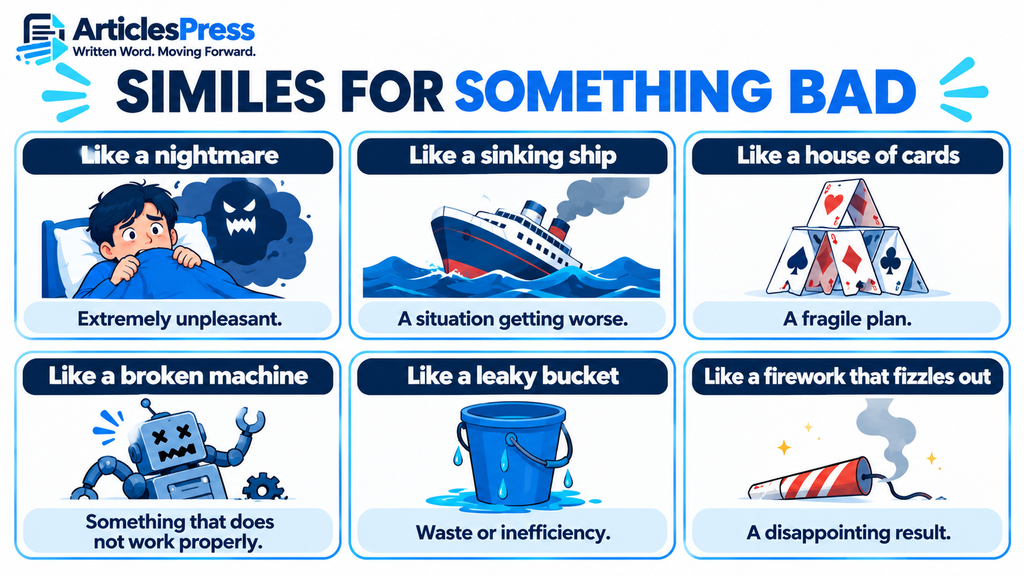
1. Like a nightmare
Meaning: An extremely unpleasant, frightening, or stressful experience.
Example: The entire journey was like a nightmare because our flight was canceled and our luggage went missing.
Why it works: A nightmare represents an experience that feels distressing and difficult to escape.
2. As bad as spoiled milk
Meaning: Extremely unpleasant, especially when something has become useless or unfit for its purpose.
Example: The milk smelled as bad as spoiled milk left in a hot kitchen for days.
Why it works: The familiar smell of spoiled milk makes the idea of something unpleasant easy to understand.
3. Like a broken machine
Meaning: Inefficient, unreliable, or unable to work properly.
Example: Without proper maintenance, the old production line operated like a broken machine.
Why it works: A malfunctioning machine suggests repeated problems and poor performance.
4. Like a bitter pill
Meaning: A difficult or unpleasant truth that someone must accept.
Example: Losing the scholarship was like a bitter pill for a student who had worked hard all year.
Why it works: The unpleasant taste of a pill represents the discomfort of accepting disappointing news.
5. As welcome as a rainy picnic
Meaning: Unwanted, inconvenient, or poorly timed.
Example: The unexpected repair bill was as welcome as a rainy picnic on the day of our family reunion.
Why it works: Rain can spoil an outdoor event, just as an unwelcome problem can ruin a good plan.
2. Similes for a Bad Experience or Difficult Situation

Use these comparisons when describing frustrating events, setbacks, uncomfortable circumstances, or situations that seem increasingly difficult to manage.
6. Like a sinking ship
Meaning: A situation that is rapidly getting worse and seems difficult to save.
Example: Without a clear plan or reliable leadership, the struggling company looked like a sinking ship.
Why it works: A sinking ship creates a strong image of danger, declining control, and possible failure.
7. Like walking through a minefield
Meaning: A situation in which every decision carries a risk of causing trouble.
Example: Discussing the disagreement with both teams felt like walking through a minefield.
Why it works: The comparison emphasizes the need for extreme caution. It is particularly effective for tense social or professional situations.
8. Like being trapped in a storm
Meaning: Feeling overwhelmed by problems, confusion, or intense pressure.
Example: During the financial crisis, the small business felt like it was trapped in a storm.
Why it works: A storm represents powerful forces that are difficult to control.
9. Like a house of cards
Meaning: Unstable and likely to collapse when something goes wrong.
Example: Their entire plan was like a house of cards because it depended on one unreliable supplier.
Why it works: A house of cards can fall apart with the slightest disturbance, making it a useful image for fragile plans.
10. Like running into a brick wall
Meaning: Making little or no progress despite repeated efforts.
Example: I felt like I was running into a brick wall when the support team ignored every request for help.
Why it works: A solid wall represents an obstacle that prevents forward movement.
11. Like a road full of potholes
Meaning: Full of interruptions, setbacks, and unexpected difficulties.
Example: The project was like a road full of potholes, with one technical problem appearing after another.
Why it works: Potholes make travel difficult and uncomfortable, just as repeated problems disrupt progress.
12. Like a dark cloud over a sunny day
Meaning: Something negative that spoils an otherwise happy experience.
Example: The argument hung over the family celebration like a dark cloud over a sunny day.
Why it works: The contrast between sunshine and a dark cloud emphasizes how one unpleasant event can change the mood.
3. Similes for Something of Poor Quality
These comparisons describe objects, work, services, or results that are disappointing, ineffective, or badly made.
13. Like a car without an engine
Meaning: Unable to function effectively or achieve its intended purpose.
Example: The marketing strategy was like a car without an engine because it had no practical way to reach customers.
Why it works: A car without an engine cannot perform its central function, making the comparison useful for ineffective plans and systems.
14. Like a leaky bucket
Meaning: Unable to retain something valuable or continually losing resources.
Example: Their advertising budget was like a leaky bucket, with money disappearing before the campaign produced results.
Why it works: Water escaping through holes creates a clear image of waste and inefficiency.
15. Like a puzzle with missing pieces
Meaning: Incomplete, confusing, or lacking essential information.
Example: The instructions were like a puzzle with missing pieces, so nobody knew how to assemble the equipment.
Why it works: A puzzle cannot be completed properly when important pieces are missing.
16. As useful as a chocolate teapot
Meaning: Completely impractical or unsuitable for its intended purpose.
Example: A password-protection system that shares every user’s password is as useful as a chocolate teapot.
Why it works: A teapot made of chocolate would melt when filled with hot liquid. The image adds humor while emphasizing uselessness.
17. Like a dull knife
Meaning: Ineffective, unimpressive, or unable to do a job properly.
Example: Without supporting evidence, the argument was like a dull knife that could not cut through the opposition’s claims.
Why it works: A dull knife struggles to perform a task that should be simple.
18. Like a patch on a leaking dam
Meaning: A temporary or inadequate solution to a much larger problem.
Example: Hiring one extra employee was like a patch on a leaking dam when the entire department needed restructuring.
Why it works: A small patch cannot reliably solve a large structural problem.
4. Similes for Bad Behavior and Poor Decisions
These similes are useful when describing carelessness, dishonesty, selfishness, or decisions that cause trouble.
19. Like a bull in a china shop
Meaning: Clumsy, careless, or insensitive in a delicate situation.
Example: He entered the sensitive negotiation like a bull in a china shop, interrupting everyone and dismissing their concerns.
Why it works: A large bull moving among fragile objects suggests damage caused by a lack of care.
20. Like a fox guarding a henhouse
Meaning: Untrustworthy or unsuitable for a position that requires honesty and responsibility.
Example: Appointing the person accused of mishandling funds to oversee the investigation was like a fox guarding a henhouse.
Why it works: A fox near a henhouse symbolizes a conflict between someone’s interests and the responsibility entrusted to them.
21. Like a loose cannon
Meaning: Unpredictable and capable of causing unexpected trouble.
Example: The manager acted like a loose cannon, making sudden decisions without consulting the team.
Why it works: The image suggests something powerful moving without proper control.
22. Like playing with fire
Meaning: Taking unnecessary risks that could lead to serious consequences.
Example: Ignoring repeated safety warnings was like playing with fire.
Why it works: Fire can spread beyond control, making it an effective comparison for reckless choices.
23. Like building a house on sand
Meaning: Making a decision or plan without a reliable foundation.
Example: Expanding the company without checking its finances was like building a house on sand.
Why it works: Sand provides an unstable foundation, so the structure may fail when pressure increases.
24. Like digging your own grave
Meaning: Doing something that creates serious problems for yourself.
Example: By repeatedly missing deadlines and blaming his coworkers, he was digging his own grave at work.
Why it works: The image emphasizes self-inflicted consequences. Because it is dramatic, use it when the stakes are genuinely serious.
5. Similes for Bad Luck, Failure, and Disappointment
These comparisons help describe failed plans, unfortunate events, missed opportunities, and outcomes that fall short of expectations.
25. Like a balloon losing air
Meaning: Gradually losing energy, excitement, confidence, or momentum.
Example: The team’s enthusiasm was like a balloon losing air after several unsuccessful attempts.
Why it works: A deflating balloon loses its shape and lift, making it a useful image for fading motivation.
26. Like a train running off the tracks
Meaning: Losing direction or control and developing into a serious problem.
Example: The event preparations went like a train running off the tracks when the venue canceled at the last minute.
Why it works: A train leaving its tracks suggests a major disruption that requires immediate attention.
27. Like a missed step on a staircase
Meaning: A small mistake that interrupts progress or causes a setback.
Example: Forgetting to attach the final document was like a missed step on a staircase during an otherwise successful application process.
Why it works: One missed step can disrupt a smooth climb, just as one mistake can interfere with a larger achievement.
28. Like a firework that fizzles out
Meaning: Starting with excitement but ending in disappointment.
Example: The product launch was like a firework that fizzled out because the company had generated excitement but failed to deliver the promised features.
Why it works: Fireworks create expectations of a bright display. A weak ending makes the disappointment more noticeable.
29. Like a door slamming shut
Meaning: A sudden rejection, lost opportunity, or unexpected end to a possibility.
Example: Receiving the rejection email felt like a door slamming shut on her plans to study abroad.
Why it works: A slammed door creates a strong sense of finality.
30. Like a game played with a broken scoreboard
Meaning: Confusing, unfair, or difficult to evaluate accurately.
Example: The competition felt like a game played with a broken scoreboard because the judges kept changing the scoring rules.
Why it works: A scoreboard should provide clear results. When it fails, participants cannot tell what is happening or whether the outcome is fair.
6. Creative Similes for Something Bad
These original comparisons are useful for fiction, poetry, reflective writing, and descriptive passages where a familiar phrase may feel too ordinary.
31. Like a stain spreading across white paper
Meaning: A problem that gradually affects more areas or becomes increasingly difficult to hide.
Example: The small lie spread through the team like a stain spreading across white paper, damaging trust with every new explanation.
Why it works: The spreading stain makes the growth and visibility of a problem easy to picture.
32. Like a clock ticking in an empty room
Meaning: An uncomfortable situation filled with tension, silence, or anticipation.
Example: Waiting for the final decision felt like a clock ticking in an empty room.
Why it works: The isolated ticking sound emphasizes the passage of time and the discomfort of waiting.
33. Like a garden choked by weeds
Meaning: A once-promising situation overwhelmed by neglect or harmful influences.
Example: The community project became like a garden choked by weeds after months without leadership or maintenance.
Why it works: Weeds can crowd out healthy plants, creating a vivid image of something valuable being damaged by neglect.
34. Like a song played on broken strings
Meaning: Something that should be enjoyable or effective but feels damaged, incomplete, or unpleasant.
Example: Their reunion was like a song played on broken strings because old disagreements overshadowed every happy memory.
Why it works: The contrast between music and broken strings suggests that something expected to bring pleasure has lost its harmony.
35. Like a candle fighting a strong wind
Meaning: Struggling to survive or succeed under difficult conditions.
Example: The small charity was like a candle fighting a strong wind as it tried to help families despite losing most of its funding.
Why it works: A candle’s fragile flame represents hope or effort threatened by powerful obstacles.
Quick-Reference Table: Choosing the Right Simile
| Simile | Meaning | Best used for |
| Like a nightmare | Extremely unpleasant | Distressing experiences |
| Like a sinking ship | Rapidly worsening | Failing projects or organizations |
| Like a house of cards | Unstable | Fragile plans |
| Like a leaky bucket | Wasteful or inefficient | Budgets and systems |
| Like a bull in a china shop | Careless or clumsy | Bad behavior |
| Like playing with fire | Risky | Reckless decisions |
| Like a firework that fizzles out | Disappointing ending | Failed expectations |
| Like a stain spreading across white paper | A growing problem | Conflict and damaged trust |
| Like a garden choked by weeds | Harmed by neglect | Deteriorating situations |
| Like a candle fighting a strong wind | Struggling against difficulties | Hope and perseverance |
How to Use Similes for Something Bad in Writing
A good simile does more than label something as bad. It helps readers understand how it is bad and what effect it has.
1. Match the comparison to the problem
Choose an image that reflects the actual situation.
- For danger: “The situation was like playing with fire.”
- For failure: “The plan was like a house of cards.”
- For frustration: “Getting an answer was like running into a brick wall.”
- For disappointment: “The launch was like a firework that fizzled out.”
The more closely the comparison fits the problem, the more natural it will sound.
2. Match the intensity to the situation
Not every negative experience is a nightmare or a sinking ship. Use milder language for small inconveniences and stronger comparisons for serious problems.
Compare these sentences:
- Mild: “The delay was like a pothole in an otherwise smooth journey.”
- Strong: “The company’s financial situation was like a sinking ship.”
The first describes an obstacle; the second suggests a serious decline.
3. Use similes to improve descriptive sentences
A plain sentence often becomes more vivid when you add a specific comparison.
Plain: The instructions were confusing.
Improved: The instructions were like a puzzle with missing pieces, leaving everyone unsure where to begin.
Plain: His decision was risky.
Improved: His decision was like playing with fire, with consequences he had barely considered.
The improved versions explain the nature of the problem instead of relying on the word bad.
4. Avoid mixing too many comparisons
One strong image is usually more effective than several competing ones.
Overloaded: The project was a sinking ship, a burning house, and a train off its tracks.
Better: The project was like a sinking ship, with costs rising and deadlines slipping away.
Choose one comparison and develop it with relevant details.
Similes for Something Bad: Common Mistakes to Avoid
- Using a comparison that does not fit: A sinking ship suggests serious decline, so it may be excessive for a minor inconvenience.
- Repeating familiar clichés: Common phrases are useful, but an original comparison can make creative writing more distinctive.
- Using a simile without context: Explain what makes the situation resemble the comparison.
- Confusing similes with metaphors: “The project was like a sinking ship” is a simile. “The project was a sinking ship” is a metaphor because it makes a direct comparison without like or as.
- Making serious situations sound humorous: Funny comparisons may suit lighthearted writing, but they can undermine descriptions of genuine suffering or loss.
Frequently Asked Questions
1. What is a good simile for something bad?
“Like a nightmare” is a good general simile for something extremely unpleasant. For a situation that is getting worse, “like a sinking ship” may be more precise. The best choice depends on the type and severity of the problem.
2. What is a strong simile for a bad situation?
“Like walking through a minefield” is a strong simile for a tense situation where every decision could create trouble. “Like a house of cards” works better when the situation is unstable and likely to collapse.
3. What is a simple simile for something bad for students?
“Like a broken machine” is an easy option because it compares something that does not work properly with a familiar object. Students can use it to describe a faulty system, an ineffective plan, or a malfunctioning device.
4. What simile describes a bad experience?
“Like a nightmare” describes an experience that is frightening or deeply unpleasant. “Like a bitter pill” is better when the experience involves accepting a disappointing truth.
5. Can similes for something bad be used in poetry?
Yes. Similes can make negative emotions, difficult circumstances, and disappointing experiences more vivid. A poet might compare loneliness to “a clock ticking in an empty room” or describe lost hope as “a candle fighting a strong wind.”
6. What is the difference between a simile for something bad and a metaphor?
A simile uses a comparison word such as like or as, as in “The meeting was like a traffic jam.” A metaphor makes a direct comparison, as in “The meeting was a traffic jam.” Both can communicate negative qualities, but they use different structures.
Practice Section: Test Your Understanding
Try these five questions to check whether you can identify and use negative similes.
- Complete the simile: “The unstable business plan was like a ______.”
- Which simile best describes a person who behaves carelessly in a delicate situation: “like a bull in a china shop” or “like a candle fighting a strong wind”?
- What does “like a leaky bucket” suggest?
- Rewrite this sentence using a suitable simile: “The instructions were incomplete and confusing.”
- Create your own simile to describe a disappointing result.
Answers
- A house of cards. It suggests a plan that could collapse easily.
- Like a bull in a china shop. It describes careless or clumsy behavior.
- It suggests waste, loss, or an inability to retain something valuable.
- One possible answer: “The instructions were like a puzzle with missing pieces.”
- Answers will vary. One possibility is: “The performance was like a firework that fizzled out.”
Suggested Internal Links
For ArticlesPress, these topics can help readers explore related forms of figurative language. Use the suggested anchor text when the corresponding articles are available.
- Similes for Sadness — for comparisons that describe disappointment, sorrow, and emotional pain.
- Similes for Scary Stories — for descriptions of frightening events and unsettling situations.
- Similes for Lying — for comparisons involving dishonesty, deception, and damaged trust.
- Similes for Anger — for descriptions of frustration, conflict, and intense negative emotions.
- Similes for Failure — for comparisons that describe setbacks, unsuccessful attempts, and lost opportunities.
Potential Keyword-Cluster or Cannibalization Notes
Keep this article focused on the broad idea of something bad. Related topics should have distinct purposes rather than repeating the same examples.
- Similes for Failure: A useful separate article if it focuses on unsuccessful efforts, setbacks, and disappointing outcomes.
- Similes for Lying: A distinct topic centered on dishonesty, deception, and trust.
- Similes for Anger: A distinct emotional topic focused on irritation, rage, and conflict.
- Similes for Sadness: A distinct topic centered on sorrow, grief, and emotional pain.
- Similes for Scary Stories: A distinct creative-writing topic focused on suspense, fear, and atmosphere.
Avoid creating another page targeting only a minor variation such as “similes for bad things” unless keyword research shows a meaningfully different search intent.
Final Thoughts
Similes for something bad help you describe more than a negative experience. They can reveal why a situation feels frustrating, how a plan becomes unstable, why a decision is risky, or how disappointment affects someone. Comparisons such as like a sinking ship, like a house of cards, and like a firework that fizzles out communicate different kinds of problems, so choose the image that fits your meaning. For more original writing, begin with a specific detail about the situation and compare it with something readers can picture clearly. A precise simile will usually be more effective than simply calling something bad.

James Wilson writes about similes, metaphors, figurative language, and descriptive writing at ArticlesPress. He creates practical examples and explanations to help students, teachers, and creative writers understand language techniques and use vivid comparisons in stories, poems, and essays