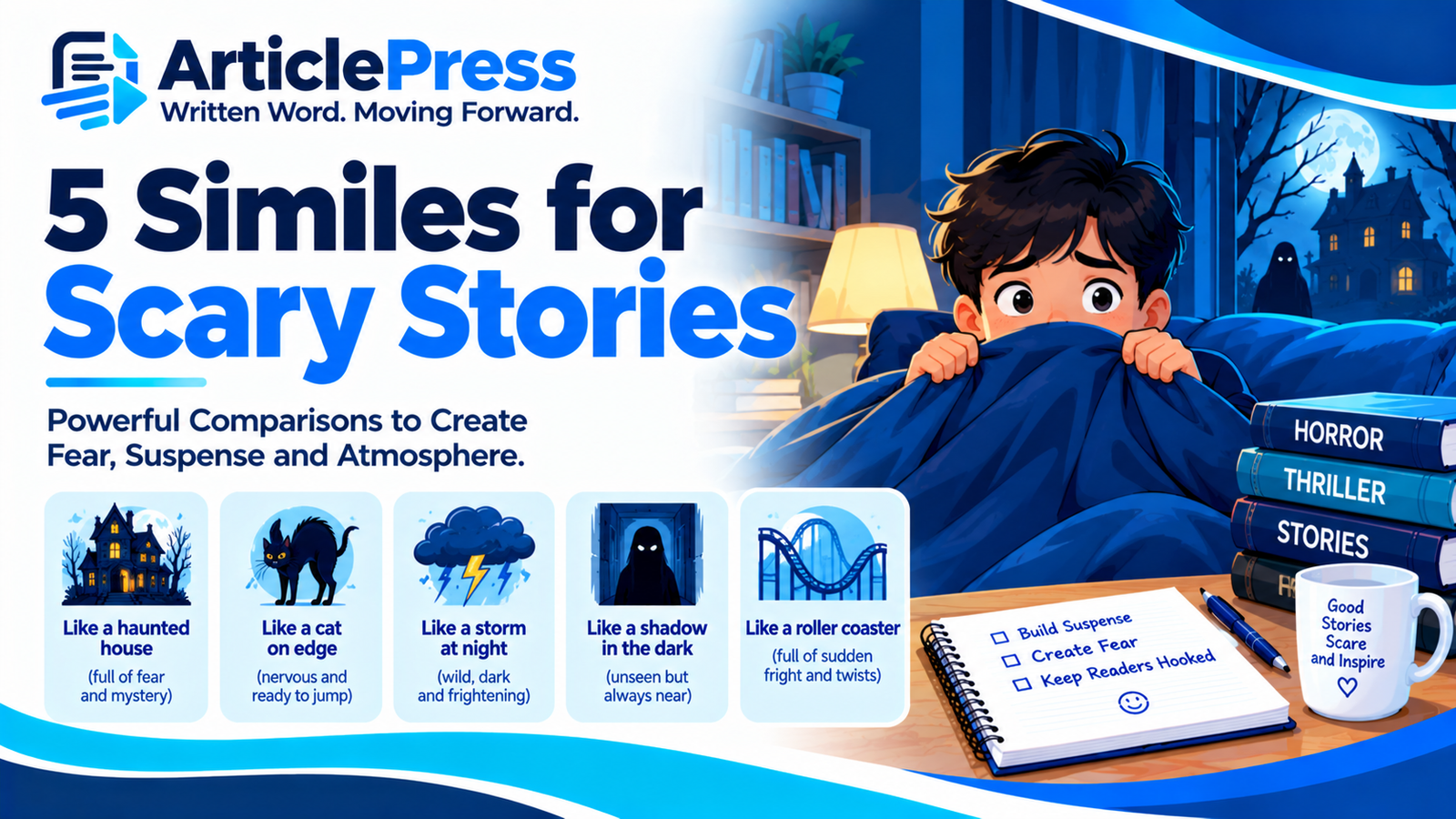
Looking for similes for scary stories? You can describe a dark hallway as narrow as a coffin, a whisper as cold as winter wind, or a shadow as long as a reaching hand. These comparisons help readers imagine frightening places, unsettling sounds, mysterious characters, and moments of suspense. The best scary similes do more than make a scene sound spooky: they build tension, create atmosphere, and make readers feel as if something terrible might happen at any moment. Below, you’ll find 45 creative similes with meanings and example sentences to help you write ghost stories, haunted-house scenes, and chilling tales.
What Is a Simile in a Scary Story?
A simile is a figure of speech that compares two different things using words such as like or as. In scary stories, similes help writers describe fear, darkness, strange noises, and threatening situations in ways readers can easily picture.
For example, “The footsteps echoed like a warning from the dead” makes ordinary footsteps sound mysterious and threatening. Instead of simply telling readers that something is frightening, a well-chosen simile helps them experience the fear through their imagination.
45 Best Similes for Scary Stories With Meanings
These similes cover different elements of horror writing, from creepy settings and eerie sounds to frightened characters and sudden scares.
1. Similes for Dark and Haunted Places

These comparisons are useful when describing abandoned buildings, shadowy forests, deserted roads, and mysterious rooms.
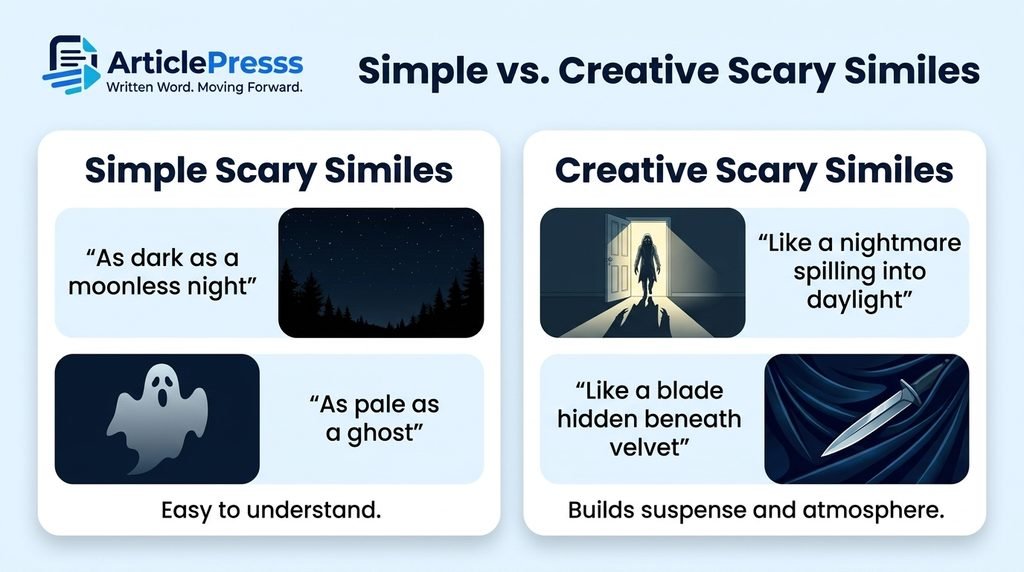
1. As dark as a moonless night
Meaning: Extremely dark, with almost no visible light.
Example: The cellar was as dark as a moonless night, hiding everything beyond the first step.
2. Like a graveyard at midnight
Meaning: Silent, gloomy, and filled with an unsettling atmosphere.
Example: The abandoned village stood like a graveyard at midnight, with not a single light in its windows.
3. As cold as a tomb
Meaning: Unnaturally cold and lifeless.
Example: The air inside the crypt was as cold as a tomb, sending shivers down Maya’s spine.
4. Like a shadow swallowing the room
Meaning: Darkness seems to spread until it covers everything.
Example: The blackness crept across the bedroom like a shadow swallowing the room.
5. As silent as a deserted church
Meaning: Completely quiet in a way that feels eerie or uncomfortable.
Example: The old mansion was as silent as a deserted church after the final bell.
6. Like a maze with no way out
Meaning: Confusing, frightening, and difficult to escape.
Example: The twisting corridors felt like a maze with no way out, and every door led to another empty room.
7. As empty as a forgotten cemetery
Meaning: Abandoned and lonely, with a sense of neglect.
Example: The playground looked as empty as a forgotten cemetery beneath the gray afternoon sky.
8. Like a mouth waiting to swallow you
Meaning: An entrance or dark opening appears threatening, as if it could consume anyone who enters.
Example: The cave entrance gaped like a mouth waiting to swallow you.
2. Similes for Scary Sounds and Mysterious Noises
Sounds can make a horror scene frightening even when the danger remains unseen.
9. Like fingernails scratching glass
Meaning: A sharp, unpleasant sound that creates discomfort.
Example: The strange noise dragged through the window like fingernails scratching glass.
10. As loud as thunder in a tunnel
Meaning: A sound that becomes overwhelming because it echoes through an enclosed space.
Example: The iron gate slammed shut, as loud as thunder in a tunnel.
11. Like a whisper from another world
Meaning: A quiet, mysterious voice that seems to come from somewhere unknown.
Example: My name drifted through the empty hallway like a whisper from another world.
12. As sudden as a gunshot in the dark
Meaning: Abrupt and startling, interrupting a quiet moment.
Example: The crash was as sudden as a gunshot in the dark, making everyone jump.
13. Like bones rattling in a box
Meaning: A dry, clattering noise that sounds eerie and unnatural.
Example: The loose shutters shook in the wind like bones rattling in a box.
14. As chilling as a child’s voice in an empty house
Meaning: Unsettling because something innocent appears in a disturbing setting.
Example: The distant singing was as chilling as a child’s voice in an empty house.
15. Like a heartbeat beneath the floorboards
Meaning: A faint, rhythmic sound that suggests something alive or hidden nearby.
Example: Three slow knocks rose from below, like a heartbeat beneath the floorboards.
3. Similes for Fear and Terror
Use these comparisons to show how fear affects a character’s thoughts, body, and behavior.
16. As pale as a ghost
Meaning: Extremely pale because of shock or fear.
Example: When the bedroom door opened by itself, Liam turned as pale as a ghost.
17. Like a rabbit caught in headlights
Meaning: Frozen with fear and unable to react.
Example: Hearing footsteps behind her, Nina stood like a rabbit caught in headlights.
18. As shaky as a leaf in a storm
Meaning: Trembling uncontrollably because of fear.
Example: His hands were as shaky as a leaf in a storm as he reached for the doorknob.
19. Like ice spreading through the veins
Meaning: A sudden, intense feeling of fear that seems to freeze the body.
Example: When the figure turned toward him, fear moved through his chest like ice spreading through the veins.
20. As tense as a wire pulled too tight
Meaning: So nervous that even a small surprise could cause a strong reaction.
Example: She waited in the dark, as tense as a wire pulled too tight.
21. Like a trapped bird beating its wings
Meaning: Frightened and desperate to escape.
Example: His heart pounded like a trapped bird beating its wings as the footsteps approached.
22. As helpless as a candle in a hurricane
Meaning: Powerless against a much stronger threat.
Example: Without a working phone or flashlight, Daniel felt as helpless as a candle in a hurricane.
23. Like a scream locked inside the throat
Meaning: So frightened that a person cannot bring themselves to cry out.
Example: When the pale face appeared at the window, a scream seemed locked inside her throat.
4. Similes for Ghosts, Shadows, and Strange Figures
These similes help make mysterious characters and unexplained appearances more vivid.
24. As thin as smoke
Meaning: Wispy, faint, or difficult to see clearly.
Example: The ghost drifted through the doorway, as thin as smoke.
25. Like a torn curtain moving in the wind
Meaning: A strange, wavering shape that seems to move without a clear purpose.
Example: The pale figure swayed beside the staircase like a torn curtain moving in the wind.
26. As still as a statue in a forgotten garden
Meaning: Completely motionless and unnervingly lifeless.
Example: The stranger stood beneath the streetlamp, as still as a statue in a forgotten garden.
27. Like a spider crawling across the ceiling
Meaning: Moving slowly in a way that feels unnatural and disturbing.
Example: A dark shape crept above the bed like a spider crawling across the ceiling.
28. As hollow as an empty mask
Meaning: Expressionless, lifeless, or lacking warmth.
Example: The stranger’s face was as hollow as an empty mask.
29. Like a reflection that had learned to move alone
Meaning: A mysterious figure that resembles a reflection but behaves independently.
Example: Something crossed the mirror behind her, like a reflection that had learned to move alone.
30. As pale as frost on a window
Meaning: Extremely pale and cold-looking.
Example: In the moonlight, the figure’s face appeared as pale as frost on a window.
5. Similes for Suspense and Approaching Danger
Suspense often comes from making readers anticipate danger rather than revealing it immediately.
31. Like a clock counting down to disaster
Meaning: Creating the feeling that something terrible is about to happen.
Example: Every drop of water from the ceiling sounded like a clock counting down to disaster.
32. As slow as a shadow crossing a sundial
Meaning: Moving so slowly that the delay becomes uncomfortable.
Example: The doorknob turned as slow as a shadow crossing a sundial.
33. Like a storm gathering behind closed doors
Meaning: A hidden threat seems to be growing stronger.
Example: Their argument filled the house like a storm gathering behind closed doors.
34. As tight as a knot around the heart
Meaning: Creating an intense feeling of anxiety or dread.
Example: A knot of fear tightened in her chest, as tight as a knot around the heart.
35. Like footsteps following from another room
Meaning: Suggesting that someone or something is nearby without revealing its location.
Example: The tapping followed him through the house like footsteps following from another room.
36. As unpredictable as lightning in a black sky
Meaning: Capable of changing suddenly and without warning.
Example: The creature’s movements were as unpredictable as lightning in a black sky.
37. Like a door opening onto a nightmare
Meaning: Entering a situation that is far more frightening than expected.
Example: When the attic door swung wide, the darkness beyond looked like a door opening onto a nightmare.
6. Similes for Monsters, Threats, and Terrifying Moments
Choose these comparisons when the story needs a more intense sense of danger.
38. As fierce as a wolf defending its den
Meaning: Aggressive and dangerous when challenged.
Example: The creature guarded the entrance as fiercely as a wolf defending its den.
39. Like a storm breaking through a locked gate
Meaning: A powerful threat that suddenly bursts into a protected place.
Example: The monster charged into the room like a storm breaking through a locked gate.
40. As silent as a snake in tall grass
Meaning: Moving quietly while remaining dangerous and difficult to notice.
Example: The stranger crept along the corridor as silent as a snake in tall grass.
41. Like a nightmare wearing a human face
Meaning: A person or creature looks human but seems deeply unnatural or frightening.
Example: Beneath the flickering light, the visitor looked like a nightmare wearing a human face.
42. As relentless as waves against a cliff
Meaning: Continuing to attack or pursue without stopping.
Example: The pounding at the door was as relentless as waves against a cliff.
43. Like a blade hidden beneath velvet
Meaning: Appearing harmless on the surface while concealing danger.
Example: His polite smile was like a blade hidden beneath velvet.
44. As sudden as a hand reaching from the dark
Meaning: Appearing unexpectedly and causing immediate alarm.
Example: Something seized her wrist, as sudden as a hand reaching from the dark.
45. Like a nightmare spilling into daylight
Meaning: A frightening experience becomes impossible to dismiss as merely a dream.
Example: The figure she had seen in her sleep appeared at the garden gate like a nightmare spilling into daylight.
Quick-Reference Table: Scary Similes and Their Uses
Use this table to choose a comparison that matches the mood of your scene.
| Simile | Meaning | Best Used For |
| As dark as a moonless night | Almost completely dark | Haunted settings |
| Like fingernails scratching glass | An unpleasant sound | Eerie noises |
| As pale as a ghost | Shock or fear | Character reactions |
| Like ice spreading through the veins | Sudden terror | Frightening discoveries |
| As thin as smoke | Wispy and faint | Ghost descriptions |
| Like a clock counting down to disaster | Impending danger | Building suspense |
| Like a blade hidden beneath velvet | Hidden threat | Suspicious characters |
| Like a nightmare spilling into daylight | Dreamlike horror becoming real | Supernatural twists |
How to Use Similes Effectively in Scary Stories
A strong simile should intensify the scene without distracting readers from what is happening. The best comparison depends on the kind of fear you want to create.
1. Match the Simile to the Type of Fear
Different comparisons create different emotional effects.
- Fear of the unknown: “The doorway yawned like a mouth hiding a secret.”
- Fear of being followed: “The footsteps trailed him like a second shadow.”
- Fear of a sudden attack: “The figure appeared as suddenly as lightning.”
- Fear of a haunted place: “The house stood like a forgotten tomb.”
Use quiet, mysterious comparisons when building suspense and sharper comparisons when the danger becomes immediate.
2. Show Fear Instead of Simply Naming It
Compare these two sentences:
Plain: Emma was very scared when she heard a noise.
More vivid: Emma froze like a rabbit caught in headlights when the noise came from beneath her bed.
The second sentence gives readers a visible reaction. It allows them to imagine the character’s fear instead of merely being told about it.
3. Use “Like” and “As” Naturally
Both structures work well in horror writing.
Using “like”: The wind moaned like a lonely spirit outside the window.
Using “as”: The corridor was as silent as a room sealed for centuries.
Choose whichever version sounds natural in the sentence. You do not need to include both forms in every paragraph.
4. Avoid Overloading a Scene With Similes
Too many comparisons can make a frightening moment feel exaggerated rather than believable.
Overloaded: The house was like a tomb, the wind was like a ghost, the shadows were like monsters, and the door creaked like a dying creature.
Improved: The house stood silent beneath the moon. Somewhere upstairs, a door creaked open.
The second version leaves room for the reader’s imagination. Add a simile where it contributes something specific, such as a stronger image, an unsettling sound, or a more intense reaction.
Frequently Asked Questions
1. What is a good simile for a scary story?
“Like a whisper from another world” is a good simile for a mysterious voice or unexplained sound. For a frightening setting, “as dark as a moonless night” works well. Choose a comparison that fits the scene rather than using the most dramatic phrase every time.
2. What is a strong simile for fear?
“Like ice spreading through the veins” conveys sudden, intense fear. It suggests that terror moves through the body and makes a character feel frozen.
3. What is a simile for a haunted house?
“A haunted house stood like a forgotten tomb” creates an image of a cold, abandoned, and lifeless place. You could also describe its entrance as “like a mouth waiting to swallow you” for a more threatening atmosphere.
4. How do you describe a ghost using a simile?
You might write, “The ghost drifted through the doorway, as thin as smoke.” Other options include “as pale as frost on a window” or “like a torn curtain moving in the wind.”
5. What is an easy scary simile for students?
“The hallway was as dark as a moonless night” is easy to understand and use. It compares the darkness of a hallway with a night when the moon provides no light.
6. Can similes make a horror story scarier?
Yes. Similes can make unfamiliar sounds, threatening figures, and frightening emotions easier to imagine. They are most effective when they build atmosphere, reveal a character’s reaction, or increase suspense without explaining everything.
7. What is the difference between a scary simile and a metaphor?
A simile compares two things using like or as, such as “The shadow moved like a snake.” A metaphor makes a direct comparison, such as “The shadow was a snake.” Both can create vivid horror imagery, but they express the comparison differently.
Practice Section: Test Your Scary Simile Skills
Complete these short exercises to practise using similes in your own horror writing.
1. Complete the simile: The abandoned house was as dark as ______.
2. Choose the best comparison: Her hands trembled with fear.
- A. Like a leaf in a storm
- B. Like a warm summer breeze
- C. Like a smooth stone
3. Identify the simile: “The footsteps echoed like thunder in a tunnel.”
4. Complete the sentence: The ghost drifted through the wall, as thin as ______.
5. Improve this sentence: “The room was scary.” Rewrite it using a simile.
6. Choose a simile for suspense: Which comparison best suggests that danger is approaching slowly?
- A. Like a clock counting down to disaster
- B. As bright as a sunny morning
- C. Like a bird singing at dawn
Practice Answers
- A moonless night.
- A. Like a leaf in a storm.
- “Like thunder in a tunnel.”
- Smoke.
- Sample answer: “The room was as silent as a deserted church, with shadows stretching across the walls.”
- A. Like a clock counting down to disaster.
Other answers to the open-ended questions are acceptable if the comparisons make sense and use like or as appropriately.
Suggested Internal Links for ArticlesPress
Link to related articles where they genuinely help readers explore a particular writing need.
| Suggested Anchor Text | Recommended Placement |
| Similes for Scary Houses | Haunted places section |
| Similes for Fear | Fear and terror section |
| Similes for Dark Sky | Dark settings section |
| Similes for Character Descriptions | Ghosts and strange figures section |
| Similes for Emotional Pain | Character reactions and psychological tension |
Use your existing published URLs for these links; don’t create links to pages that do not yet exist.
Potential Keyword-Cluster or Cannibalization Notes
- Similes for scary stories should focus on applying comparisons to horror storytelling, including atmosphere, suspense, and frightening scenes.
- Similes for fear can focus more narrowly on the physical and emotional experience of being afraid.
- Similes for scary houses can focus on architecture, abandoned rooms, creepy hallways, and haunted settings.
- Similes for horror stories may overlap substantially with this article. Consider combining them or differentiating the content clearly before publishing a separate page.
Final Thoughts
The most effective similes for scary stories help readers see, hear, and feel the fear unfolding on the page. A dark corridor can resemble a forgotten tomb, an unexplained whisper can sound like a voice from another world, and a frightened character can tremble like a leaf in a storm. Choose comparisons that match the scene’s intensity, whether you are building quiet suspense or revealing a terrifying presence. You can also create original similes by connecting an ordinary detail, such as a creaking door or a moving shadow, with an image that captures the exact emotion you want readers to experience.

Emily Carter is an English vocabulary and synonyms writer at ArticlesPress. She creates helpful guides on synonyms, alternative phrases, word meanings, and everyday English communication. Her writing helps readers discover natural expressions, improve their vocabulary, and communicate more clearly in personal, academic, and professional situations.