Looking for similes for lying? You can describe dishonesty as being like a house of cards, as slippery as an eel, or like a mask hiding the truth. These comparisons help readers picture how lies can mislead others, conceal facts, and damage trust. Some similes describe a person who lies often, while others focus on false promises, misleading stories, or the consequences of deception.
Whether you are writing a school assignment, developing a fictional character, or adding detail to a poem, the right simile can make dishonesty easier to understand. Below are 45 similes for lying, organized by meaning and tone, with explanations and example sentences to help you use them naturally.
What Does Lying Mean in a Simile?
A simile for lying compares dishonesty or deceptive behavior to something familiar using words such as like or as. It helps readers imagine how a lie works or how a dishonest person behaves.
For example, “His story was like a house of cards” suggests that his explanation was built on weak claims and could collapse when questioned. Similes can make dishonesty sound subtle, dramatic, humorous, or threatening, depending on the comparison.
45 Best Similes for Lying
Simple Similes for Lying
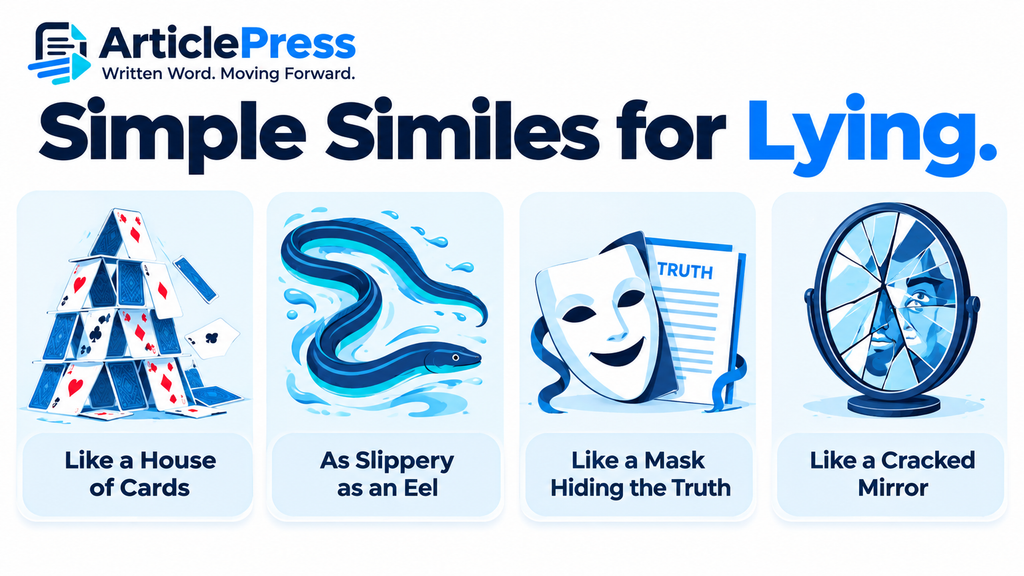
These straightforward comparisons are easy to understand and useful for everyday writing.
1. Like a house of cards
Meaning: A fragile story that can easily fall apart when challenged.
Example: His explanation was like a house of cards, collapsing after one simple question.
Why it works: A house of cards depends on a delicate balance. One missing fact can bring an invented story down.
2. As slippery as an eel
Meaning: Difficult to pin down or get a straight answer from.
Example: Whenever we asked about the missing money, he was as slippery as an eel.
Why it works: An eel is hard to hold, making it a useful image for someone who avoids direct answers.
3. Like a mask hiding the truth
Meaning: A false appearance that conceals what is really happening.
Example: Her cheerful smile was like a mask hiding the truth about the mistake.
Why it works: A mask covers someone’s real expression, just as a lie can conceal the facts.
4. As false as a counterfeit coin
Meaning: Completely untrustworthy or not genuine.
Example: The promise sounded as false as a counterfeit coin.
Why it works: A counterfeit coin looks real but has no genuine value, much like a convincing lie.
5. Like smoke in the wind
Meaning: An explanation that is vague, shifting, or difficult to verify.
Example: His account of what happened disappeared like smoke in the wind whenever anyone asked for details.
Why it works: Smoke changes shape and direction, suggesting a story that never stays consistent.
6. As twisted as a winding road
Meaning: Complicated and misleading, with details that are hard to follow.
Example: The witness gave an explanation as twisted as a winding road.
Why it works: A winding road takes many turns, just as a deceptive explanation may avoid the truth.
7. Like a cracked mirror
Meaning: A distorted version of reality.
Example: His retelling of the argument was like a cracked mirror, showing only a distorted picture of what happened.
Why it works: A cracked mirror changes the image it reflects, making it a useful comparison for a misleading account.
8. As unreliable as a broken clock
Meaning: Not dependable or accurate.
Example: His excuses were as unreliable as a broken clock.
Why it works: A broken clock cannot be trusted to tell the correct time, just as repeated false statements cannot be trusted.
9. Like a wolf in sheep’s clothing
Meaning: Someone who hides harmful or dishonest intentions behind a harmless appearance.
Example: The dishonest salesman was like a wolf in sheep’s clothing, pretending to help while taking advantage of customers.
Why it works: The contrast between appearance and reality makes the deception clear. This traditional expression describes concealed intentions more than lying alone.
10. Like a painted window
Meaning: Something that looks convincing from the outside but hides what lies behind it.
Example: His perfect explanation was like a painted window, showing an attractive picture but revealing nothing about the truth.
Why it works: A painted window offers an image instead of a real view, much like a fabricated story can replace facts with appearances.
Creative Similes for Lying
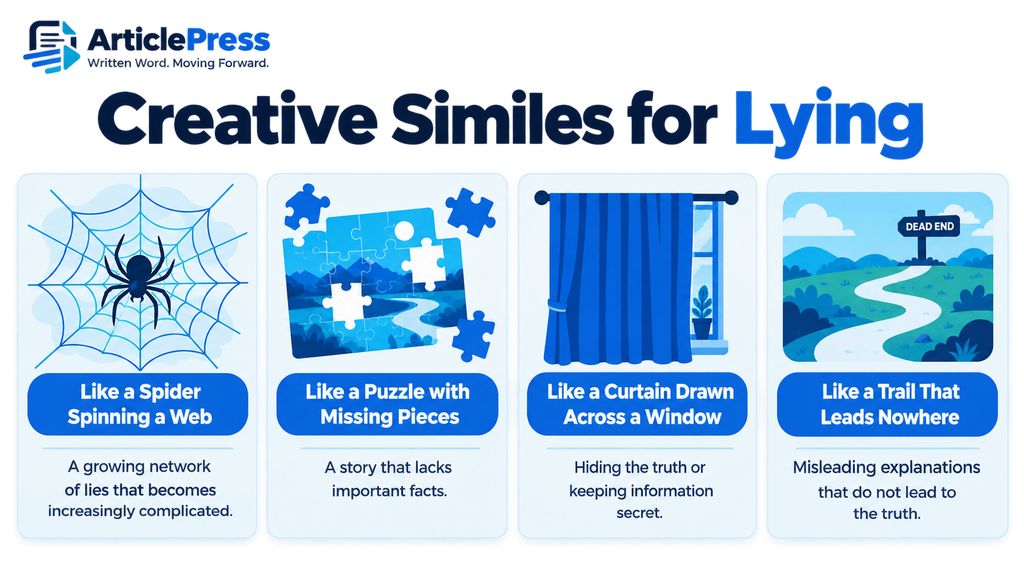
Use these imaginative comparisons in stories, poems, essays, and descriptive passages.
11. Like a spider spinning a web
Meaning: Creating a complicated network of lies that traps the liar.
Example: Each excuse became another thread as he spun lies like a spider spinning a web.
Why it works: A web grows through connected threads, reflecting how one lie can require several more.
12. Like a magician hiding a trick
Meaning: Concealing the truth through distraction or misdirection.
Example: He changed the subject like a magician hiding a trick whenever the conversation became uncomfortable.
Why it works: A magician directs attention away from what is really happening, much like someone who uses distraction to avoid revealing facts.
13. As thin as tissue paper
Meaning: An excuse that is weak and easy to see through.
Example: Her excuse for missing the meeting was as thin as tissue paper.
Why it works: Tissue paper tears easily, making it an image for an explanation that cannot withstand scrutiny.
14. Like a shadow pretending to be a person
Meaning: An imitation of reality that lacks substance.
Example: His invented achievements were like a shadow pretending to be a person.
Why it works: A shadow resembles a real figure but has no independent substance, suggesting claims that sound impressive but lack evidence.
15. Like a puzzle with missing pieces
Meaning: A story that leaves out important facts.
Example: The report was like a puzzle with missing pieces, and nobody could understand what had really happened.
Why it works: Missing pieces prevent a complete picture, just as omitted facts can mislead an audience.
16. As changeable as the weather
Meaning: Constantly changing a story to suit the situation.
Example: His version of the incident was as changeable as the weather.
Why it works: Weather can change quickly, suggesting an account that shifts whenever new questions arise.
17. Like a curtain drawn across a window
Meaning: Concealing facts that should be visible.
Example: The carefully worded statement was like a curtain drawn across a window.
Why it works: A curtain blocks the view, just as misleading language can hide important information.
18. Like a trail that leads nowhere
Meaning: A misleading explanation that prevents people from reaching the truth.
Example: Every clue he offered was like a trail that led nowhere.
Why it works: A trail usually guides someone toward a destination, but this one wastes the searcher’s effort.
19. Like a paper bridge over a river
Meaning: A claim that appears useful but cannot withstand pressure.
Example: His promise to repay everyone was like a paper bridge over a river.
Why it works: A paper bridge would not safely support someone crossing a river, reflecting a promise without a reliable foundation.
20. Like a candle burning at both ends
Meaning: A deceptive situation that becomes increasingly difficult to sustain.
Example: Maintaining two conflicting stories was like a candle burning at both ends.
Why it works: A candle burning at both ends is consumed quickly. Similarly, keeping contradictory lies straight can exhaust the person telling them.
Similes for Someone Who Lies Often
These comparisons describe habitual dishonesty, evasive behavior, and people who are difficult to trust.
21. As slippery as wet soap
Meaning: Hard to question directly or hold accountable.
Example: The politician was as slippery as wet soap when reporters asked about the missing funds.
Why it works: Wet soap slips out of your hands, creating a vivid picture of someone who avoids clear answers.
22. Like a chameleon changing colors
Meaning: Changing a story or position to match the audience.
Example: He was like a chameleon changing colors, agreeing with whoever happened to be listening.
Why it works: A chameleon is associated with changing appearance, making it a useful comparison for someone who adjusts their claims to suit others.
23. As two-faced as a double-sided mask
Meaning: Presenting different versions of oneself to different people.
Example: She acted as two-faced as a double-sided mask, praising her colleague in public while spreading false stories in private.
Why it works: Two different faces symbolize conflicting appearances and hidden intentions.
24. Like a fox hiding its tracks
Meaning: Concealing evidence of dishonest actions.
Example: He acted like a fox hiding its tracks after changing the records.
Why it works: The image suggests someone carefully trying to prevent others from discovering what happened.
25. As untrustworthy as a faulty compass
Meaning: Unable to guide others reliably toward the truth.
Example: His advice was as untrustworthy as a faulty compass.
Why it works: A compass should point in the right direction. A faulty one leads people astray.
26. Like a salesperson selling empty boxes
Meaning: Making attractive promises that contain little or no real value.
Example: His business pitch was like a salesperson selling empty boxes.
Why it works: The packaging promises something worthwhile, but the contents fail to deliver.
27. Like a broken record repeating the same excuse
Meaning: Repeatedly using the same explanation to avoid responsibility.
Example: He sounded like a broken record repeating the same excuse every time he arrived late.
Why it works: The repetition highlights a pattern of evasion, although the expression itself does not prove that the excuse is false.
28. Like a chaser running after a mirage
Meaning: Encouraging people to pursue something that is not real or attainable.
Example: The dishonest promoter kept investors chasing a mirage with promises of impossible returns.
Why it works: A mirage looks real from a distance but disappears upon approach, capturing the frustration of false promises.
29. As empty as a hollow drum
Meaning: Full of impressive words but lacking truth or substance.
Example: His grand claims were as empty as a hollow drum.
Why it works: A hollow drum makes noise without containing anything substantial, suggesting talk that sounds important but offers little evidence.
30. Like a puppet dancing on hidden strings
Meaning: Presenting a controlled performance that conceals the real motives or people involved.
Example: The spokesperson seemed like a puppet dancing on hidden strings, repeating a story prepared by someone else.
Why it works: The image suggests that what people see on the surface may not reveal the real source of the message.
Similes for False Promises and Deception
These comparisons work well when describing broken commitments, misleading claims, and stories that create false hope.
31. Like a rainbow made of smoke
Meaning: A beautiful promise that cannot become reality.
Example: His promise of instant success was like a rainbow made of smoke.
Why it works: A rainbow appears colorful and appealing, while smoke cannot form a lasting, solid structure.
32. As fragile as a soap bubble
Meaning: A claim that quickly falls apart under examination.
Example: The manager’s explanation was as fragile as a soap bubble once the records were checked.
Why it works: Soap bubbles look delicate and disappear easily, making them a natural image for a weak claim.
33. Like a bridge built on sand
Meaning: A plan or promise based on unreliable information.
Example: Their agreement was like a bridge built on sand because it depended on promises nobody could verify.
Why it works: Sand provides an unstable foundation, suggesting that a claim without evidence may fail.
34. Like bait hiding a hook
Meaning: An attractive offer designed to deceive or exploit someone.
Example: The unbelievable prize was like bait hiding a hook, drawing people into a dishonest scheme.
Why it works: Bait attracts attention while hiding danger, reflecting the difference between an offer’s appearance and its purpose.
35. As hollow as an empty shell
Meaning: A promise that sounds meaningful but has no real substance.
Example: His apology was as hollow as an empty shell because he continued blaming everyone else.
Why it works: An empty shell retains its shape but lacks what once filled it.
36. Like a road sign pointing the wrong way
Meaning: Giving false directions or misleading information.
Example: The instructions were like a road sign pointing the wrong way, sending customers toward the wrong office.
Why it works: Road signs are meant to guide people accurately, so a misleading sign creates confusion and wasted effort.
37. Like a locked box with a false label
Meaning: Presenting something under a misleading description.
Example: The product advertisement was like a locked box with a false label, promising features the product did not have.
Why it works: The label shapes expectations while concealing the actual contents.
38. Like a mirror reflecting a painted picture
Meaning: Showing an invented version of reality instead of the truth.
Example: His social media posts were like a mirror reflecting a painted picture of his life.
Why it works: The image suggests a carefully manufactured appearance that differs from real circumstances.
39. Like a golden apple hiding a worm
Meaning: Something attractive that conceals a serious flaw.
Example: The investment offer was like a golden apple hiding a worm.
Why it works: The attractive exterior draws attention away from the hidden problem.
40. Like a thread unraveling from a sweater
Meaning: A lie gradually falling apart as evidence emerges.
Example: Her account began to unravel like a thread pulling loose from a sweater.
Why it works: One loose thread can lead to a larger unraveling, just as one contradiction can expose a broader deception.
Powerful Similes for the Consequences of Lying
These comparisons focus on the damage dishonesty can cause to relationships, credibility, and trust.
41. Like a crack spreading through glass
Meaning: A small lie that gradually damages trust.
Example: His first lie was like a crack spreading through glass, weakening the relationship over time.
Why it works: A crack may begin small but spread, showing how one dishonest act can have lasting consequences.
42. Like a fire consuming dry leaves
Meaning: A lie that grows quickly and causes increasing damage.
Example: The rumor spread like a fire consuming dry leaves, damaging reputations before anyone checked the facts.
Why it works: Dry leaves burn rapidly, reflecting how misinformation can spread and cause harm.
43. Like a stone thrown into still water
Meaning: A lie that disrupts peace and creates consequences beyond the original moment.
Example: His accusation was like a stone thrown into still water, disturbing friendships throughout the group.
Why it works: A stone creates ripples that move outward, just as one false claim can affect many people.
44. Like a house sinking into a swamp
Meaning: A dishonest situation gradually collapsing under its own problems.
Example: The fraudulent business was like a house sinking into a swamp as unpaid bills and false records came to light.
Why it works: A house on unstable ground cannot remain secure, illustrating the danger of building something on deception.
45. Like a thread pulled from a tangled knot
Meaning: One discovered lie revealing several connected lies.
Example: The first false statement was like a thread pulled from a tangled knot, exposing a chain of other deceptions.
Why it works: Pulling one thread can loosen a complicated knot, just as questioning one lie can uncover more hidden details.
Quick-Reference Table: Similes for Lying
| Simile | Meaning | Best Used For |
|---|---|---|
| Like a house of cards | Easily disproved | Weak stories |
| As slippery as an eel | Avoids direct answers | Evasive people |
| Like a mask hiding the truth | Conceals reality | Hidden intentions |
| Like a spider spinning a web | Builds connected lies | Complicated deception |
| As thin as tissue paper | Weak excuse | Everyday dialogue |
| Like a chameleon changing colors | Adapts the story | Inconsistent behavior |
| Like bait hiding a hook | Attractive but deceptive | Scams and false offers |
| Like a bridge built on sand | Unreliable foundation | Broken promises |
| Like a crack spreading through glass | Damages trust | Relationships |
| Like a thread pulled from a tangled knot | Reveals connected lies | Exposing deception |
How to Use Similes for Lying in Your Writing
The best simile depends on what you want readers to notice. Choose a comparison that matches the situation rather than adding a dramatic image to every sentence.
- For a weak excuse: Use “as thin as tissue paper” to suggest that the explanation is easy to challenge.
- For an evasive character: Use “as slippery as an eel” to show how the person avoids direct answers.
- For a complicated deception: Use “like a spider spinning a web” to suggest that one lie connects to several others.
- For a broken promise: Use “like a bridge built on sand” to emphasize the lack of a reliable foundation.
- For damaged trust: Use “like a crack spreading through glass” to show the gradual effects of dishonesty.
- For a revealing discovery: Use “like a thread pulled from a tangled knot” when one exposed lie leads to others.
Using “Like” in a Simile
A simile using like compares one thing with another.
Example: “His explanation was like a maze with no exit.”
This comparison suggests that the explanation was confusing and led nowhere.
Using “As” in a Simile
A simile using as often compares a quality or characteristic.
Example: “Her excuse was as fragile as a soap bubble.”
This suggests that the excuse could not withstand questioning.
Not every comparison needs to be elaborate. A simple, accurate image often communicates dishonesty more effectively than a complicated metaphor or simile.
Common Mistakes When Writing Similes About Lying
- Using a comparison that does not fit. Choose an image that clearly connects to deception, such as concealment, instability, or confusion.
- Overusing familiar expressions. Traditional comparisons can work well, but original details help your writing sound fresh.
- Confusing dishonesty with uncertainty. Someone who gives an incorrect answer is not necessarily lying; lying generally involves intentional deception.
- Making every character sound dramatic. A quiet, ordinary comparison can be more convincing than a string of intense images.
- Repeating the same idea. If several similes all suggest that a story is weak, choose the one that best suits your scene.
Frequently Asked Questions
1. What is a good simile for lying?
“His story was like a house of cards” is a strong simile for lying. It suggests that the story is fragile and may collapse when someone questions it or discovers missing facts. It works well in essays, stories, and descriptions of someone whose explanation is difficult to believe.
2. What is a simile for someone who lies all the time?
“As slippery as an eel” is useful for describing someone who repeatedly avoids direct answers. If you want to emphasize changing stories, “like a chameleon changing colors” may be more suitable. Choose the comparison that describes the person’s actual behavior rather than simply labeling them dishonest.
3. What is a creative simile for deception?
“Like a mask hiding the truth” is a clear, flexible comparison for deception. For a more imaginative description, try “like a rainbow made of smoke,” which suggests a promise that looks appealing but cannot become reality. Both examples work well in fiction and descriptive writing.
4. How can I describe a lie falling apart?
You could write, “The lie unraveled like a thread pulling loose from a sweater.” This image suggests that one inconsistency gradually reveals a larger problem. Another option is “like a house of cards,” which emphasizes how quickly a weak story can collapse under pressure.
5. Are similes for lying suitable for school assignments?
Yes. Similes can help students explain dishonesty, false promises, and damaged trust in descriptive essays or creative-writing assignments. Choose examples with clear meanings, such as “like a cracked mirror” or “as thin as tissue paper,” and explain how the comparison supports the main idea.
6. What is the difference between a simile and a metaphor about lying?
A simile makes a comparison using like or as, as in “His excuse was as thin as tissue paper.” A metaphor makes a direct comparison, as in “His excuse was tissue paper.” Both can communicate dishonesty, but they use different grammatical structures.
Practice Section: Test Your Understanding
Complete these sentences using the most suitable simile from the article.
- His explanation fell apart after one question, like a ______.
- She avoided every direct question and was as slippery as an ______.
- The attractive offer concealed a scam, like ______ hiding a hook.
- One discovered lie revealed several more, like a thread pulled from a tangled ______.
- The first lie gradually damaged their relationship, like a crack spreading through ______.
Answers:
- House of cards
- Eel
- Bait
- Knot
- Glass
Final Thoughts
Similes for lying help writers describe more than a false statement. They can reveal a weak excuse, a carefully hidden motive, an unreliable promise, or the lasting damage dishonesty causes. Comparisons such as “like a house of cards” and “as slippery as an eel” are useful when you want readers to understand a character’s behavior quickly. More imaginative comparisons can bring depth to stories, poems, and descriptive essays. To create your own simile, identify the specific feature of lying you want to describe, such as concealment or inconsistency, and compare it with something readers can easily picture. The strongest simile is the one that makes your intended meaning clear.

Sophia Bennett contributes to ArticlesPress with a focus on English grammar, vocabulary development, word usage, and language learning. She aims to make complex language concepts easier to understand through clear explanations, practical examples, and reader-friendly educational content.