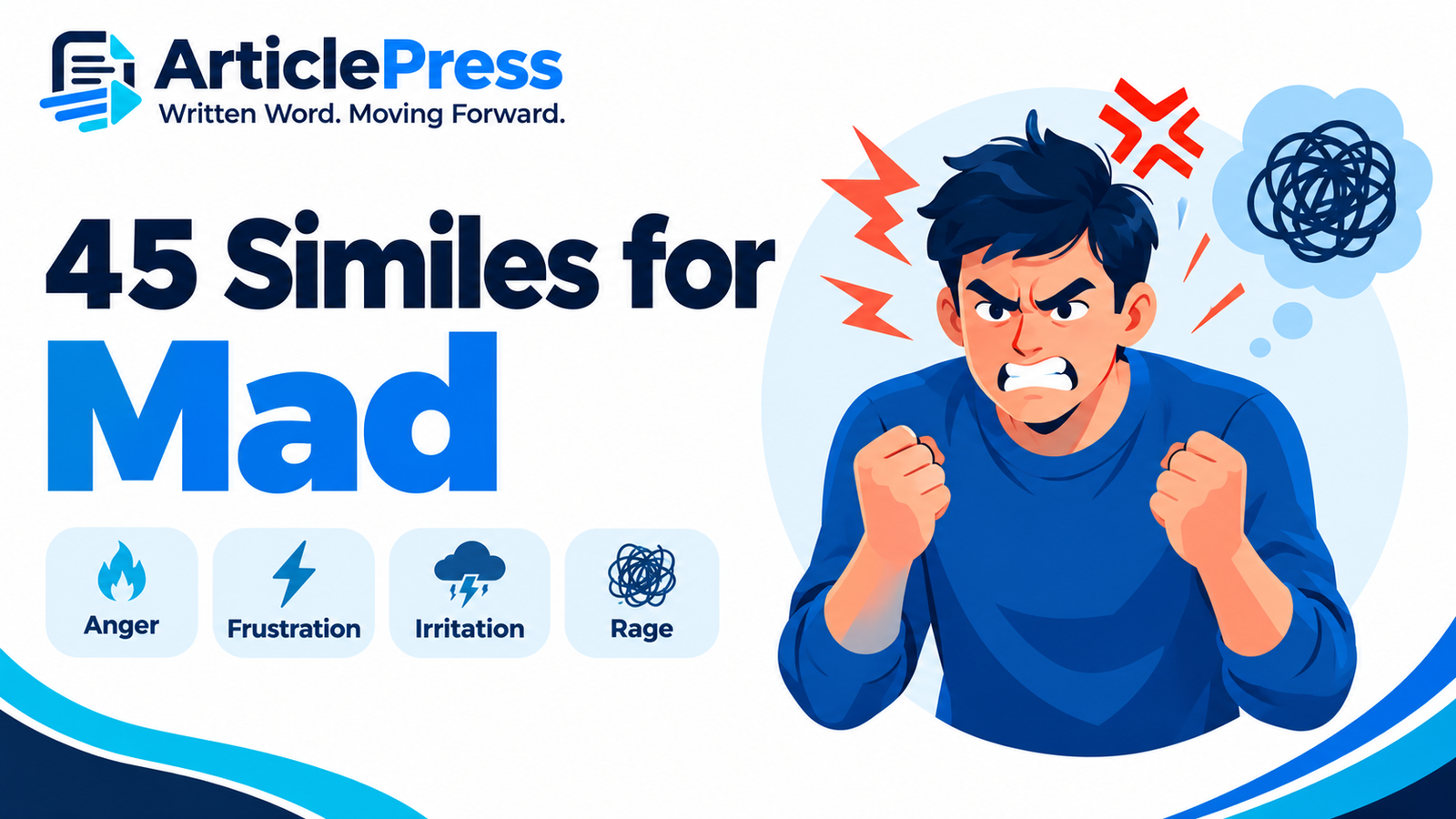
Looking for similes for mad? You can describe anger as hot as fire, explosive as a bursting balloon, or fierce as a storm. These comparisons help readers picture different levels of anger, from mild irritation to uncontrollable rage. Whether you’re writing a short story, completing a school assignment, or describing an angry character, the right simile can make your words more vivid and memorable.
This collection includes 45 similes for mad, each with a clear meaning and a natural example sentence. Some are simple enough for everyday writing, while others work well in stories, poems, and character descriptions.
What Is a Simile for Mad?
A simile for mad compares an angry person, feeling, or reaction to something recognizable using words such as like or as. For example, “He was as angry as a raging bull” compares someone’s anger to a bull’s fierce behavior. Similes help readers imagine how anger looks, feels, or affects someone’s actions.
45 Best Similes for Mad With Meanings and Examples
The examples below cover different forms of anger, including sudden outbursts, simmering frustration, intense fury, and restrained irritation. Choose a comparison that matches the emotion and scene you’re trying to describe.
Simple Similes for Mad
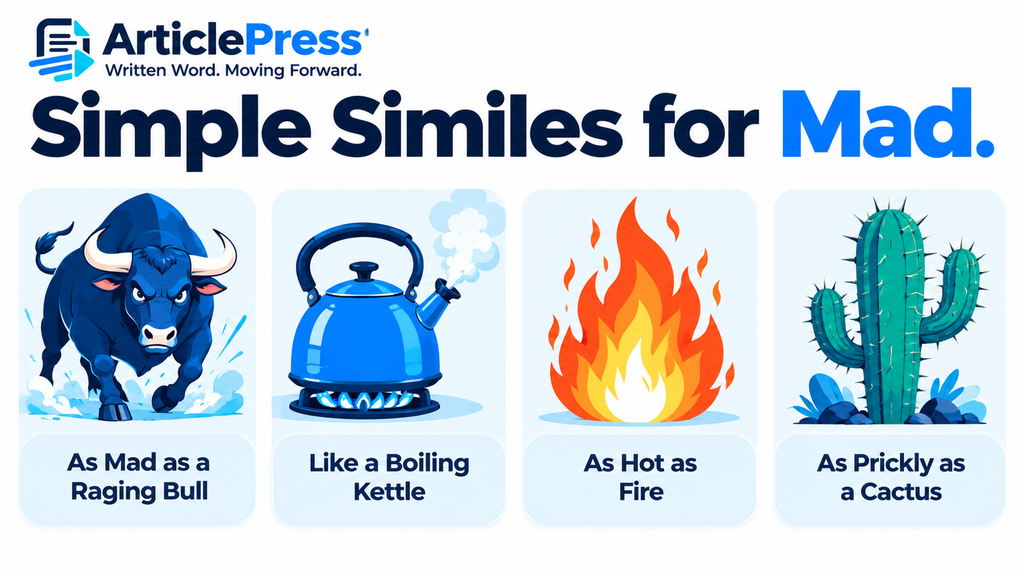
1. As mad as a raging bull
Meaning: Extremely angry and ready to confront someone.
Why it works: A raging bull suggests raw power, aggression, and an intense reaction.
Example: When Jake discovered the damage to his car, he was as mad as a raging bull.
2. As mad as a hornet
Meaning: Very irritated, angry, and ready to snap.
Why it works: A hornet’s defensive behavior creates an image of someone who reacts sharply when annoyed.
Example: Mom was as mad as a hornet when she found muddy footprints across the clean floor.
3. As hot as fire
Meaning: Burning with intense anger.
Why it works: Fire represents heat and intensity, making it a vivid comparison for strong emotions.
Example: His face felt as hot as fire after the embarrassing argument.
4. Like a boiling kettle
Meaning: Becoming increasingly angry and close to losing control.
Why it works: A kettle builds pressure as it heats, much like frustration that grows when problems remain unresolved.
Example: She paced around the room like a boiling kettle while waiting for an explanation.
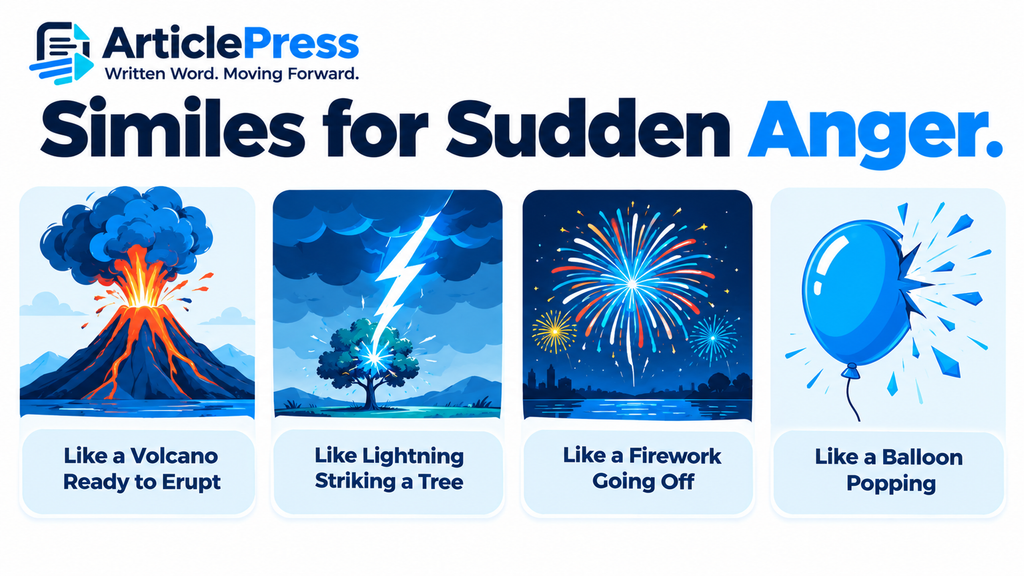
5. Like a volcano ready to erupt
Meaning: Holding in intense anger that could burst out at any moment.
Why it works: A volcano suggests pressure building beneath the surface before a sudden explosion.
Example: After hours of unfair criticism, Daniel looked like a volcano ready to erupt.
6. As furious as a thunderstorm
Meaning: Extremely angry, with powerful and overwhelming emotions.
Why it works: A thunderstorm brings loud sounds, sudden flashes, and turbulent weather, reflecting an intense outburst.
Example: The coach was as furious as a thunderstorm after the team ignored his instructions.
7. Like a shaken soda bottle
Meaning: Full of built-up frustration and likely to explode emotionally.
Why it works: A shaken bottle contains pressure that escapes suddenly when opened.
Example: After keeping quiet all morning, Maya was like a shaken soda bottle when her brother teased her again.
8. As red as a beet
Meaning: So angry or embarrassed that someone’s face turns noticeably red.
Why it works: The familiar image of a red beet makes a flushed face easy to picture.
Example: He turned as red as a beet when his coworker accused him of taking credit for the project.
9. Like a dog with a bone
Meaning: Relentlessly focused on an issue because of anger or determination.
Why it works: The comparison suggests someone who refuses to let a problem go.
Example: She pursued the complaint like a dog with a bone until the company corrected the mistake.
10. As prickly as a cactus
Meaning: Irritable, defensive, and unpleasant to approach.
Why it works: A cactus’s sharp spines create an image of someone who pushes others away when upset.
Example: He was as prickly as a cactus after a difficult meeting.
Creative Similes for Mad
11. Like a match thrown into gasoline
Meaning: Reacting explosively when something triggers existing anger.
Why it works: The image conveys how a small trigger can produce a sudden, intense reaction.
Example: Her sarcastic remark was like a match thrown into gasoline, turning a minor disagreement into a heated argument.
12. As fierce as a wildfire
Meaning: Experiencing anger that spreads quickly and becomes difficult to contain.
Why it works: A wildfire moves rapidly and can overwhelm everything in its path.
Example: His anger spread through the discussion as fiercely as a wildfire.
13. Like a pressure cooker about to burst
Meaning: Holding back so much frustration that an outburst seems imminent.
Why it works: The pressure cooker represents emotions accumulating without a release.
Example: After weeks of extra work and no recognition, Priya felt like a pressure cooker about to burst.
14. As stormy as a dark sky
Meaning: Moody, angry, and emotionally unsettled.
Why it works: Dark, turbulent skies mirror a person’s troubled mood.
Example: His expression was as stormy as a dark sky when he heard the disappointing news.
15. Like lightning striking a tree
Meaning: Becoming suddenly and intensely angry.
Why it works: Lightning represents a swift, powerful event that changes a situation in an instant.
Example: She reacted like lightning striking a tree when she realized someone had deleted her work.
16. As sharp as a thorn
Meaning: Speaking in a cutting, hurtful, or irritated way.
Why it works: A thorn suggests words that prick or wound another person’s feelings.
Example: His reply was as sharp as a thorn after his suggestion was dismissed.
17. Like a fire trapped in a cage
Meaning: Containing powerful anger while struggling to express it.
Why it works: The trapped fire symbolizes an intense emotion with no easy outlet.
Example: Behind her polite smile, she felt like a fire trapped in a cage.
18. As wild as a raging river
Meaning: Experiencing anger that feels powerful and difficult to control.
Why it works: A raging river rushes forward with force, reflecting an overwhelming emotional reaction.
Example: His frustration became as wild as a raging river when the negotiations collapsed.
19. Like a ticking time bomb
Meaning: Appearing calm on the outside while anger builds toward an outburst.
Why it works: A ticking time bomb suggests mounting tension and the possibility of a sudden reaction.
Example: After being interrupted repeatedly, Mark seemed like a ticking time bomb.
20. As fierce as a lion protecting its cubs
Meaning: Showing intense anger when defending someone or something important.
Why it works: The image connects anger with protection, courage, and strong loyalty.
Example: She became as fierce as a lion protecting its cubs when someone bullied her younger brother.
Similes for Sudden Anger and Rage
21. Like a firework going off
Meaning: Bursting into anger suddenly and dramatically.
Why it works: A firework creates an immediate, attention-grabbing explosion.
Example: He went off like a firework when he discovered that the tickets had been lost.
22. As explosive as dynamite
Meaning: Prone to sudden, powerful outbursts of anger.
Why it works: Dynamite represents an intense reaction that happens with little warning.
Example: His temper was as explosive as dynamite whenever someone challenged his decisions.
23. Like a storm breaking loose
Meaning: Releasing anger in a forceful and uncontrolled way.
Why it works: The comparison captures the sudden change from tension to emotional intensity.
Example: When the truth finally came out, her anger broke loose like a storm.
24. As fierce as a charging bull
Meaning: Showing aggressive determination during an angry confrontation.
Why it works: A charging bull creates a strong image of force moving directly toward a target.
Example: He charged into the debate as fiercely as a charging bull.
25. Like a balloon popping
Meaning: Releasing built-up frustration in one sudden moment.
Why it works: A balloon can hold tension until a small event makes it burst.
Example: His patience disappeared like a balloon popping when the computer crashed again.
26. As loud as a crashing wave
Meaning: Expressing anger with a powerful voice or forceful words.
Why it works: A crashing wave creates a sense of volume and overwhelming force.
Example: Her protest was as loud as a crashing wave when the unfair decision was announced.
27. Like a spark hitting dry leaves
Meaning: Triggering a rapid spread of anger or conflict.
Why it works: Dry leaves catch fire quickly, suggesting how one comment can set off an argument.
Example: That careless accusation was like a spark hitting dry leaves in an already tense room.
28. As fierce as a dragon breathing fire
Meaning: Displaying exaggerated or dramatic anger.
Why it works: A fire-breathing dragon is a vivid fantasy image for someone whose fury seems overwhelming.
Example: The little boy looked as fierce as a dragon breathing fire when his sister broke his favorite toy.
29. Like a pot boiling over
Meaning: Finally expressing anger after keeping frustration inside for too long.
Why it works: Boiling liquid spills when heat and pressure exceed what the pot can contain.
Example: After weeks of missed deadlines, the manager’s frustration spilled out like a pot boiling over.
30. As fierce as a raging sea
Meaning: Feeling powerful, turbulent, and difficult-to-control anger.
Why it works: A raging sea suggests waves of emotion that are hard to calm.
Example: Inside, she felt as fierce as a raging sea, although she remained silent.
Similes for Irritation and Frustration
31. Like sand in a shoe
Meaning: Feeling increasingly annoyed by a small but persistent problem.
Why it works: Even a tiny grain of sand can make walking uncomfortable when it remains inside a shoe.
Example: His coworker’s constant interruptions were like sand in a shoe during an already stressful day.
32. As impatient as a child waiting for candy
Meaning: Becoming irritated because something is taking too long.
Why it works: The familiar image communicates eagerness mixed with frustration.
Example: I was as impatient as a child waiting for candy when the delayed train finally arrived.
33. Like a cat with its tail stepped on
Meaning: Reacting sharply because of irritation or sudden discomfort.
Why it works: The comparison suggests an immediate, defensive response.
Example: He answered like a cat with its tail stepped on when I asked about the unfinished report.
34. As grumpy as a bear woken from hibernation
Meaning: Being bad-tempered, especially when disturbed or tired.
Why it works: A bear waking unexpectedly from a long sleep provides a memorable picture of someone who wants to be left alone.
Example: Dad was as grumpy as a bear woken from hibernation before his morning coffee.
35. Like a mosquito buzzing around your ear
Meaning: Feeling persistently annoyed by something or someone.
Why it works: The repeated buzzing of a mosquito represents a small irritation that is difficult to ignore.
Example: The repeated notification sound was like a mosquito buzzing around my ear during the exam.
36. As tense as a tightly stretched rubber band
Meaning: Feeling increasingly irritated and close to snapping.
Why it works: A stretched rubber band suggests mounting tension that could be released suddenly.
Example: By the end of the long meeting, she was as tense as a tightly stretched rubber band.
37. Like a scratched record
Meaning: Becoming frustrated by repeated words, complaints, or problems.
Why it works: A scratched record repeats the same sound, suggesting an irritating cycle that never seems to end.
Example: His constant complaints sounded like a scratched record to everyone in the office.
38. As sour as an unripe lemon
Meaning: Showing a displeased, bitter, or unfriendly mood.
Why it works: The sharp taste of an unripe lemon suggests an unpleasant expression or attitude.
Example: She looked as sour as an unripe lemon after hearing that her plans had been canceled.
39. Like a thorn in someone’s side
Meaning: Being a persistent source of irritation or frustration.
Why it works: A thorn causes continuing discomfort, much like a problem that repeatedly annoys someone.
Example: The unresolved billing error remained like a thorn in the manager’s side for weeks.
40. As restless as a caged bird
Meaning: Feeling trapped, frustrated, and unable to settle down.
Why it works: A caged bird’s restless movement suggests a strong desire to escape an unpleasant situation.
Example: He paced the hallway as restlessly as a caged bird while waiting for the decision.
Similes for Quiet or Controlled Anger
41. Like ice hiding a fire
Meaning: Appearing calm while feeling intense anger underneath.
Why it works: Ice represents a cool exterior, while fire symbolizes the strong emotion hidden beneath it.
Example: She spoke politely, like ice hiding a fire, while deciding how to respond to the insult.
42. As cold as a winter morning
Meaning: Acting distant, unfriendly, or emotionally withdrawn because of anger.
Why it works: A cold winter morning creates an image of distance and discomfort rather than an explosive reaction.
Example: After their disagreement, his greeting was as cold as a winter morning.
43. Like a storm behind closed doors
Meaning: Hiding intense anger from other people.
Why it works: The storm represents powerful emotions that remain out of sight.
Example: She smiled during the meeting, but inside she felt like a storm behind closed doors.
44. As tight as a clenched fist
Meaning: Holding anger and tension in a controlled, physical way.
Why it works: A clenched fist suggests restrained force and the effort required to control a reaction.
Example: His hands were as tight as clenched fists as he listened to the accusation.
45. Like embers beneath ash
Meaning: Carrying anger that seems to have faded but can easily return.
Why it works: Embers remain hot beneath ash even when visible flames have disappeared.
Example: Although they had apologized to each other, resentment remained like embers beneath ash.
Quick-Reference Table: Similes for Mad
Use this table to choose a comparison that matches the type of anger you want to describe.
| Simile | Meaning | Best Used For |
| As mad as a raging bull | Powerful anger | Intense rage |
| Like a boiling kettle | Growing frustration | Building tension |
| Like a volcano ready to erupt | Suppressed fury | Character descriptions |
| As red as a beet | A flushed face | Physical reactions |
| Like a ticking time bomb | Anger building inside | Suspenseful scenes |
| Like a firework going off | Sudden anger | Unexpected outbursts |
| Like sand in a shoe | Persistent irritation | Everyday annoyances |
| As grumpy as a bear woken from hibernation | Bad temper | Humorous writing |
| Like ice hiding a fire | Hidden anger | Emotional scenes |
| Like embers beneath ash | Lingering resentment | Relationships and conflict |
How to Use Similes for Mad in Writing
The best simile depends on whether your character is irritated, furious, embarrassed, or trying to hide their feelings. Match the comparison to the situation rather than choosing the most dramatic expression every time.
1. In stories and novels
Use vivid comparisons to show how a character reacts to conflict.
Example: When she discovered the betrayal, her anger erupted like a volcano ready to erupt.
This comparison emphasizes the release of emotions that have been building for some time.
2. In poems
Choose comparisons with strong imagery, rhythm, or emotional contrast.
Example: His fury burned like fire beneath a sky of ice.
This original comparison contrasts intense anger with an outward appearance of calm.
3. In school assignments
Choose straightforward similes that readers can understand easily.
Example: My brother was as mad as a hornet when I borrowed his bicycle without asking.
The comparison communicates anger without needing a long explanation.
4. In descriptive paragraphs
Combine a simile with a physical reaction to make the scene more convincing.
Example: He stood like a volcano ready to erupt, his jaw clenched and his hands trembling.
The simile conveys emotional pressure, while the physical details help readers picture the character.
5. In everyday communication
Use familiar comparisons when you want to describe a frustrating situation informally.
Example: I was like a boiling kettle after waiting two hours for the delayed appointment.
This works in casual storytelling, although a simpler phrase such as “I was extremely frustrated” may suit a formal setting better.
How to Choose the Right Simile for Anger
Different comparisons communicate different levels and types of anger.
- For mild irritation: Use “like sand in a shoe” or “like a mosquito buzzing around your ear.”
- For growing frustration: Choose “like a boiling kettle” or “as tense as a tightly stretched rubber band.”
- For sudden rage: Try “like a firework going off” or “like a match thrown into gasoline.”
- For hidden anger: Use “like ice hiding a fire” or “like embers beneath ash.”
- For humorous descriptions: Choose “as grumpy as a bear woken from hibernation.”
- For protective anger: Use “as fierce as a lion protecting its cubs.”
One important writing tip: a simile should strengthen the scene, not overwhelm it. A quiet character who is silently upset may be better described as “ice hiding a fire” than as a raging bull.
Frequently Asked Questions
1. What is a good simile for mad?
A good simile for mad is “as mad as a raging bull.” It compares intense anger to the powerful, aggressive behavior of a bull. For quieter anger, “like ice hiding a fire” is another useful choice because it suggests strong emotions concealed beneath a calm exterior.
2. What is a simile for extremely angry?
“Like a volcano ready to erupt” is an effective simile for extreme anger. It suggests that frustration has been building beneath the surface and may soon burst out. You can use it in stories, descriptive paragraphs, and character sketches to communicate intense emotional pressure.
3. What is a simple simile for anger for kids?
“As hot as fire” is a simple simile for anger. It connects the feeling of anger with the familiar sensation of heat. For example, “Liam felt as hot as fire when his friend broke his toy.” The comparison is easy to understand and suitable for elementary-school writing.
4. What is a funny simile for mad?
“As grumpy as a bear woken from hibernation” is a humorous way to describe someone who is irritated, especially when disturbed or tired. It creates a memorable picture without relying on insults. Use it in lighthearted stories or informal descriptions when the situation is not serious.
5. How do you describe anger using a simile?
Compare anger to an object, natural event, or recognizable experience using like or as. For example, “Her frustration bubbled like a boiling kettle” suggests growing irritation, while “His anger exploded like a firework” communicates a sudden outburst. Choose imagery that matches the emotion’s intensity.
6. What is the difference between a simile for mad and a simile for furious?
A simile for mad can describe anything from mild irritation to intense anger. A simile for furious usually emphasizes extreme rage. For example, “like sand in a shoe” suggests a persistent annoyance, while “as fierce as a raging sea” conveys overwhelming anger.
7. Can I use similes for mad in poems and essays?
Yes. Similes can make both creative and academic writing more descriptive, but the tone matters. In poetry and fiction, imaginative comparisons can strengthen imagery and emotion. In formal essays, use similes selectively and make sure they clarify your point rather than distract from it.
Practice: Complete These Similes
Test your understanding by filling in each blank with a suitable comparison from the article.
- He was as mad as a _____.
- Her anger was like a volcano ready to _____.
- I felt like a boiling _____ after the repeated delays.
- His hidden anger was like embers beneath _____.
- She was as grumpy as a bear woken from _____.
Answers
- Raging bull
- Erupt
- Kettle
- Ash
- Hibernation
Try creating one original simile of your own. Think of an object or natural event that captures the kind of anger you want readers to imagine.
Final Thoughts
These 45 similes for mad offer different ways to describe irritation, frustration, sudden outbursts, and deep-seated anger. Comparisons such as “like a volcano ready to erupt” communicate mounting pressure, while “like embers beneath ash” describes resentment that remains after an argument. Simpler options, including “as hot as fire,” are useful for students and everyday writing.
When choosing a simile, consider the intensity of the emotion, the character’s behavior, and the overall tone of your writing. A thoughtful comparison can make an angry character more believable and a descriptive paragraph more engaging. You can also create original similes by connecting anger with familiar sensations, objects, or natural events.