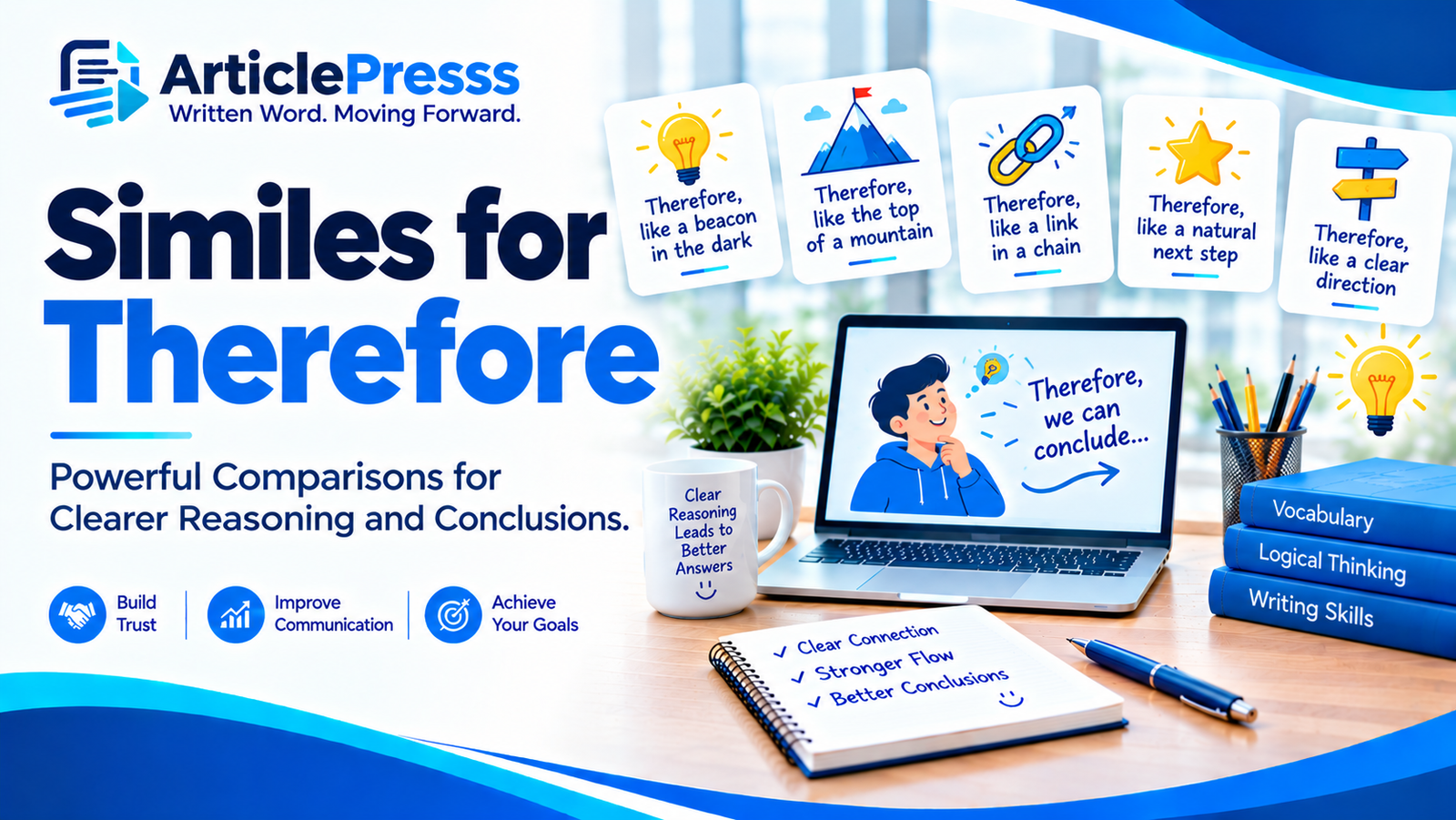
Looking for similes for “therefore”? The word therefore shows that a conclusion follows from a reason, fact, or previous statement. Although it is not a feeling, action, or physical object that naturally invites comparison, writers can use creative similes to describe how a conclusion follows from evidence, how one event leads to another, or how a result becomes clear.
For example, “The evidence connected to the conclusion like pieces of a puzzle” describes how facts fit together to support a result. In this guide, you’ll find original comparisons, sentence examples, and practical alternatives that help you express logical connections in essays, stories, speeches, and everyday writing.
What Does “Therefore” Mean?
Therefore is a linking adverb that means “for that reason,” “as a result,” or “consequently.” Writers use it to connect a reason or piece of evidence with a conclusion.
Example: The roads were covered in ice; therefore, school started late.
Here, the icy roads provide the reason, and the delayed school opening is the result.
A simile, on the other hand, compares two different things using words such as like or as. Since “therefore” expresses a logical relationship rather than a physical quality, a useful simile compares the way a conclusion follows from evidence to something readers can picture.
20 Similes for Therefore With Meanings and Examples
The following comparisons explore logical connections, cause and effect, evidence, and conclusions. They are creative expressions for describing the relationship represented by “therefore,” rather than direct synonyms for the word itself.
1. Like Pieces of a Puzzle
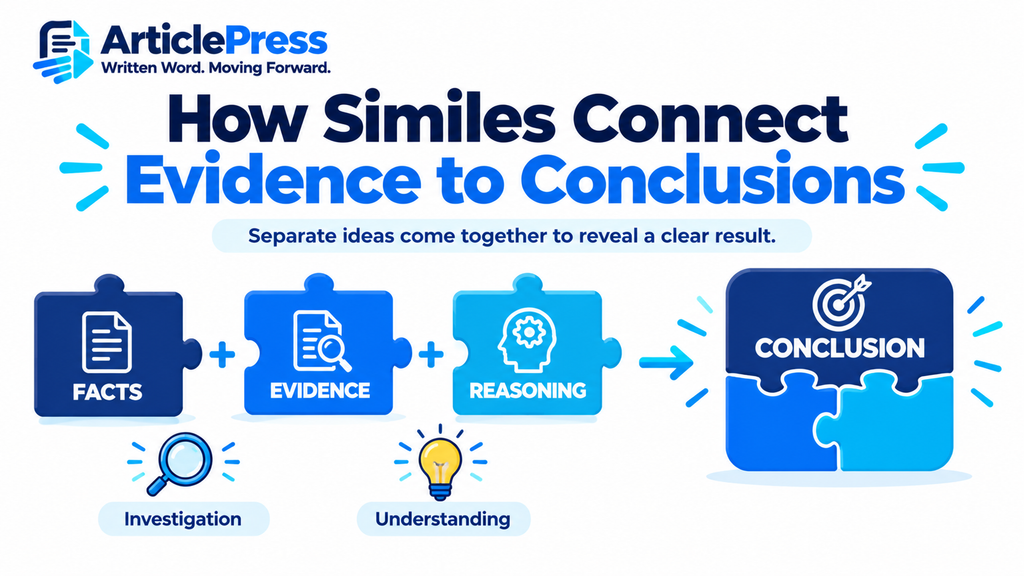
Meaning: Facts fit together to support a clear conclusion.
Why it works: Puzzle pieces illustrate how separate details can form one complete picture.
Example: The witness statements matched the physical evidence like pieces of a puzzle; therefore, investigators developed a clearer understanding of the incident.
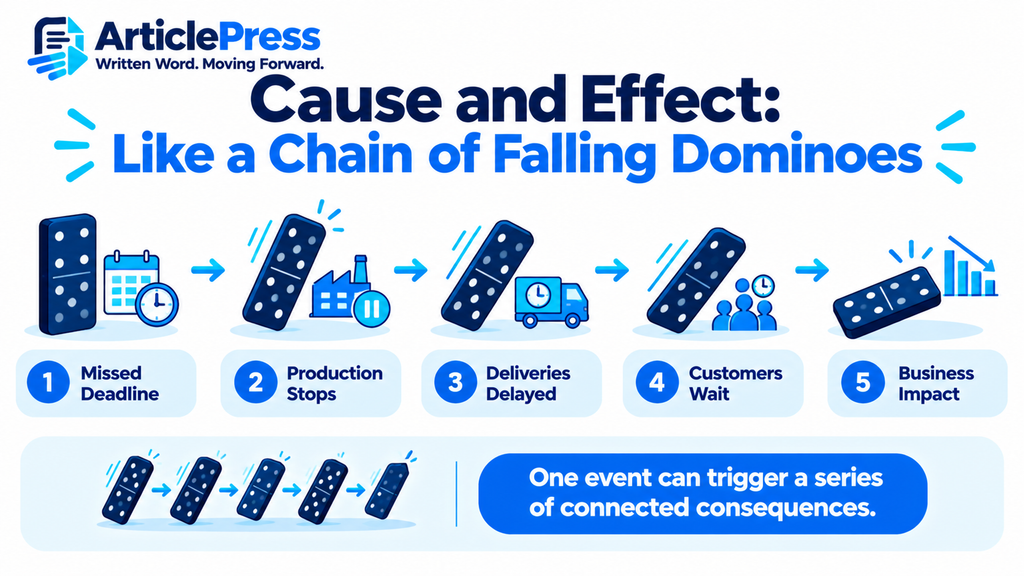
2. Like a Chain of Falling Dominoes
Meaning: One event leads to another in a connected sequence.
Why it works: Each falling domino triggers the next, making this comparison useful for explaining consequences.
Example: The supplier missed the deadline, production stopped, and deliveries were delayed like a chain of falling dominoes; therefore, the company revised its ordering process.
3. Like a Shadow Following an Object
Meaning: A result follows something that causes or explains it.
Why it works: A shadow stays connected to the object that creates it, suggesting a close relationship between cause and effect.
Example: The unexpected costs followed the poorly planned project like a shadow; therefore, the manager introduced a stricter budget.
4. Like a Bridge Between Two Banks
Meaning: A conclusion connects evidence with a final judgment.
Why it works: A bridge joins two separate sides, just as reasoning connects facts to conclusions.
Example: Her explanation linked the research findings to the final recommendation like a bridge between two banks; therefore, the committee understood her proposal.
5. Like a Trail Leading to Its Destination
Meaning: Evidence points toward a particular conclusion.
Why it works: A trail gives travelers a direction to follow, much like clues guide reasoning.
Example: Each new clue led the detective closer to the truth like a trail leading to its destination; therefore, she investigated the same suspect further.
6. Like a Key Fitting a Lock
Meaning: A fact provides the missing information needed to understand a situation.
Why it works: A suitable key unlocks something that was previously inaccessible.
Example: The final measurement fit the existing data like a key fitting a lock; therefore, the engineer identified the source of the error.
7. Like a River Flowing Toward the Sea
Meaning: Events move naturally toward a particular outcome.
Why it works: A river follows a course toward its destination, creating an image of a developing result.
Example: Demand continued to rise, and orders increased like a river flowing toward the sea; therefore, the business expanded its production capacity.
8. Like the Final Piece Completing a Picture
Meaning: One last fact makes a conclusion understandable.
Why it works: A missing piece can transform scattered fragments into a complete image.
Example: The latest report completed the investigation like the final piece completing a picture; therefore, the board approved the proposed changes.
9. Like an Echo Returning to Its Source
Meaning: An outcome reflects an earlier action or statement.
Why it works: An echo returns after a sound is produced, illustrating how actions can produce corresponding consequences.
Example: The team’s repeated mistakes returned like an echo of its poor training; therefore, management arranged additional coaching.
10. Like a Compass Pointing North
Meaning: Evidence provides a clear direction for making a decision.
Why it works: A compass helps travelers orient themselves, just as reliable facts guide sound judgments.
Example: The customer feedback pointed toward better service like a compass pointing north; therefore, the company focused on staff training.
11. Like a Seed Growing Into a Tree
Meaning: A small initial event develops into a larger result.
Why it works: A seed gradually grows into something much larger, illustrating how outcomes develop over time.
Example: The team’s small experiment grew into a successful product like a seed growing into a tree; therefore, the company invested in further development.
12. Like a Light Switching on in a Dark Room
Meaning: New information suddenly makes a situation clear.
Why it works: A light reveals what was previously difficult to see.
Example: The missing document clarified the disagreement like a light switching on in a dark room; therefore, both parties agreed on the next step.
13. Like a Map Revealing the Route
Meaning: Reasoning helps someone identify the best path toward a conclusion.
Why it works: A map organizes information into a route that can be followed.
Example: The research revealed the main causes of the problem like a map revealing the route; therefore, the team knew where to begin.
14. Like Rain Filling an Empty Pond
Meaning: Several small contributions combine to create a noticeable result.
Why it works: Individual drops gradually increase the amount of water, illustrating cumulative effects.
Example: Each donation added to the community fund like rain filling an empty pond; therefore, the organizers eventually purchased the needed supplies.
15. Like a Thread Connecting Beads
Meaning: One idea links several separate facts or arguments.
Why it works: A thread holds individual beads together, creating a connected whole.
Example: The central argument connected the research findings like a thread connecting beads; therefore, the essay presented a consistent point of view.
16. Like a Clock Reaching the Final Hour
Meaning: Earlier events lead toward an expected outcome or deadline.
Why it works: A clock’s movement marks the approach of a particular moment.
Example: The project fell behind schedule as the deadline approached like a clock reaching the final hour; therefore, the team reassigned several tasks.
17. Like Clouds Gathering Before Rain
Meaning: Several signs suggest that a particular event is likely to happen.
Why it works: Gathering clouds can signal approaching rain, just as warning signs can suggest a coming consequence.
Example: Falling sales and rising costs gathered like clouds before rain; therefore, the owners prepared a recovery plan.
18. Like a Balance Settling on One Side
Meaning: The available evidence favors one conclusion over another.
Why it works: A balance illustrates how competing considerations can lead toward one outcome.
Example: The benefits outweighed the risks like a balance settling on one side; therefore, the committee supported the proposal.
19. Like a Door Opening After a Long Search
Meaning: Careful investigation reveals a possible solution.
Why it works: An open door suggests access to an opportunity that was previously unavailable.
Example: The final experiment revealed a workable solution like a door opening after a long search; therefore, the researchers continued testing it.
20. Like a Photograph Coming Into Focus
Meaning: Confusing information gradually becomes clear enough to support a conclusion.
Why it works: A blurry photograph becomes recognizable as its details sharpen.
Example: The financial records brought the company’s situation into focus like a photograph coming into focus; therefore, the directors changed their spending plans.
Simple Similes for Therefore
Simple comparisons can help younger students and English learners understand how reasoning connects facts and results.
| Simile | Meaning | Best Used For |
|---|---|---|
| Like a puzzle coming together | Facts form a clear picture | School assignments |
| Like a road to a destination | Reasoning leads to a result | Explanations |
| Like a key opening a door | Information reveals an answer | Problem-solving |
| Like dominoes falling | One event causes another | Cause and effect |
| Like a light turning on | Something becomes clear | Discoveries |
| Like a bridge joining two sides | Ideas become connected | Essays |
| Like a river reaching the sea | Events reach an outcome | Stories |
| Like a map showing the way | Evidence guides a decision | Reports |
These comparisons are most effective when the surrounding sentence makes the relationship between the facts and the conclusion clear.
Creative Similes for Cause and Effect
When writing a story, poem, or descriptive passage, you may want a more imaginative comparison.
- Like a spark waking a sleeping fire: A small action triggers a much larger response. The first complaint spread like a spark waking a sleeping fire; therefore, the company reviewed its customer service policy.
- Like a thread pulling a curtain open: One discovery reveals something hidden. The overlooked email pulled the curtain open like a thread; therefore, the manager reconsidered the decision.
- Like a snowball gathering snow downhill: A small problem grows as it continues. The minor delay grew like a snowball gathering snow downhill; therefore, the team needed extra time.
- Like a path emerging through the fog: New information makes a difficult decision easier. The test results revealed a path through the fog; therefore, the doctor discussed the available options with the patient.
- Like a bell ringing after a quiet moment: A new event signals that something has changed. The unexpected announcement rang out like a bell after a quiet moment; therefore, everyone reconsidered the schedule.
These are original, context-dependent comparisons rather than established idioms. Use them when their imagery strengthens the meaning.
Similes Using “Like” and “As”
Most of the examples above use like because it makes comparisons easy to express naturally. You can also use as … as structures when describing how clear, direct, or inevitable a conclusion seems.
- As clear as a glass window: The evidence is easy to understand.
- As connected as links in a chain: The events depend on one another.
- As steady as a flowing river: A process continues consistently toward an outcome.
- As revealing as a light in darkness: New information makes a hidden fact visible.
- As direct as an arrow toward its target: The reasoning points clearly to its conclusion.
Example sentence: The evidence was as clear as a glass window; therefore, the committee reached its decision without further delay.
Remember that as comparisons describe a quality, while therefore connects a reason to a conclusion. They perform different grammatical jobs.
Is There a Direct Simile for “Therefore”?
There is no single standard simile that directly means “therefore.” The best comparison depends on what you want to express.
If you mean that evidence supports a conclusion, use like pieces of a puzzle. If you want to show a chain of consequences, choose like falling dominoes. If you want to describe a discovery that makes an answer clear, use like a light switching on in a dark room.
For formal writing, it is usually better to use the word therefore itself or a suitable transition instead of replacing it with a figurative expression.
Better Alternatives to “Therefore”
Because therefore is a logical transition rather than a descriptive quality, readers may actually be searching for alternative words and phrases. These options communicate similar relationships more directly.
| Alternative | Meaning or Function | Example |
|---|---|---|
| As a result | Introduces a consequence | The road was closed. As a result, we took another route. |
| Consequently | Shows an outcome | The figures were incorrect; consequently, the report was revised. |
| Thus | Introduces a conclusion | The evidence was incomplete; thus, further research was needed. |
| Hence | Indicates a logical result | The parts were unavailable, hence the delay. |
| For this reason | Clearly identifies the cause | For this reason, the school postponed the event. |
| Accordingly | Shows a response to circumstances | The requirements changed; accordingly, the plan was updated. |
| So | Provides a natural, conversational connection | It was getting late, so we went home. |
| This means that | Explains an implication | Demand has increased. This means that production must expand. |
Choose the alternative that matches the relationship between your ideas. Consequently often suits formal reports, so works well in conversation, and as a result is useful in explanatory writing.
How to Use These Similes in Writing
The right comparison depends on the point you want to communicate. A simile should clarify the relationship between ideas instead of distracting the reader.
In Essays
Use comparisons to explain how evidence supports a conclusion, but keep the main argument precise.
Example: The findings fitted together like pieces of a puzzle. Therefore, the researchers concluded that the proposed explanation deserved further investigation.
For academic essays, avoid using too many figurative expressions in place of clear reasoning.
In Stories
Similes can show how one event leads to another or how a character reaches a realization.
Example: Each unanswered question led to another like dominoes falling. Therefore, Maya decided to search the old library for more clues.
In Speeches
A familiar comparison can make a complicated argument easier for an audience to understand.
Example: Each small contribution became another drop filling the pond. Therefore, our combined efforts made the community project possible.
In Everyday Communication
Use short, familiar comparisons when explaining decisions or outcomes.
Example: The final detail was like a key fitting a lock. Therefore, we finally understood what had gone wrong.
Three Tips for Choosing the Right Simile
- Identify the relationship. Decide whether you are describing evidence, a consequence, a discovery, or a developing process.
- Choose a matching image. A puzzle suggests connected facts, while falling dominoes suggest a chain of events.
- Keep the logic clear. A figurative comparison can illustrate a conclusion, but it should not replace the evidence needed to support one.
Frequently Asked Questions
1. What is a good simile for therefore?
“Like pieces of a puzzle” is a useful comparison when separate facts combine to support a conclusion. It illustrates how evidence fits together. For example, “The findings fitted together like pieces of a puzzle; therefore, the team accepted the explanation as plausible.”
2. Can you use a simile to replace the word therefore?
Not usually. A simile creates a comparison, while therefore connects a reason to a conclusion. You can use a simile to illustrate the relationship between two ideas, but transitions such as as a result, consequently, and thus are more direct substitutes.
3. What is a simile for cause and effect?
“Like a chain of falling dominoes” is a useful simile for cause and effect. Each falling domino triggers the next, illustrating how one event can lead to another. For example, “One missed deadline delayed the next task like falling dominoes.”
4. What is an easy simile for students?
“Like a puzzle coming together” is an easy comparison for students. It describes how separate facts can form a complete explanation. Students can use it in descriptive writing, reading responses, and assignments that explain how evidence supports a conclusion.
5. What is a creative simile for reaching a conclusion?
“Like a photograph coming into focus” describes how confusing information becomes clear. It works well in stories, essays, and reflective writing when someone discovers an answer after examining several details.
6. Are similes for therefore suitable for academic writing?
They can be useful in introductions, explanations, or illustrative passages, but academic writing generally benefits from precise reasoning. Use a simile to make an idea easier to understand, then use therefore, thus, or consequently to state the logical conclusion clearly.
Final Thoughts
Similes for “therefore” work best when they illustrate how facts connect, how one event produces another, or how evidence leads to a conclusion. Comparisons such as like pieces of a puzzle, like falling dominoes, and like a photograph coming into focus help readers picture these relationships.
However, a simile does not directly replace the word therefore. Choose figurative language when you want to make an explanation more vivid, and use a logical transition when you need to state a conclusion precisely. By matching the comparison to the context, you can make your writing clearer, more engaging, and easier to follow.

Emily Carter is an English vocabulary and synonyms writer at ArticlesPress. She creates helpful guides on synonyms, alternative phrases, word meanings, and everyday English communication. Her writing helps readers discover natural expressions, improve their vocabulary, and communicate more clearly in personal, academic, and professional situations.