Suffering can feel like carrying a heavy weight, walking through a storm, or being trapped in a dark tunnel with no clear way out. The right simile helps readers understand these difficult experiences by turning abstract pain into something they can picture and feel.
These 45 similes for suffering cover emotional distress, grief, loneliness, physical discomfort, and the challenges of enduring hardship. Each example includes a meaning and a sentence showing how to use it naturally in descriptive writing, poetry, stories, or essays.
What Does Suffering Mean in a Simile?
A simile for suffering compares pain, distress, or hardship to another experience using words such as like or as. These comparisons help readers visualize an invisible feeling or understand how difficult circumstances affect someone.
For example, “Her grief felt like a storm that would not pass” compares emotional pain to prolonged bad weather. The image suggests that her sadness is powerful, overwhelming, and difficult to escape.
45 Best Similes for Suffering
The following examples are grouped by the kind of suffering they describe, making it easier to choose a comparison that fits your writing.
Emotional Pain and Heartbreak
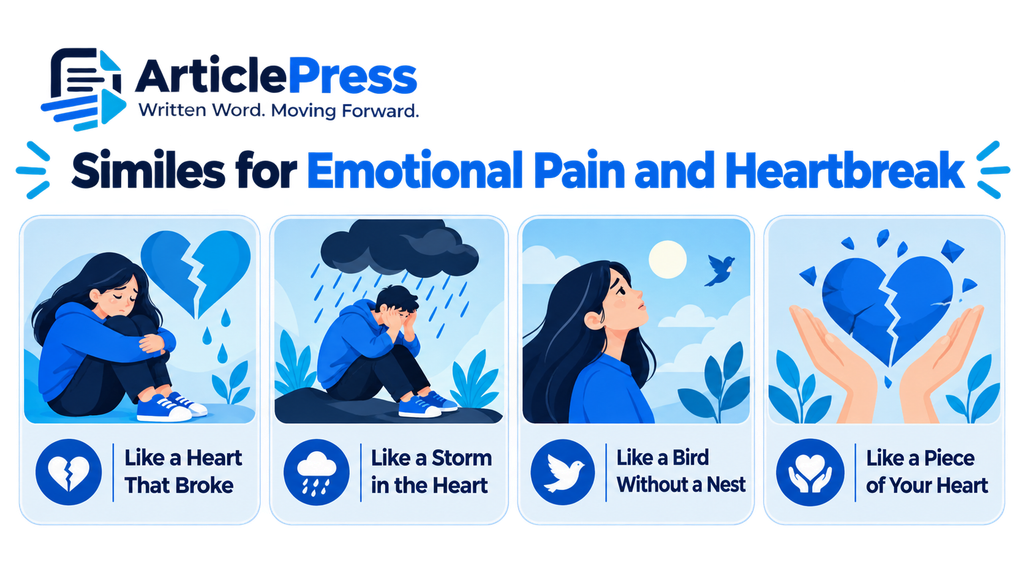
Use these comparisons to describe sadness, disappointment, rejection, and emotional wounds.
1. Like a knife twisting in an open wound
Meaning: Emotional pain that becomes more intense when something makes an existing hurt worse.
Example: Every reminder of their broken friendship felt like a knife twisting in an open wound.
Why it works: The image communicates sharp, renewed pain rather than a wound that is simply healing.
2. Like carrying a mountain on your shoulders
Meaning: Feeling overwhelmed by emotional burdens or responsibilities.
Example: After losing his job, he felt like he was carrying a mountain on his shoulders.
Why it works: A mountain represents a weight too enormous for one person to manage easily.
3. Like a storm raging inside
Meaning: Experiencing intense emotions that are difficult to control.
Example: She smiled politely, but inside, her disappointment raged like a storm.
Why it works: The contrast between outward calm and inner turmoil creates a vivid emotional picture.
4. Like a wound that never heals
Meaning: Painful memories or emotional injuries that remain unresolved.
Example: The betrayal stayed with him like a wound that never healed.
Why it works: It suggests that time has passed without fully removing the hurt.
5. Like drowning in sadness
Meaning: Feeling so overwhelmed by sorrow that it becomes difficult to think or function normally.
Example: During the weeks after the loss, he felt like he was drowning in sadness.
Why it works: Drowning creates an image of being overwhelmed by something difficult to escape.
6. As heavy as a heart full of grief
Meaning: Feeling emotionally burdened by loss or deep sorrow.
Example: Her heart was as heavy as a heart full of grief after saying goodbye to her closest friend.
Why it works: The comparison connects emotional sadness with physical heaviness. For more natural wording, you could write, “Her heart felt as heavy as stone with grief.”
7. Like a shattered mirror
Meaning: Feeling emotionally broken or struggling to recognize yourself after a painful experience.
Example: After the relationship ended, his confidence lay scattered like a shattered mirror.
Why it works: Broken pieces suggest damage and a sense of wholeness that is difficult to restore.
8. Like an endless rainy day
Meaning: Experiencing prolonged sadness that seems to have no end.
Example: Without the people she loved, every day felt like an endless rainy day.
Why it works: Persistent rain creates a quiet image of gloom and emotional exhaustion.
9. Like a song played in a minor key
Meaning: Carrying a sadness that colors ordinary experiences.
Example: Even the happiest memories sounded like a song played in a minor key after his father passed away.
Why it works: Music communicates emotional tone without needing to describe every feeling directly.
10. Like a broken string that cannot hold its tune
Meaning: Feeling emotionally exhausted or unable to return to your former self.
Example: After months of disappointment, she felt like a broken string that could no longer hold its tune.
Why it works: The image of a damaged instrument suggests that something once expressive or strong has been strained.
Grief, Loss, and Loneliness

These similes suit stories, poems, and personal reflections about losing someone or feeling alone.
11. Like walking through a house emptied of its memories
Meaning: Feeling the emptiness left behind when someone important is gone.
Example: After her grandmother died, visiting the old family home felt like walking through a house emptied of its memories.
Why it works: An empty house represents the absence of familiar people, routines, and shared experiences.
12. Like a candle burning at both ends
Meaning: Becoming physically or emotionally exhausted from prolonged demands.
Example: While caring for his sick father and working full-time, Daniel felt like a candle burning at both ends.
Why it works: The image suggests that energy is being used up faster than it can be restored.
13. Like a ship drifting without a compass
Meaning: Feeling lost and uncertain after a painful life change.
Example: After the divorce, she felt like a ship drifting without a compass.
Why it works: A ship without direction represents uncertainty and the struggle to find a new path.
14. Like an echo in an empty room
Meaning: Feeling lonely when your words or emotions receive no meaningful response.
Example: His attempts to explain his grief felt like an echo in an empty room.
Why it works: An echo returns a sound without providing the warmth of a real conversation.
15. Like a garden without sunlight
Meaning: Feeling emotionally neglected, discouraged, or deprived of support.
Example: Without her closest friends, her life felt like a garden without sunlight.
Why it works: A garden needs sunlight to flourish, just as people often need care and connection to feel supported.
16. Like a bridge collapsing beneath your feet
Meaning: Experiencing the sudden loss of security, trust, or stability.
Example: When his business partner betrayed him, his sense of trust collapsed like a bridge beneath his feet.
Why it works: A collapsing bridge captures the shock of losing something you believed would support you.
17. Like winter settling over a quiet town
Meaning: Feeling surrounded by coldness, silence, and emotional isolation.
Example: After her closest friend moved away, loneliness settled over her life like winter over a quiet town.
Why it works: Winter provides a strong image of stillness, distance, and a lack of warmth.
18. Like a photograph fading in the sun
Meaning: Feeling distressed as cherished memories or connections seem to grow distant.
Example: He feared that their shared memories were fading like a photograph left in the sun.
Why it works: The fading photograph symbolizes the painful passage of time and the fear of losing meaningful details.
19. Like a door closing on a familiar world
Meaning: Feeling grief when an important chapter of life ends.
Example: Leaving her childhood home felt like a door closing on a familiar world.
Why it works: A closing door represents separation from a place, relationship, or stage of life.
20. Like a lone tree on a windswept hill
Meaning: Feeling isolated while facing difficult circumstances without much support.
Example: In the unfamiliar city, he felt like a lone tree on a windswept hill.
Why it works: The solitary tree suggests vulnerability and endurance in an exposed environment.
Physical Pain and Exhaustion
These comparisons describe bodily discomfort, fatigue, and the physical demands of enduring hardship.
21. Like walking on broken glass
Meaning: Experiencing a situation that feels painful at every step.
Example: Every movement after the exhausting journey felt like walking on broken glass.
Why it works: Broken glass suggests sharp, repeated discomfort. It can also describe emotional situations that make every decision difficult.
22. Like a body made of lead
Meaning: Feeling extremely heavy, tired, or physically drained.
Example: After three sleepless nights, his body felt like it was made of lead.
Why it works: Lead is heavy, making it an effective image for fatigue that slows every movement.
23. Like running uphill through deep mud
Meaning: Struggling to make progress despite continuous effort.
Example: Recovering from the setback felt like running uphill through deep mud.
Why it works: The resistance of mud and the steep slope communicate how exhausting progress can become.
24. Like a machine grinding without oil
Meaning: Continuing to work while exhausted and under strain.
Example: By the end of the double shift, he felt like a machine grinding without oil.
Why it works: A poorly lubricated machine suggests friction, strain, and the danger of pushing beyond comfortable limits.
25. Like a stretched rubber band ready to snap
Meaning: Feeling close to the limit of your patience or endurance.
Example: After weeks of deadlines and little rest, Maya felt like a stretched rubber band ready to snap.
Why it works: The image communicates mounting pressure and the possibility of suddenly reaching a breaking point.
26. Like carrying a backpack full of stones
Meaning: Feeling weighed down by responsibilities, worries, or ongoing difficulties.
Example: Every unfinished task added another stone to the backpack he carried through the day.
Why it works: The accumulating weight makes invisible burdens easy to imagine.
27. Like a runner who has reached the final mile
Meaning: Feeling deeply tired while trying to finish a difficult task.
Example: By the final week of the project, she felt like a runner struggling through the last mile.
Why it works: The runner represents someone who has already spent considerable energy but must keep going.
28. Like climbing a staircase that never ends
Meaning: Feeling exhausted by a challenge that appears to have no finish line.
Example: Managing one problem after another felt like climbing a staircase that never ended.
Why it works: Each new step represents another demand, while the missing endpoint makes the struggle feel endless.
29. Like a fire burning through dry wood
Meaning: Experiencing pain or stress that consumes energy quickly.
Example: The constant arguments drained him like a fire burning through dry wood.
Why it works: A rapidly burning fire suggests that personal resources can disappear faster than expected.
30. Like a cracked bell struggling to ring
Meaning: Trying to continue despite exhaustion, weakness, or a loss of confidence.
Example: Her voice sounded like a cracked bell as she struggled to finish the speech.
Why it works: A damaged bell suggests that the effort remains, but the strength or clarity has diminished.
Hardship, Struggle, and Adversity
Choose these similes to describe setbacks, difficult circumstances, and the effort required to keep moving forward.
31. Like fighting against a powerful current
Meaning: Struggling against circumstances that continually push you backward.
Example: Trying to keep the small business open during the downturn felt like fighting against a powerful current.
Why it works: A strong current makes forward movement difficult even when someone keeps trying.
32. Like a small boat in a raging sea
Meaning: Feeling vulnerable and overwhelmed by problems larger than yourself.
Example: Facing the sudden financial crisis, the family felt like a small boat in a raging sea.
Why it works: The contrast between a small boat and a vast stormy sea highlights vulnerability.
33. Like pushing a boulder up a steep hill
Meaning: Working hard at a task that repeatedly resists progress.
Example: Convincing everyone to cooperate felt like pushing a boulder up a steep hill.
Why it works: The boulder represents an enormous burden that takes constant effort to move.
34. Like walking through a thick fog
Meaning: Facing uncertainty when the next step is difficult to see.
Example: After the unexpected announcement, the future looked like a road through thick fog.
Why it works: Fog hides what lies ahead, mirroring confusion and an inability to predict outcomes.
35. Like being trapped in a maze without an exit
Meaning: Feeling stuck in a complicated situation with no obvious solution.
Example: The endless paperwork made resolving the dispute feel like being trapped in a maze without an exit.
Why it works: A maze represents repeated attempts to find a way out of a difficult problem.
36. Like standing beneath a waterfall
Meaning: Feeling overwhelmed by a continuous rush of demands or problems.
Example: During the busiest month of the year, he felt like he was standing beneath a waterfall of urgent requests.
Why it works: The force and volume of falling water convey the pressure of too many demands arriving at once.
37. Like a tree bending beneath a heavy storm
Meaning: Being pushed to your limits by adversity while still trying to endure.
Example: Despite the setbacks, she stood firm like a tree bending beneath a heavy storm.
Why it works: The tree’s bending shows strain, while its continued presence suggests endurance.
38. Like crossing a desert without water
Meaning: Enduring a long, difficult period while lacking something essential, such as support or hope.
Example: Searching for work without receiving a single response felt like crossing a desert without water.
Why it works: The desert represents a harsh environment in which basic needs seem out of reach.
39. Like dragging an anchor across the ground
Meaning: Feeling held back by a burden, mistake, or difficult memory.
Example: His regret followed him like an anchor dragging across the ground.
Why it works: An anchor is designed to hold something in place, making it a strong image for whatever prevents forward movement.
40. Like a wall closing in from every side
Meaning: Feeling trapped by pressure, responsibilities, or a lack of choices.
Example: With deadlines approaching and no help available, the pressure felt like walls closing in from every side.
Why it works: The shrinking space represents a growing sense of confinement.
Inner Turmoil, Despair, and Endurance
These similes help portray difficult thoughts, internal conflict, and the struggle to withstand emotional pressure.
41. Like a battle raging in the mind
Meaning: Experiencing an internal conflict between competing thoughts, feelings, or decisions.
Example: He appeared calm, but a battle was raging in his mind over whether to leave his job.
Why it works: The battle imagery makes an invisible struggle feel active and intense.
42. Like a clock ticking in an empty house
Meaning: Feeling the weight of time while waiting anxiously or enduring loneliness.
Example: Waiting for news about her brother felt like listening to a clock ticking in an empty house.
Why it works: The ticking emphasizes every passing moment, while the empty house adds isolation.
43. Like a flame flickering in a cold wind
Meaning: Holding on to a small amount of hope while facing difficult circumstances.
Example: His determination flickered like a flame in a cold wind, but he refused to give up.
Why it works: A flickering flame is vulnerable to being extinguished, yet it continues to burn.
44. Like a knot that grows tighter with every pull
Meaning: Experiencing a problem that becomes more difficult as attempts to solve it make matters worse.
Example: Each hurried decision tightened the situation like a knot pulled from both ends.
Why it works: The knot illustrates how pressure and poorly chosen actions can make a problem harder to resolve.
45. Like a lighthouse standing against the storm
Meaning: Enduring hardship while continuing to offer guidance, strength, or reassurance.
Example: Even through years of difficulty, her grandmother remained like a lighthouse standing against the storm.
Why it works: The lighthouse provides a contrast to the surrounding danger. This simile focuses on resilience rather than suffering alone.
Quick-Reference Table: Similes for Suffering
Use this table to find a comparison that fits the emotion or situation you want to describe.
| Simile | Meaning | Best Used For |
|---|---|---|
| Like carrying a mountain on your shoulders | An enormous emotional burden | Stress and responsibility |
| Like drowning in sadness | Overwhelming sorrow | Grief and heartbreak |
| Like a wound that never heals | Lasting emotional pain | Betrayal and loss |
| Like walking on broken glass | Pain at every step | Difficult experiences |
| Like a stretched rubber band ready to snap | Approaching your limit | Pressure and frustration |
| Like a ship drifting without a compass | Feeling lost | Major life changes |
| Like fighting against a powerful current | Struggling against resistance | Adversity and setbacks |
| Like a staircase that never ends | An apparently endless challenge | Exhaustion and frustration |
| Like a battle raging in the mind | Internal conflict | Difficult decisions |
| Like a flame flickering in a cold wind | Fragile hope | Resilience and endurance |
How to Use Similes for Suffering in Your Writing
A strong simile does more than tell readers that someone is hurting. It helps them understand the nature of the suffering, how intense it feels, and how it affects the person’s life.
1. Match the simile to the emotion
Choose a comparison that reflects the specific feeling you want to communicate.
- For heartbreak: “Her disappointment felt like a wound that never healed.”
- For exhaustion: “His body felt like it was made of lead.”
- For uncertainty: “The future stretched ahead like a road hidden in fog.”
- For overwhelming pressure: “He felt like a small boat in a raging sea.”
2. Choose the right level of intensity
Not every painful experience needs a dramatic comparison. A fading photograph might communicate quiet grief, while a raging storm suggests intense emotional turmoil.
Use gentle images for subtle sadness and stronger images when the character faces overwhelming distress.
3. Avoid mixing too many comparisons
Too many similes in one paragraph can distract readers from the experience you are describing.
Instead of writing, “Her grief was a storm, a mountain, a fire, and a dark tunnel,” choose the comparison that best captures the moment and develop it naturally.
4. Show suffering through actions
Combine a simile with a character’s behavior to make the writing more believable.
Basic: He was exhausted.
More descriptive: He moved like a machine running out of power, pausing after every few steps.
The second sentence gives readers a clearer picture of the character’s physical condition.
5. Balance suffering with context
Suffering does not always mean complete despair. Some characters struggle while maintaining hope, courage, or determination. A simile such as “a flame flickering in a cold wind” communicates both vulnerability and persistence.
Choose comparisons that reflect the entire experience rather than reducing a complex emotion to a single feeling.
Common Mistakes When Writing Similes for Suffering
- Using a comparison that is too dramatic: A minor inconvenience rarely needs imagery involving a devastating storm.
- Repeating the same image: Using storms, darkness, and heavy burdens in every paragraph can make your writing predictable.
- Choosing unclear comparisons: Readers should understand the connection between the two things being compared.
- Confusing a simile with a metaphor: “Her grief was a storm” is a metaphor, while “Her grief was like a storm” is a simile.
- Forgetting the intended tone: A lighthearted comparison may undermine a serious scene about grief or hardship.
Frequently Asked Questions
1. What is a good simile for suffering?
“Like carrying a mountain on your shoulders” is a good simile for suffering because it describes the feeling of being overwhelmed by emotional pain, responsibility, or hardship. For example: “After months of uncertainty, she felt like she was carrying a mountain on her shoulders.”
2. What is a strong simile for emotional pain?
“Like a knife twisting in an open wound” is a strong simile for emotional pain. It describes hurt that becomes more intense when an existing wound is reopened by a memory, betrayal, or disappointing experience.
3. What is a simile for deep sadness?
“Like drowning in sadness” communicates deep sadness that feels overwhelming and difficult to escape. Another option is “like an endless rainy day,” which conveys a quieter, prolonged sense of gloom.
4. What is a simile for struggling through hard times?
“Like fighting against a powerful current” describes someone who continues trying despite circumstances that repeatedly push them backward. It works well in stories about financial problems, difficult goals, career setbacks, and personal challenges.
5. How do you describe suffering in creative writing?
Use specific sensory details and comparisons that match the character’s experience. For example, “He carried his worries like a backpack full of stones” describes a heavy emotional burden without simply stating that he feels stressed.
6. Can similes for suffering be used in poems?
Yes. Similes can make suffering more vivid in poetry by connecting emotions to familiar images, sounds, and sensations. Comparisons involving storms, fading photographs, lonely trees, and flickering flames can communicate grief, isolation, uncertainty, or resilience.
7. What is a simple simile for suffering for students?
“Hardship felt like climbing a steep hill” is a simple, easy-to-understand simile. It compares facing difficulties to the physical effort required to climb uphill. Students can adapt it for essays, stories, and classroom exercises.
Final Thoughts
Similes for suffering help writers express difficult experiences in ways readers can visualize and understand. A heavy mountain can represent responsibility, a storm can communicate emotional turmoil, and a fading photograph can suggest the sadness of losing something meaningful. The best comparison depends on the kind of pain you want to portray and the tone of your writing.
When choosing a simile, consider whether the character feels overwhelmed, exhausted, isolated, uncertain, or determined to keep going. Select one clear image that communicates that feeling naturally. With thoughtful comparisons and specific details, you can make descriptions of suffering more vivid, meaningful, and memorable.

James Wilson writes about similes, metaphors, figurative language, and descriptive writing at ArticlesPress. He creates practical examples and explanations to help students, teachers, and creative writers understand language techniques and use vivid comparisons in stories, poems, and essays