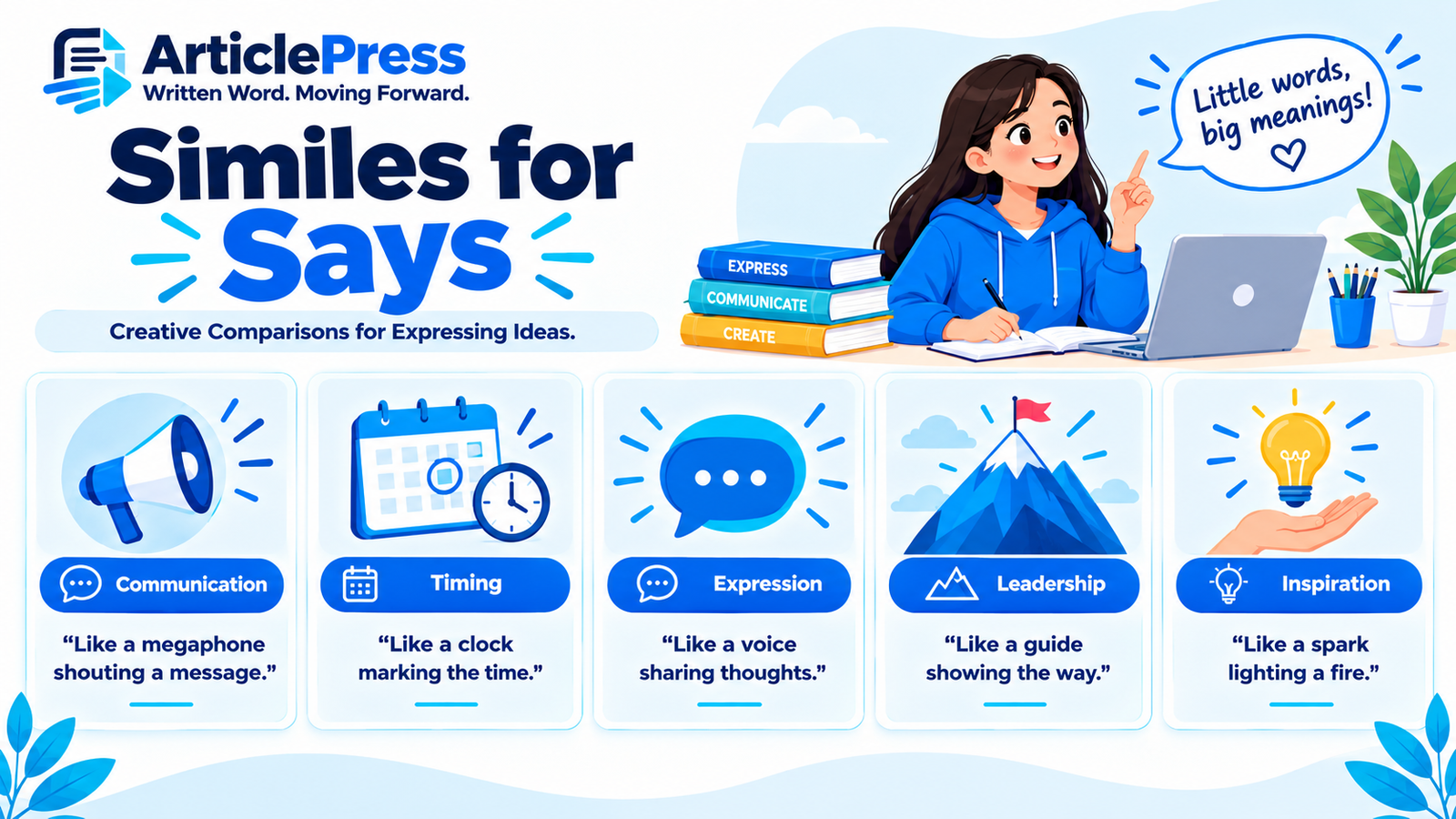
Looking for similes for says? The best comparisons describe how someone speaks, whether their words sound gentle, loud, angry, cheerful, mysterious, or persuasive. For example, “She spoke like a gentle breeze” suggests a soft, soothing voice, while “He spoke like a roaring lion” conveys power and anger.
These comparisons can help you make dialogue more expressive and give readers a clearer sense of a character’s voice. Below are 25 similes for describing speech, with simple meanings, explanations, and example sentences you can use in your own writing.
What Does “Says” Mean in Descriptive Writing?
The word says means that someone expresses something through speech. It is a common dialogue tag used in stories, conversations, and written dialogue.
A simile compares two different things using words such as like or as. When describing someone who says something, a simile can show how their voice sounds, how their words affect others, or what their speaking style resembles.
For example:
- Plain: “She says the words softly.”
- Descriptive: “She says the words as softly as falling snow.”
The second sentence creates a clearer image of a quiet, gentle voice.
25 Best Similes for Says With Meanings and Examples
1. Says Like a Gentle Breeze
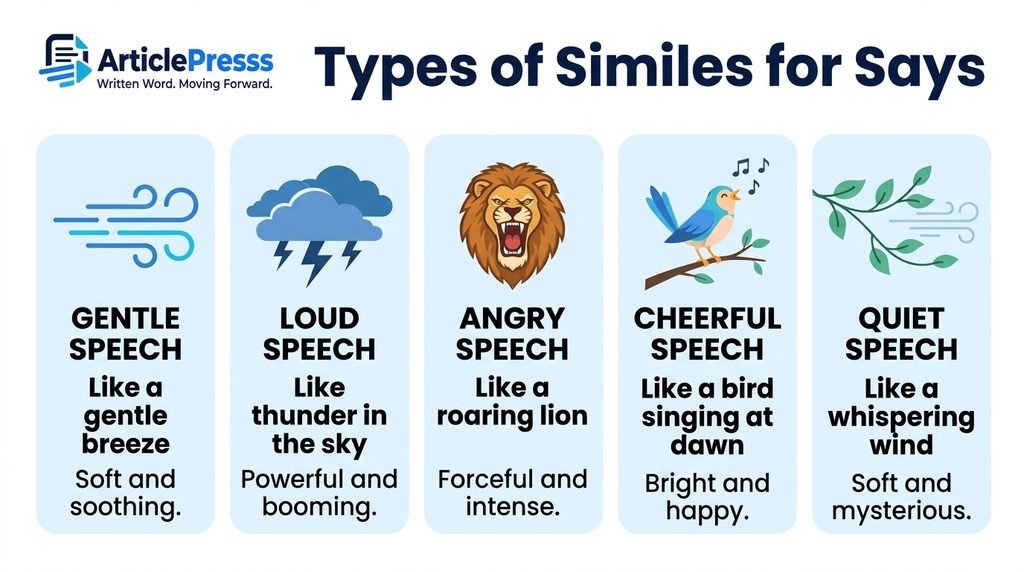
Meaning: Speaks softly, calmly, and pleasantly.
Why it works: A gentle breeze suggests peaceful movement and a soothing feeling, making it suitable for quiet conversations.
Example: “Everything will be all right,” she said like a gentle breeze, calming the worried child.
Best for: Comforting dialogue, peaceful scenes, and gentle characters.
2. Says Like a Roaring Lion
Meaning: Speaks loudly, boldly, or angrily.
Why it works: A lion’s roar suggests strength and authority, helping readers imagine a powerful voice.
Example: The coach spoke like a roaring lion when the players ignored his instructions.
Best for: Arguments, dramatic scenes, and commanding characters.
3. Says Like a Whispering Wind
Meaning: Speaks in a very quiet, delicate voice.
Why it works: The image of wind moving quietly through trees creates a mysterious or peaceful atmosphere.
Example: “Meet me after sunset,” he said like a whispering wind.
Best for: Secrets, suspense, and intimate conversations.
4. Says Like a Bird Singing at Dawn
Meaning: Speaks cheerfully, sweetly, and with energy.
Why it works: Birds singing in the morning suggest freshness, happiness, and a positive mood.
Example: She said good morning like a bird singing at dawn, brightening everyone’s day.
Best for: Happy characters, welcoming conversations, and uplifting scenes.
5. Says Like Thunder in the Sky
Meaning: Speaks with a deep, booming, or forceful voice.
Why it works: Thunder is powerful and difficult to ignore, making it a useful comparison for dramatic speech.
Example: “Everyone, stop talking!” the principal said like thunder in the sky.
Best for: Serious announcements, warnings, and intense scenes.
6. Says Like Honey Dripping From a Spoon
Meaning: Speaks in a sweet, smooth, and pleasant manner.
Why it works: Honey suggests sweetness and richness, creating an image of charming or affectionate speech.
Example: “You did a wonderful job,” she said like honey dripping from a spoon.
Best for: Compliments, romantic dialogue, and affectionate conversations.
7. Says Like a Machine Reading Instructions
Meaning: Speaks mechanically, without much emotion or expression.
Why it works: A machine follows a predictable pattern, suggesting speech that sounds flat or rehearsed.
Example: He said the announcement like a machine reading instructions, leaving the audience uninterested.
Best for: Bored characters, robotic dialogue, and monotonous presentations.
8. Says Like a Broken Record
Meaning: Repeats the same words or ideas again and again.
Why it works: A broken record is associated with repetitive playback, making it a familiar comparison for repeated speech.
Example: “Clean your room,” Mom said like a broken record until everyone finally listened.
Best for: Repetitive conversations, humorous scenes, and nagging dialogue.
9. Says Like a Teacher Explaining a Lesson
Meaning: Speaks clearly, patiently, and instructively.
Why it works: A teacher explaining a lesson suggests organized speech intended to help someone understand.
Example: He said each step like a teacher explaining a lesson to beginners.
Best for: Instructions, educational writing, and helpful characters.
10. Says Like a Firecracker Bursting
Meaning: Speaks suddenly, quickly, and with explosive energy.
Why it works: A firecracker creates an abrupt burst of sound, reflecting speech delivered with excitement or anger.
Example: “I won the competition!” she said like a firecracker bursting with excitement.
Best for: Surprising news, energetic dialogue, and emotional reactions.
11. Says Like a Calm Lake
Meaning: Speaks peacefully and without visible agitation.
Why it works: A calm lake suggests stillness and emotional balance.
Example: Even during the disagreement, he said his opinion like a calm lake reflecting the sky.
Best for: Peaceful characters, negotiations, and thoughtful conversations.
12. Says Like a Drumbeat
Meaning: Speaks with a firm, rhythmic, or forceful delivery.
Why it works: A drumbeat creates a steady rhythm and can suggest confidence or determination.
Example: “We will finish this project,” she said like a drumbeat that kept the team moving forward.
Best for: Motivational speeches, determined characters, and dramatic dialogue.
13. Says Like a Child Telling a Secret
Meaning: Speaks quietly, carefully, or with a sense of secrecy.
Why it works: A child sharing a secret suggests lowered voices and a desire to keep information private.
Example: He said the surprising news like a child telling a secret, checking that nobody else could hear.
Best for: Secrets, suspenseful stories, and private conversations.
14. Says Like a Bell Ringing Clearly
Meaning: Speaks distinctly, confidently, and in a way that attracts attention.
Why it works: A clear bell is easy to hear, making it a useful image for understandable speech.
Example: The speaker said every word like a bell ringing clearly across the room.
Best for: Public speaking, important announcements, and confident dialogue.
15. Says Like a Cat Hissing
Meaning: Speaks sharply, irritably, or threateningly.
Why it works: A cat’s hiss signals displeasure or a warning, helping establish tension between characters.
Example: “Stay away from my desk,” he said like a cat hissing at an intruder.
Best for: Hostile conversations, warnings, and tense scenes.
16. Says Like a River Flowing
Meaning: Speaks smoothly, continuously, and without frequent pauses.
Why it works: A flowing river suggests a natural, uninterrupted movement of words.
Example: She said her ideas like a river flowing through the valley, moving easily from one point to the next.
Best for: Storytelling, fluent speakers, and long explanations.
17. Says Like Ice Cracking
Meaning: Speaks in a cold, sharp, or emotionally tense manner.
Why it works: Cracking ice suggests sudden tension and a fragile sense of calm.
Example: “I thought you trusted me,” she said like ice cracking beneath someone’s feet.
Best for: Betrayal, emotional conflict, and suspenseful dialogue.
18. Says Like a Clock Ticking
Meaning: Speaks in a steady, measured, or repetitive rhythm.
Why it works: A ticking clock creates a regular pattern, suggesting controlled or predictable speech.
Example: He said the instructions like a clock ticking, repeating each step at the same pace.
Best for: Methodical characters, routine instructions, and scenes involving time pressure.
19. Says Like a Spark Igniting a Fire
Meaning: Speaks in a way that inspires excitement, action, or strong emotion.
Why it works: A spark can start a much larger fire, reflecting words that motivate people or change a situation.
Example: The captain spoke like a spark igniting a fire, inspiring the exhausted team to keep going.
Best for: Motivational dialogue, leadership, and turning points in stories.
20. Says Like a Feather Floating Down
Meaning: Speaks lightly, gently, and without force.
Why it works: A floating feather suggests softness and delicate movement.
Example: “You can take your time,” she said like a feather floating down onto the grass.
Best for: Reassuring conversations, gentle characters, and peaceful scenes.
21. Says Like a Judge Delivering a Verdict
Meaning: Speaks seriously, firmly, and with authority.
Why it works: A judge delivering a verdict suggests a final decision that carries weight.
Example: “The decision will stand,” the manager said like a judge delivering a verdict.
Best for: Formal discussions, decisive characters, and moments of judgment.
22. Says Like a Child Bursting With Questions
Meaning: Speaks eagerly, curiously, and with little restraint.
Why it works: An excited child asking questions suggests enthusiasm and an intense desire to learn.
Example: She said her thoughts like a child bursting with questions about a new discovery.
Best for: Curious characters, interviews, and lively conversations.
23. Says Like a Distant Echo
Meaning: Speaks faintly, as though the voice is far away or emotionally detached.
Why it works: An echo can sound distant and less immediate than the original voice.
Example: His reply came like a distant echo, barely reaching the people around him.
Best for: Lonely scenes, distant voices, and reflective storytelling.
24. Says Like a Knife Cutting Through Silence
Meaning: Speaks sharply and forcefully, immediately capturing attention.
Why it works: A knife cutting through something suggests a sudden, decisive action that interrupts the surrounding quiet.
Example: “Enough!” she said like a knife cutting through silence.
Best for: Confrontations, dramatic interruptions, and moments of sudden tension.
25. Says Like Sunshine Breaking Through Clouds
Meaning: Speaks warmly, hopefully, or reassuringly after a difficult moment.
Why it works: Sunshine emerging from clouds suggests relief, renewed hope, and a positive change in mood.
Example: “We still have a chance,” he said like sunshine breaking through clouds.
Best for: Encouraging conversations, emotional reunions, and hopeful endings.
Quick-Reference Table: Similes for Says
| Simile | Meaning | Best Used For |
|---|---|---|
| Like a gentle breeze | Soft and soothing | Comfort |
| Like a roaring lion | Loud and forceful | Anger or authority |
| Like a whispering wind | Quiet and mysterious | Secrets |
| Like a bird singing at dawn | Cheerful and lively | Happiness |
| Like thunder in the sky | Deep and booming | Announcements |
| Like honey dripping from a spoon | Sweet and charming | Affection |
| Like a machine reading instructions | Emotionless and flat | Monotony |
| Like a broken record | Repetitive | Humor or frustration |
| Like a bell ringing clearly | Clear and confident | Public speaking |
| Like a river flowing | Smooth and continuous | Storytelling |
| Like ice cracking | Cold and tense | Conflict |
| Like sunshine breaking through clouds | Hopeful and reassuring | Encouragement |
How to Use Similes for Says in Your Writing
The best simile depends on the character, situation, and emotion you want to communicate. A comparison that works in a tense argument may sound unnatural in a peaceful conversation.
1. Use Similes in Story Dialogue
Similes can make characters sound different from one another.
Plain sentence: “Leave me alone,” he said.
Improved sentence: “Leave me alone,” he said like a cat hissing at an intruder.
The comparison gives the character a defensive and hostile tone without requiring a long explanation.
2. Use Similes in Descriptive Writing
When describing speech, choose a comparison that matches the scene.
Example: Her words drifted like a gentle breeze through the quiet room.
This comparison creates a peaceful atmosphere and helps readers imagine the delivery of her words.
3. Use Similes in Poems
Poetry benefits from comparisons that create strong images or emotional associations.
Example: His promise rang like a bell across the silent night.
The bell suggests that his words are clear, memorable, and powerful.
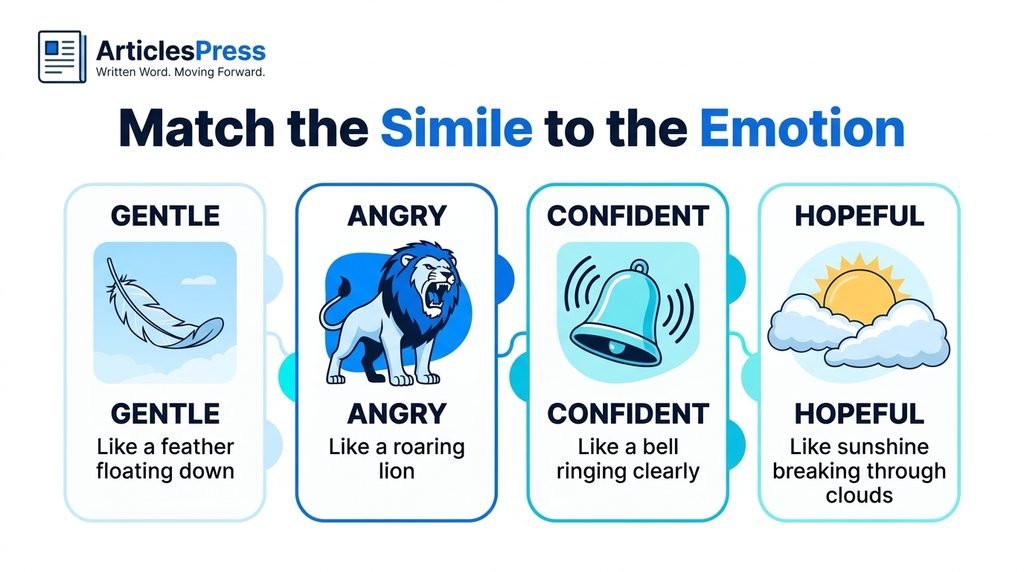
4. Match the Simile to the Emotion
Consider these differences:
- Gentle: “She spoke like a feather floating down.”
- Angry: “He spoke like a roaring lion.”
- Confident: “Her words rang like a clear bell.”
- Hopeful: “He spoke like sunshine breaking through clouds.”
Choose the image that supports the mood instead of adding a comparison merely to make the sentence longer.
5. Avoid Overusing Similes
One strong comparison can be more effective than several competing images.
For example, “He spoke like thunder in the sky” already communicates a powerful voice. Adding comparisons to a roaring lion, a bursting firecracker, and a ringing bell in the same sentence would make the description crowded.
Similes for Says vs. Other Ways to Describe Speech
Not every descriptive phrase involving says is a simile. Understanding the difference helps you write more accurately.
| Expression | Type | Example |
|---|---|---|
| Says like a roaring lion | Simile | He says it like a roaring lion. |
| Says angrily | Adverbial description | He says it angrily. |
| Shouts | Speech verb | He shouts across the room. |
| Says as softly as falling snow | Simile | She says the words as softly as falling snow. |
| Whispers | Speech verb | She whispers a secret. |
A simile creates a comparison using like or as. Words such as shouts, whispers, and murmurs describe speech directly but are not similes by themselves.
Frequently Asked Questions
1. What is a good simile for says?
A good simile for says is “speaks like a gentle breeze” when describing a soft, soothing voice. For forceful speech, “speaks like a roaring lion” works well. The best choice depends on the speaker’s tone, emotion, and the atmosphere of the scene.
2. What is a simile for someone speaking loudly?
“Speaks like thunder in the sky” is a useful simile for someone speaking loudly and forcefully. It creates an image of a booming voice that commands attention. You can use it in dramatic stories, speeches, and scenes involving anger or authority.
3. What is a simile for someone speaking softly?
“Speaks like a whispering wind” describes someone who speaks quietly and delicately. Another option is “speaks as softly as falling snow,” which suggests a gentle and peaceful voice. Both comparisons work well in quiet scenes and comforting conversations.
4. How can similes improve dialogue?
Similes help readers imagine how a character speaks and how their words affect others. Rather than simply stating that someone spoke angrily, you can compare their delivery to a roaring lion. This adds imagery, strengthens characterization, and makes dialogue more memorable.
5. Can I use similes for says in school assignments?
Yes. Similes can improve descriptive paragraphs, creative stories, and poetry assignments. Choose comparisons that are easy to understand and relevant to the situation. For formal essays, use them selectively and make sure they support your point rather than distract from it.
6. What is the difference between a simile and a speech verb?
A simile compares speech to another thing using like or as, as in “her voice sounded like a song.” A speech verb directly identifies how someone communicates, such as whispered, shouted, or murmured. Both can improve writing, but they serve different purposes.
Final Thoughts
Similes for says help writers turn ordinary dialogue into vivid descriptions of sound, emotion, and personality. Comparisons such as a gentle breeze, a roaring lion, and sunshine breaking through clouds can communicate softness, anger, or hope in just a few words.
When choosing a simile, consider how the speaker sounds, what they feel, and how you want readers to respond. Use gentle images for soothing conversations, powerful images for intense moments, and imaginative comparisons for memorable dialogue. Most importantly, keep your language natural. A well-chosen simile should make a character’s words easier to imagine, not distract readers from what the character is trying to say.

Sophia Bennett contributes to ArticlesPress with a focus on English grammar, vocabulary development, word usage, and language learning. She aims to make complex language concepts easier to understand through clear explanations, practical examples, and reader-friendly educational content.