A name can sound as sweet as a melody, stand out like a bright star, or feel as familiar as an old friend. Similes for names help writers describe how a name sounds, feels, or stands out to others. These comparisons can make character descriptions more vivid, improve poetry, and add personality to creative writing.
Whether you are describing a beautiful name, an unusual name, or a name that is easy to remember, the right simile can communicate your idea clearly. Below are 25 similes for names, complete with meanings and example sentences to help you use each comparison naturally.
What Is a Simile for a Name?
A simile for a name compares a name or its qualities to something else using words such as like or as. The comparison might describe how a name sounds, how memorable it is, or the emotions it creates.
For example, “Her name sounded like a gentle song” compares the sound of a name to music. Similarly, “His name stood out like a bright star” suggests that the name was noticeable and memorable.
25 Best Similes for Names With Meanings and Examples
These similes cover different qualities, from beautiful and musical names to unusual, powerful, and unforgettable ones. Choose the comparison that best matches the impression you want to create.
Beautiful and Sweet Similes for Names
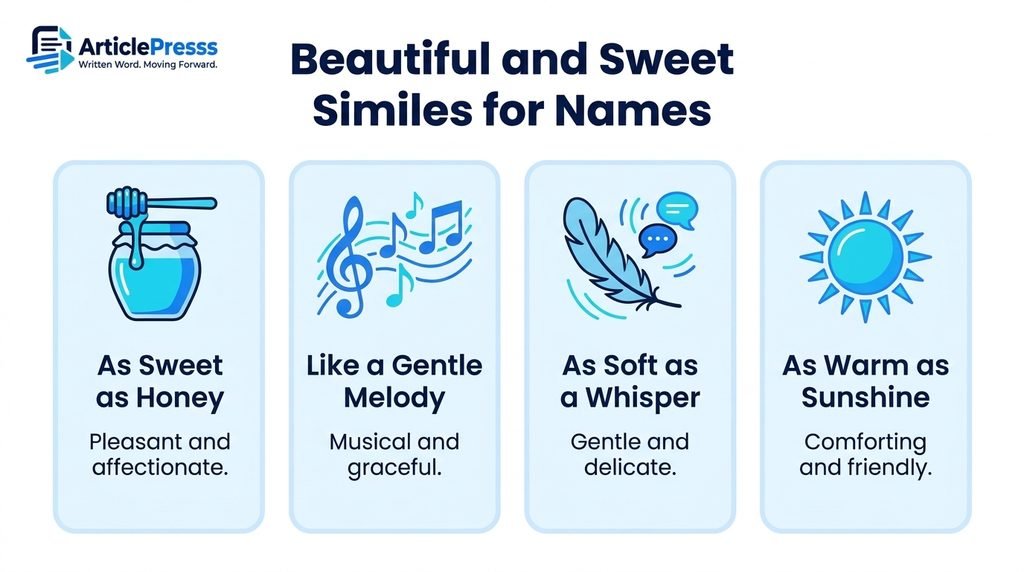
1. As sweet as honey
Meaning: A name that sounds pleasant, gentle, or affectionate.
Why it works: Honey suggests sweetness and warmth, making this comparison suitable for names with a soft, appealing sound.
Example: “Lily was as sweet as honey, and everyone loved hearing it.”
Best used for: Describing charming names in stories, poems, and personal writing.
2. Like a gentle melody
Meaning: A name that sounds smooth, musical, and pleasant to hear.
Why it works: A melody creates a sense of harmony, helping readers imagine a name with a graceful rhythm.
Example: “Her name flowed like a gentle melody whenever her grandmother spoke it.”
Best used for: Romantic writing, poetry, and descriptions of elegant names.
3. As soft as a whisper
Meaning: A name that sounds delicate, quiet, or gentle.
Why it works: A whisper suggests softness rather than loudness or force.
Example: “The name Elara was as soft as a whisper in the quiet room.”
Best used for: Gentle characters, peaceful scenes, and lyrical descriptions.
4. Like a rose in bloom
Meaning: A name that feels beautiful, graceful, or full of life.
Why it works: A blooming rose creates an image of beauty and freshness.
Example: “Her unusual name shone like a rose in bloom among ordinary introductions.”
Best used for: Describing names in romantic fiction or expressive poetry.
5. As warm as sunshine
Meaning: A name that creates feelings of comfort, happiness, or friendliness.
Why it works: Sunshine is commonly associated with warmth and brightness.
Example: “The name Emma felt as warm as sunshine to everyone in the family.”
Best used for: Family stories, affectionate descriptions, and positive character introductions.
Unique and Memorable Similes for Names
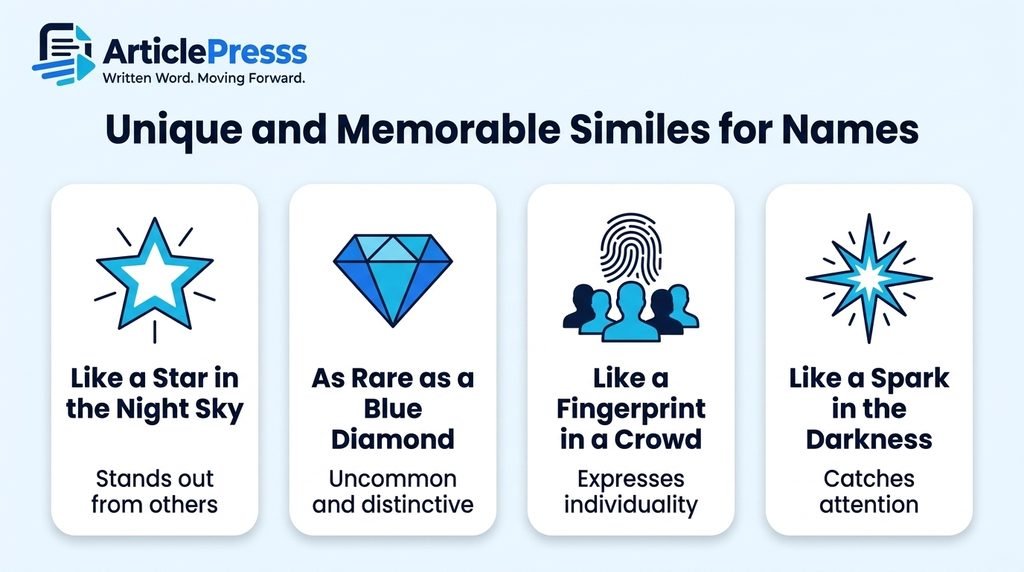
6. Like a star in the night sky
Meaning: A name that stands out from many others.
Why it works: A bright star is noticeable against a dark sky, creating a clear image of distinction.
Example: “Among the names on the class list, Zephyr stood out like a star in the night sky.”
Best used for: Unusual names, distinctive characters, and memorable introductions.
7. As rare as a blue diamond
Meaning: A name that feels uncommon or distinctive.
Why it works: Blue diamonds are rare and striking, making them a useful comparison for unusual names.
Example: “The name Aurelian was as rare as a blue diamond in his small hometown.”
Best used for: Fictional names, uncommon baby names, and distinctive characters.
8. Like a fingerprint in a crowd
Meaning: A name that feels individual and different from others.
Why it works: A fingerprint represents individuality, helping communicate the idea of a name that is not easily confused with another.
Example: “Her distinctive name was like a fingerprint in a crowd of familiar names.”
Best used for: Stories about identity, individuality, and self-expression.
9. As unforgettable as a first impression
Meaning: A name that leaves a lasting impression when someone hears it.
Why it works: First impressions are often remembered, making this comparison useful for emphasizing a name’s impact.
Example: “The name Cassian was as unforgettable as a first impression.”
Best used for: Character introductions, biographies, and storytelling.
10. Like a spark in the darkness
Meaning: A name that immediately attracts attention.
Why it works: A spark creates a sudden flash of light, suggesting that a name is striking or unexpected.
Example: “When she introduced herself as Nova, her name flashed like a spark in the darkness of the silent room.”
Best used for: Dramatic fiction and descriptions of bold, distinctive names.
Strong and Powerful Similes for Names
11. As bold as a lion’s roar
Meaning: A name that sounds strong, confident, or commanding.
Why it works: A lion’s roar suggests power and presence.
Example: “The name Maximus was as bold as a lion’s roar in the ancient kingdom.”
Best used for: Heroic characters, fantasy stories, and powerful fictional names.
12. Like thunder across the mountains
Meaning: A name that creates a powerful or dramatic impression.
Why it works: Thunder carries a strong sound across a wide space, suggesting a name that commands attention.
Example: “His warrior name echoed like thunder across the mountains.”
Best used for: Adventure stories, legends, and epic poetry.
13. As solid as an oak tree
Meaning: A name that feels dependable, strong, or firmly established.
Why it works: An oak tree symbolizes strength and stability.
Example: “The family name was as solid as an oak tree, carrying generations of tradition.”
Best used for: Family histories, heritage stories, and descriptions of respected names.
14. Like a drumbeat before a battle
Meaning: A name that sounds energetic, forceful, or full of anticipation.
Why it works: A drumbeat before a battle suggests courage, movement, and excitement.
Example: “The captain’s name rang like a drumbeat before a battle as the soldiers prepared to march.”
Best used for: Action scenes, historical fiction, and adventurous writing.
15. As commanding as a royal decree
Meaning: A name that sounds authoritative or important.
Why it works: A royal decree represents authority, giving the comparison a formal and powerful tone.
Example: “His full name sounded as commanding as a royal decree when the headmaster announced it.”
Best used for: Royal characters, formal settings, and historical or fantasy fiction.
Funny and Playful Similes for Names
16. Like a tongue twister on a windy day
Meaning: A name that is difficult to pronounce, especially when spoken quickly.
Why it works: A tongue twister challenges pronunciation, while the windy-day detail adds a playful exaggeration.
Example: “Trying to pronounce the fictional name Zbigniew was like a tongue twister on a windy day.”
Best used for: Lighthearted stories and humorous descriptions. Avoid using it to embarrass someone about their real name.
17. As catchy as a pop song
Meaning: A name that is easy to remember and repeats pleasantly in the mind.
Why it works: Catchy songs often stay in people’s memories after one or two listens.
Example: “The character’s name, Coco, was as catchy as a pop song.”
Best used for: Fictional characters, brand naming discussions, and playful writing.
18. Like a bouncing ball
Meaning: A name with a lively, energetic, or playful sound.
Why it works: A bouncing ball suggests movement and rhythm.
Example: “The cheerful nickname Pip moved through the conversation like a bouncing ball.”
Best used for: Children’s stories, energetic characters, and informal descriptions.
19. As unexpected as a clown at a wedding
Meaning: A name that surprises people in a particular situation.
Why it works: The comparison creates a humorous image of something unexpected appearing in a formal setting.
Example: “The villain’s unexpectedly cheerful alias was as surprising as a clown at a wedding.”
Best used for: Comedy and deliberately surprising fictional names.
20. Like popcorn popping in a pan
Meaning: A name that sounds lively, quick, or full of playful energy.
Why it works: Popping popcorn suggests a series of quick, energetic sounds.
Example: “The playful name Bibi bounced through the room like popcorn popping in a pan.”
Best used for: Children’s writing, nicknames, and humorous character descriptions.
Emotional and Meaningful Similes for Names
21. Like an old friend at the door
Meaning: A name that creates a sense of familiarity and comfort.
Why it works: Seeing an old friend can bring back positive memories and a feeling of belonging.
Example: “After years away, hearing her childhood nickname felt like an old friend at the door.”
Best used for: Nostalgic stories, family memories, and emotional scenes.
22. As precious as a family heirloom
Meaning: A name that carries deep family or cultural significance.
Why it works: A family heirloom represents something treasured and passed between generations.
Example: “The name Daniel was as precious as a family heirloom because it had belonged to his grandfather.”
Best used for: Family histories and stories about heritage or tradition.
23. Like a bridge to the past
Meaning: A name that connects someone to family history, culture, or earlier generations.
Why it works: A bridge links two places, making it a natural image for a name that connects past and present.
Example: “Her traditional surname was like a bridge to the past, preserving her family’s history.”
Best used for: Memoirs, cultural writing, and stories about identity.
24. As comforting as a familiar lullaby
Meaning: A name that creates a peaceful, reassuring feeling.
Why it works: A familiar lullaby is associated with rest, safety, and childhood memories.
Example: “To the homesick traveler, hearing his mother’s voice say his name was as comforting as a familiar lullaby.”
Best used for: Emotional fiction, family scenes, and reflective writing.
25. Like a message carried by the wind
Meaning: A name that travels from one person to another or seems to carry a story beyond its original setting.
Why it works: Wind suggests movement and distance, making this a poetic way to describe a name that spreads or lingers in memory.
Example: “The explorer’s name traveled like a message carried by the wind, reaching villages far beyond his home.”
Best used for: Poetry, legends, historical fiction, and stories about lasting reputations.
Quick-Reference Table: Similes for Names
| Simile | Meaning | Best Used For |
| As sweet as honey | Pleasant and affectionate | Warm descriptions |
| Like a gentle melody | Musical and graceful | Poetry |
| As soft as a whisper | Delicate and quiet | Gentle characters |
| Like a star in the night sky | Noticeable and distinctive | Unique names |
| As rare as a blue diamond | Uncommon | Fictional names |
| Like a fingerprint in a crowd | Individual | Identity and character |
| As bold as a lion’s roar | Strong and confident | Heroic characters |
| As solid as an oak tree | Dependable and established | Family names |
| As catchy as a pop song | Easy to remember | Nicknames |
| Like an old friend at the door | Familiar and comforting | Nostalgic writing |
| As precious as a family heirloom | Deeply valued | Heritage stories |
| Like a bridge to the past | Connected to history | Cultural writing |
How to Use Similes for Names in Creative Writing
A good simile does more than make a sentence sound decorative. It helps readers understand the impression a name creates in a particular situation.
1. Match the simile to the character
Think about the personality or role of the person whose name you are describing.
For a confident hero, you might write:
“His name sounded as bold as a lion’s roar.”
For a gentle character, a better choice could be:
“Her name flowed like a gentle melody.”
The comparison should support the character rather than distract from the story.
2. Describe the sound of the name
If the sound matters, choose a comparison connected to music, rhythm, or volume.
- “The name flowed like a river.”
- “Her nickname was as catchy as a pop song.”
- “His name sounded like a bell ringing through a quiet hall.”
These examples focus on how a name sounds when spoken aloud.
3. Show what the name means to someone
Names can carry memories and emotions. A simile can communicate those feelings without a lengthy explanation.
For example:
“To her, the name Grandma was as comforting as a familiar lullaby.”
This sentence describes an emotional connection rather than the literal sound of the word.
4. Use similes carefully in academic writing
For school essays, keep your comparisons clear and relevant. A simple sentence such as “The family name was like a bridge to the past” can explain an idea effectively.
In formal research or factual writing, avoid overly poetic comparisons when a direct explanation would be clearer.
Similes Using “Like” and “As” to Describe Names
Both structures can create effective comparisons, but they work in slightly different grammatical patterns.
Using “like”: Compare the name to an image or experience.
- Her name sounded like a gentle melody.
- The unusual surname spread like a whisper through the village.
- His nickname bounced like a ball across the playground.
Using “as”: Often compare a quality by using the pattern “as + adjective + as.”
- Her name was as sweet as honey.
- The family name was as solid as an oak tree.
- His chosen name was as memorable as a first impression.
Choose whichever structure sounds natural in the sentence. You do not need to force both forms into every description.
Common Mistakes When Writing Similes for Names
- Confusing similes with metaphors. “Her name was music” is a metaphor. “Her name was like music” is a simile.
- Using a comparison that does not fit. A gentle name may not suit an image associated with aggression unless the contrast is intentional.
- Overloading a sentence. One clear comparison is often stronger than three competing similes.
- Ignoring context. A funny comparison might work in a children’s story but feel out of place in a serious family memoir.
- Making assumptions about real names. A name’s cultural meaning, pronunciation, or emotional significance can vary. Avoid implying that an unfamiliar name is inferior or inherently difficult.
7. FAQ Section
1. What is a good simile for a name?
A good simile is “Her name sounded like a gentle melody.” It describes a name as musical and pleasant to hear. You can also use “as sweet as honey” for a name that feels warm and affectionate.
2. What is a simile for a unique name?
“Her name stood out like a star in the night sky” is a useful simile for a distinctive name. It suggests that the name attracts attention and is easy to remember among many familiar names.
3. What is a simile for a beautiful name?
“Her name was as sweet as honey” is a simple simile for a beautiful-sounding name. For a more poetic description, try “Her name flowed like a gentle melody.”
4. How do you describe a name using a simile?
First, decide what you want to describe: the name’s sound, uniqueness, emotional meaning, or impression. Then compare that quality to something familiar. For example, “His name was as solid as an oak tree” suggests strength and dependability.
5. Can you use similes for names in poetry?
Yes. Similes can make a name more vivid and expressive in poetry. A line such as “Your name drifts like a melody across the evening air” creates an image of sound, movement, and memory.
6. What is a funny simile for a name?
“The name was as catchy as a pop song” is a playful comparison for a memorable name. For a humorous description of pronunciation, “like a tongue twister on a windy day” adds exaggeration without needing to insult anyone.
7. What is the difference between a simile and a metaphor when describing names?
A simile uses words such as like or as to make a comparison: “Her name sounded like music.” A metaphor makes a direct comparison: “Her name was music.” Both can make descriptions more vivid, but they use different structures.
8. Practice Section: Create Your Own Similes for Names
Complete each sentence with a suitable comparison.
- Her name sounded as sweet as ______.
- His unusual name stood out like ______.
- The family surname was like ______ to their ancestors.
- The playful nickname bounced like ______.
- Hearing her childhood name felt as comforting as ______.
Suggested Answers
- Honey
- A star in the night sky
- A bridge to the past
- A bouncing ball
- A familiar lullaby
These answers are suggestions, not strict rules. You can create other comparisons if they make sense in context.
9. Conclusion: Choose the Right Simile for a Name
Similes for names can help you describe beauty, uniqueness, strength, humor, and emotional connection. Comparisons such as “like a gentle melody,” “as rare as a blue diamond,” and “like a bridge to the past” give readers a clearer impression of the name and the role it plays in a story.
The best simile depends on your purpose. Choose a musical comparison when sound matters, a vivid image when uniqueness matters, or an emotional comparison when a name represents a memory or relationship. Keep your wording natural, avoid unnecessary exaggeration, and make sure the comparison adds meaning to the sentence. You can also create original similes by identifying one quality of a name and comparing it with a familiar image.

James Wilson writes about similes, metaphors, figurative language, and descriptive writing at ArticlesPress. He creates practical examples and explanations to help students, teachers, and creative writers understand language techniques and use vivid comparisons in stories, poems, and essays