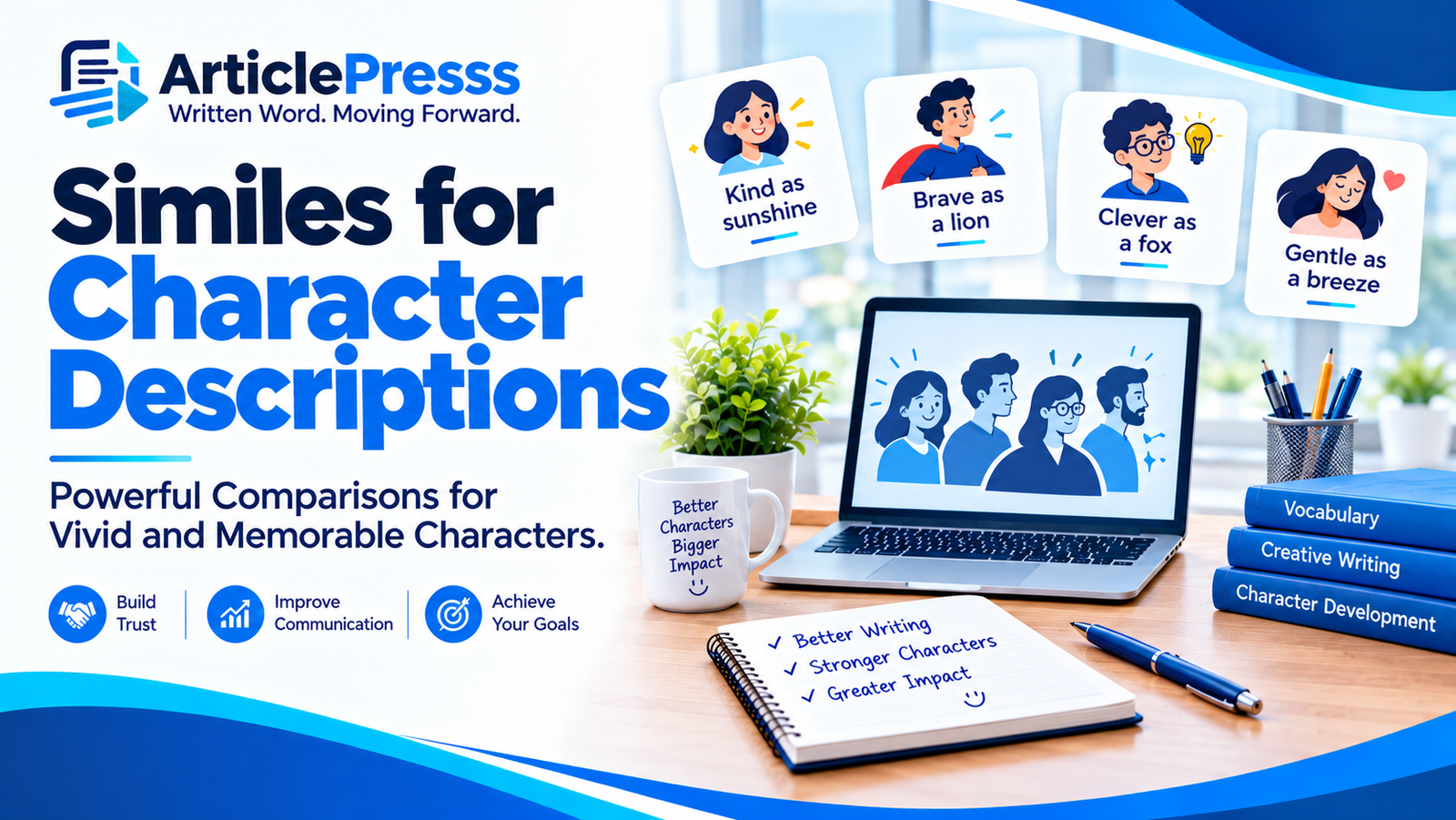
Similes for character descriptions help you bring people to life through vivid comparisons. You can describe someone as as brave as a lion, as quiet as a mouse, or like a lighthouse guiding ships through a storm. These comparisons reveal more than physical appearance; they can communicate personality, emotions, habits, strengths, and weaknesses.
Whether you’re writing a short story, developing a novel character, completing a school assignment, or creating a descriptive paragraph, the right simile can make your writing more memorable. Below, you’ll find 45 similes organized by personality, appearance, emotions, behavior, and creative storytelling, each with a meaning and an example sentence.
What Is a Simile for Character Description?
A simile for character description compares a person to something else using words such as like or as. It helps readers imagine what a person looks like, how they behave, or what kind of personality they have.
For example, “Maya was as stubborn as a mule” suggests that Maya refuses to change her mind. Similarly, “He moved like a shadow” creates an impression of someone who moves quietly and almost unnoticed.
A well-chosen simile gives readers a quick impression of a character without requiring a long explanation.
45 Best Similes for Character Descriptions
1. Similes for Personality Traits
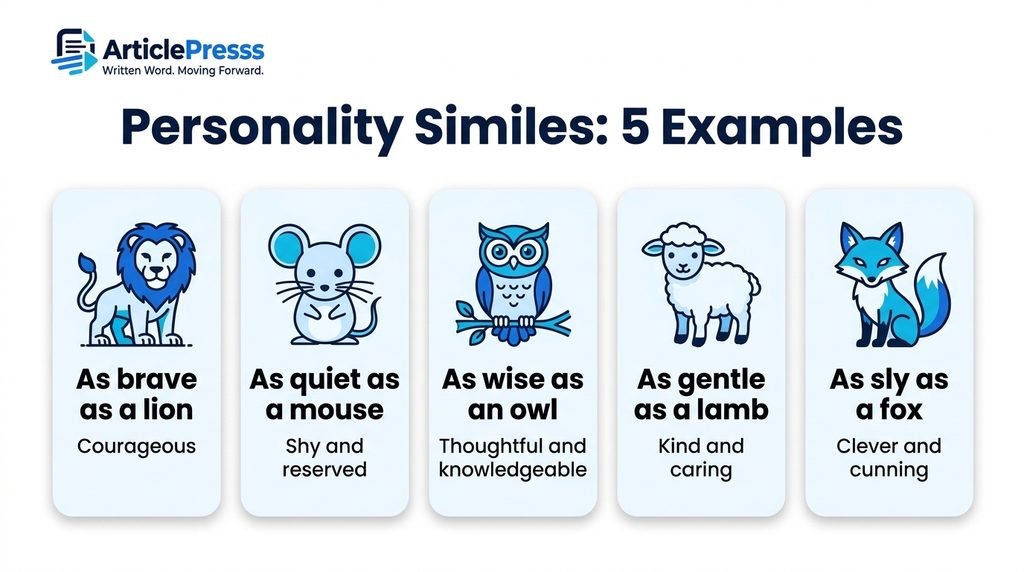
These comparisons help describe a character’s strengths, weaknesses, habits, and general nature.
1. As brave as a lion
Meaning: Extremely courageous, especially when facing danger or difficulty.
Example: Even when everyone else stepped back, Daniel stood his ground, as brave as a lion.
Best for: Heroes, courageous leaders, and characters who protect others.
2. As quiet as a mouse
Meaning: Very quiet, shy, or unwilling to attract attention.
Example: The new student sat as quiet as a mouse during her first day in class.
Best for: Shy students, reserved characters, and people who prefer to observe.
3. As stubborn as a mule
Meaning: Unwilling to change an opinion or decision.
Example: Oliver was as stubborn as a mule and refused to admit that he had made a mistake.
Best for: Determined, headstrong, or difficult characters.
4. As wise as an owl
Meaning: Showing good judgment, knowledge, or understanding.
Example: Whenever the team faced a difficult decision, they turned to their coach, who was as wise as an owl.
Best for: Mentors, teachers, elders, and thoughtful leaders.
5. As gentle as a lamb
Meaning: Kind, calm, and unlikely to hurt others.
Example: Despite his enormous size, the old gardener was as gentle as a lamb with the children.
Best for: Caring parents, kind friends, and compassionate characters.
6. As sly as a fox
Meaning: Clever and skillful at achieving goals, sometimes through deception.
Example: As sly as a fox, Marcus convinced both rivals to reveal their plans without sharing his own.
Best for: Cunning villains, clever strategists, and secretive characters.
7. As proud as a peacock
Meaning: Very pleased with oneself or eager to display one’s achievements.
Example: Wearing his newly won medal, Ethan walked into the hall as proud as a peacock.
Best for: Confident characters, boastful personalities, and people celebrating success.
8. Like a rock
Meaning: Emotionally strong, dependable, and difficult to discourage.
Example: During the family crisis, Grandma remained like a rock, offering comfort to everyone around her.
Best for: Reliable friends, supportive family members, and resilient leaders.
9. As curious as a cat
Meaning: Very eager to discover information or explore unfamiliar things.
Example: As curious as a cat, Priya opened every drawer in the abandoned workshop.
Best for: Young protagonists, detectives, inventors, and adventurous characters.
10. Like a breath of fresh air
Meaning: Refreshingly different, pleasant, or encouraging.
Example: After months of working with difficult managers, Lena felt like a breath of fresh air to her new team.
Best for: Positive leaders, friendly newcomers, and inspiring personalities.
2. Similes for Physical Appearance
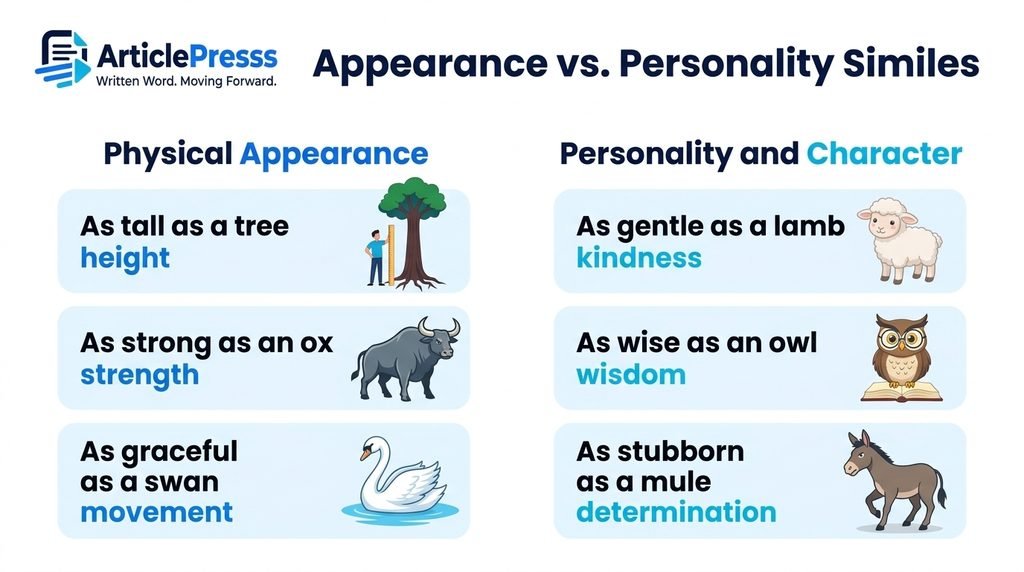
Use these comparisons to help readers picture a character’s features, posture, or presence. Focus on details that contribute to the scene rather than describing everything at once.
11. As tall as a tree
Meaning: Extremely tall.
Example: Standing beside his classmates, the basketball player looked as tall as a tree.
Best for: Tall athletes, towering guards, and physically imposing characters.
12. As thin as a rake
Meaning: Very thin.
Example: After weeks of hiking through the mountains, the traveler looked as thin as a rake.
Best for: Characters whose thinness is relevant to their circumstances or appearance.
13. As pale as a ghost
Meaning: Extremely pale, often because of fear, shock, or illness.
Example: When the lights suddenly went out, Noah turned as pale as a ghost.
Best for: Characters experiencing fright, surprise, or sudden distress.
14. As strong as an ox
Meaning: Exceptionally strong.
Example: Although he rarely spoke about his strength, the blacksmith was as strong as an ox.
Best for: Laborers, athletes, protectors, and physically powerful characters.
15. As bright as a button
Meaning: Alert, lively, or quick to understand things.
Example: The little girl was as bright as a button, answering every question before anyone else could speak.
Best for: Intelligent children, energetic students, and sharp-minded characters.
16. Like a statue
Meaning: Standing or sitting perfectly still.
Example: When the headmaster entered the room, Ben stood like a statue beside his desk.
Best for: Nervous students, guards, frightened characters, and people frozen by surprise.
17. Like a shadow
Meaning: Moving quietly and staying close to someone or something.
Example: The young detective followed the suspect like a shadow through the crowded market.
Best for: Spies, detectives, mysterious figures, and observant characters.
18. As graceful as a swan
Meaning: Moving smoothly, elegantly, and effortlessly.
Example: Amara crossed the stage as graceful as a swan, barely making a sound.
Best for: Dancers, elegant characters, and people with fluid movements.
3. Similes for Emotions and Feelings
Emotional similes reveal what a character is experiencing internally. They are especially useful when you want readers to feel the character’s mood rather than simply naming it.
19. As happy as a lark
Meaning: Extremely cheerful and full of joy.
Example: After receiving the acceptance letter, Sofia was as happy as a lark.
Best for: Celebrations, exciting news, and joyful moments.
20. As nervous as a cat on a hot tin roof
Meaning: Extremely anxious and unable to relax.
Example: Waiting outside the interview room, James was as nervous as a cat on a hot tin roof.
Best for: Interviews, auditions, competitions, and uncertain situations.
21. Like a volcano ready to erupt
Meaning: Filled with anger that may soon burst out.
Example: After hearing the unfair accusation, Mr. Reed looked like a volcano ready to erupt.
Best for: Characters suppressing anger, tense confrontations, and dramatic scenes.
22. As cold as ice
Meaning: Emotionally distant, unfriendly, or showing little sympathy.
Example: The manager was as cold as ice when he dismissed the employee’s concerns.
Best for: Unsympathetic antagonists, distant authority figures, and emotionally guarded people.
23. Like a balloon floating in the sky
Meaning: Feeling carefree, lighthearted, or free from worries.
Example: With the final exam behind her, Mia felt like a balloon floating in the sky.
Best for: Relief, freedom, and moments of happiness.
24. As restless as the wind
Meaning: Unable to remain still or settle down.
Example: Before the championship match, Leo was as restless as the wind, pacing from one end of the room to the other.
Best for: Impatient characters, anxious travelers, and people anticipating important events.
25. Like a storm trapped in a bottle
Meaning: Holding powerful emotions inside while trying to remain controlled.
Example: Elena smiled politely at the meeting, but inside she was like a storm trapped in a bottle.
Best for: Characters hiding anger, grief, frustration, or fear.
26. As gloomy as a rainy afternoon
Meaning: Looking or feeling sad and discouraged.
Example: After his closest friend moved away, Caleb seemed as gloomy as a rainy afternoon.
Best for: Lonely characters, disappointing moments, and reflective scenes.
27. Like a candle in the wind
Meaning: Appearing fragile or vulnerable in difficult circumstances.
Example: Alone in the unfamiliar city, the young traveler seemed like a candle in the wind.
Best for: Vulnerable protagonists, uncertain situations, and emotionally delicate moments.
4. Similes for Behavior and Actions
These similes describe how characters speak, move, react, or interact with others. They are particularly useful when showing personality through action.
28. Like a bull in a china shop
Meaning: Acting clumsily or carelessly in a delicate situation.
Example: Trying to organize the tiny art studio, Greg moved like a bull in a china shop.
Best for: Clumsy characters, awkward newcomers, and people who overlook details.
29. As busy as a bee
Meaning: Constantly active and occupied with tasks.
Example: Before the school festival, Aisha was as busy as a bee, arranging decorations and checking the guest list.
Best for: Hardworking students, organizers, and energetic characters.
30. Like a fish out of water
Meaning: Feeling uncomfortable or out of place in an unfamiliar situation.
Example: Wearing a formal suit at the casual beach party, Daniel felt like a fish out of water.
Best for: New students, outsiders, and characters facing unfamiliar environments.
31. As quick as lightning
Meaning: Moving or reacting extremely fast.
Example: As quick as lightning, Maya caught the glass before it hit the floor.
Best for: Athletes, quick thinkers, and characters who react rapidly.
32. Like a dog with a bone
Meaning: Refusing to give up on a task, question, or argument.
Example: The young journalist pursued the mystery like a dog with a bone until she uncovered the truth.
Best for: Determined investigators, persistent students, and relentless characters.
33. As slippery as an eel
Meaning: Difficult to catch, control, or pin down, especially when avoiding responsibility.
Example: Whenever the team asked who had lost the documents, their supervisor was as slippery as an eel.
Best for: Evasive suspects, dishonest characters, and clever escape artists.
34. Like a parrot repeating every word
Meaning: Repeating what others say without adding original thought.
Example: Instead of forming his own opinion, Kevin sounded like a parrot repeating every word his friends said.
Best for: Characters who imitate others or lack independent judgment.
35. Like a moth drawn to a flame
Meaning: Being strongly attracted to something despite possible danger.
Example: Despite knowing that the gambler would cause trouble, Nina returned to him like a moth drawn to a flame.
Best for: Risk-taking characters, complicated relationships, and people tempted by danger.
36. As steady as a clock
Meaning: Consistent, reliable, and regular in behavior.
Example: Every morning, Mr. Ellis arrived at the library as steady as a clock.
Best for: Dependable workers, disciplined students, and trustworthy characters.
5. Creative Similes for Complex Characters
These original comparisons can help make fictional characters more distinctive. They are especially useful for novels, short stories, and descriptive essays where familiar expressions might feel predictable.
37. Like a locked book with a missing key
Meaning: Difficult to understand because the person keeps their thoughts and feelings hidden.
Example: Daniel was like a locked book with a missing key, and even his closest friends struggled to understand him.
Best for: Mysterious protagonists, secretive characters, and emotionally guarded people.
38. As unpredictable as a changing sky
Meaning: Frequently changing moods or behavior without warning.
Example: One moment, Ava laughed with the group; the next, she walked away in silence, as unpredictable as a changing sky.
Best for: Volatile characters, complicated personalities, and dramatic stories.
39. Like a lighthouse in a storm
Meaning: Providing guidance, hope, or reassurance during difficult times.
Example: When the entire team began to panic, Coach Rivera stood like a lighthouse in a storm.
Best for: Mentors, wise leaders, and supportive friends.
40. Like a puzzle with pieces from different boxes
Meaning: Having a complicated personality that seems inconsistent or difficult to understand.
Example: With his quiet kindness, sudden temper, and unusual sense of humor, Felix was like a puzzle with pieces from different boxes.
Best for: Complex protagonists, morally ambiguous characters, and realistic fictional personalities.
41. As sharp as a needle
Meaning: Quick to notice details or make clever observations.
Example: As sharp as a needle, Detective Brooks noticed the muddy footprint everyone else had missed.
Best for: Detectives, strategists, perceptive students, and observant characters.
42. Like a bridge between two worlds
Meaning: Connecting people, communities, or different ways of thinking.
Example: Growing up in two cultures, Leila became like a bridge between two worlds, helping her friends understand one another.
Best for: Mediators, multicultural characters, and people who bring groups together.
43. As stubborn as a mountain rooted in the earth
Meaning: Extremely resistant to change or persuasion.
Example: Even after hearing every argument, the village elder remained as stubborn as a mountain rooted in the earth.
Best for: Strong-willed leaders, traditional characters, and people who refuse to compromise.
44. Like a spark in a room full of ashes
Meaning: Bringing energy, hope, or excitement into a dull or discouraged environment.
Example: When the new teacher arrived, her enthusiasm made her seem like a spark in a room full of ashes.
Best for: Inspiring newcomers, energetic leaders, and characters who revive a struggling group.
45. Like a compass pointing toward the truth
Meaning: Consistently seeking honesty and guiding others toward what is right.
Example: Even when the truth was uncomfortable, Amira acted like a compass pointing toward the truth.
Best for: Honest protagonists, principled leaders, and characters guided by strong values.
Quick-Reference Table: Choosing the Right Character Simile
| Character quality | Simile | Tone |
|---|---|---|
| Courage | As brave as a lion | Strong, positive |
| Shyness | As quiet as a mouse | Gentle |
| Intelligence | As wise as an owl | Respectful |
| Anger | Like a volcano ready to erupt | Intense |
| Mystery | Like a locked book with a missing key | Intriguing |
| Kindness | As gentle as a lamb | Warm |
| Unpredictability | As unpredictable as a changing sky | Uncertain |
| Reliability | As steady as a clock | Reassuring |
| Cleverness | As sly as a fox | Cunning |
| Leadership | Like a lighthouse in a storm | Hopeful |
| Clumsiness | Like a bull in a china shop | Humorous |
| Persistence | Like a dog with a bone | Determined |
How to Use Similes for Character Descriptions in Writing
A strong simile does more than decorate a sentence. It helps readers understand a character’s personality, behavior, or emotional state.
1. Match the simile to the character
Choose a comparison that reflects the specific quality you want to show.
Basic: Mark was brave.
Improved: Mark stood at the doorway, as brave as a lion, refusing to leave his younger brother behind.
The second sentence shows courage through the character’s actions.
2. Use similes to reveal emotions
Instead of naming an emotion directly, compare it to something readers can imagine.
Basic: Sarah was nervous.
Improved: Sarah paced the hallway like a restless bird trapped in a cage.
The comparison makes her anxiety visible through movement.
3. Combine similes with actions
Avoid relying on a comparison alone. Give readers a behavior that supports it.
Basic: James was as stubborn as a mule.
Improved: James was as stubborn as a mule; even after three failed attempts, he refused to abandon the broken machine.
The action demonstrates his persistence and stubbornness.
4. Choose comparisons that fit the tone
A humorous simile might suit a lighthearted story, while a more thoughtful comparison may work better in a serious novel.
- Funny: He entered the kitchen like a bull in a china shop.
- Emotional: She carried her sadness like a heavy coat she could not remove.
- Mysterious: He moved through the corridor like a shadow.
- Inspirational: She stood like a lighthouse in a storm.
5. Avoid overusing similes
Too many comparisons can make a character description feel crowded.
Instead of writing, “He was as tall as a tree, as strong as an ox, as brave as a lion, and as proud as a peacock,” choose one or two comparisons that matter most in the scene.
A single precise simile often creates a stronger impression than several competing images.
Similes for Character Descriptions vs. Direct Description
Both techniques are useful, but they serve different purposes.
| Direct description | Description using a simile |
|---|---|
| She was very quiet. | She was as quiet as a mouse. |
| He was extremely angry. | He looked like a volcano ready to erupt. |
| Maya moved gracefully. | Maya moved as gracefully as a swan. |
| The teacher was dependable. | The teacher was as steady as a clock. |
| He was difficult to understand. | He was like a locked book with a missing key. |
Direct description communicates information efficiently. Similes create imagery and help readers form an emotional impression. Use direct statements when clarity matters most and similes when a comparison adds something meaningful.
Frequently Asked Questions
1. What is a good simile for character description?
A good simile is “as brave as a lion” because it communicates courage quickly and clearly. Other useful choices include “as gentle as a lamb” for kindness, “as sly as a fox” for cleverness, and “like a lighthouse in a storm” for a person who provides guidance during difficult times.
2. What is a simile for a person’s personality?
A simile can compare a person’s personality to an animal, object, or natural phenomenon. For example, “as stubborn as a mule” describes someone who refuses to change their mind, while “as wise as an owl” suggests good judgment and thoughtful decision-making.
3. How do you describe a character using a simile?
Identify one important quality, choose a comparison that expresses it clearly, and place the comparison in a natural sentence. For example, instead of writing “Lena was observant,” you could write, “Lena was as sharp as a needle, noticing the missing key beneath the desk.”
4. What are some creative similes for fictional characters?
Creative options include “like a locked book with a missing key” for a mysterious person, “like a puzzle with pieces from different boxes” for a complicated personality, and “like a compass pointing toward the truth” for someone guided by honesty. These comparisons can make fictional characters feel more distinctive.
5. Can similes describe both appearance and personality?
Yes. Appearance-focused similes describe features, movement, or posture, such as “as tall as a tree.” Personality-focused similes describe traits or behavior, such as “as stubborn as a mule.” Some comparisons can suggest both physical and emotional qualities depending on their context.
6. How can students use similes in character descriptions?
Students can choose a character trait, find a familiar comparison, and use it in a complete sentence. For example, “My grandfather was as wise as an owl because he always gave thoughtful advice.” Adding an action or explanation helps readers understand why the comparison fits.
Conclusion
Similes for character descriptions help readers picture a person’s appearance, understand their personality, and connect with their emotions. Comparisons such as “as brave as a lion,” “as quiet as a mouse,” and “like a lighthouse in a storm” communicate different qualities in memorable ways.
The best simile depends on the character and the scene. Use gentle comparisons for kindness, vivid images for strong emotions, and original comparisons when you want a character to feel distinctive. You can also create your own by identifying a trait and connecting it to an image that expresses the same quality.
Remember to support each simile with meaningful actions and details. When a comparison fits naturally into the story, it helps readers see not only what a character is like but also why that character matters.

Sophia Bennett contributes to ArticlesPress with a focus on English grammar, vocabulary development, word usage, and language learning. She aims to make complex language concepts easier to understand through clear explanations, practical examples, and reader-friendly educational content.