
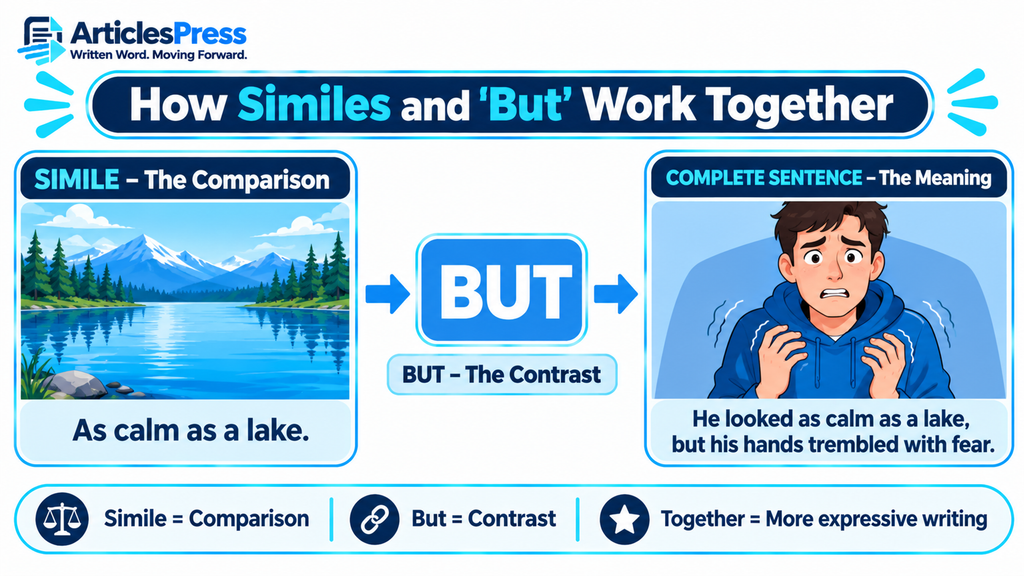
The word “but” helps connect two contrasting ideas, while a simile compares two different things using like or as. When you combine them, you can create sentences that show a difference between someone’s appearance and behavior, a situation and its outcome, or an expectation and reality.
For example, “He looked as calm as a lake, but his hands trembled with fear” uses a simile to describe calmness and but to reveal a surprising contrast. These sentence patterns can make stories, essays, and everyday descriptions more vivid and expressive.
What Does “But” Mean in a Simile Sentence?
“But” is a conjunction that introduces a contrast or an unexpected difference. It does not create a simile by itself. The simile comes from the comparison, while but connects that comparison to another idea.
Consider this sentence:
“She was as busy as a bee, but she still made time for her friends.”
The phrase “as busy as a bee” is the simile. The word “but” introduces an unexpected detail: despite being busy, she makes time for her friends.
20 Simile Examples Using “But” in Sentences
These examples show how to combine similes with but to create contrast, surprise, and more descriptive writing.
1. Similes for Contrasting Feelings
1. As happy as a child at Christmas, but worried about the future
Meaning: Someone feels excited but also has concerns.
Example: Maya was as happy as a child at Christmas, but she worried about starting her new school.
2. Like a storm at sea, but calm on the surface
Meaning: Someone hides intense emotions behind a composed appearance.
Example: He seemed calm during the meeting, like a storm at sea hidden beneath a quiet sky, but inside he felt overwhelmed.
3. As cold as ice, but warm at heart
Meaning: Someone may appear unfriendly while actually being kind.
Example: The old shopkeeper was as cold as ice when we first met, but he was warm at heart.
4. Like a broken record, but full of new ideas
Meaning: Someone repeats certain statements but still has creative thoughts.
Example: Our teacher reminded us about deadlines like a broken record, but she was full of new ideas for our project.
5. As nervous as a cat in a room full of dogs, but determined to succeed
Meaning: Someone feels frightened but refuses to give up.
Example: I was as nervous as a cat in a room full of dogs, but I presented my speech anyway.
2. Similes for Contrasting Appearances and Reality
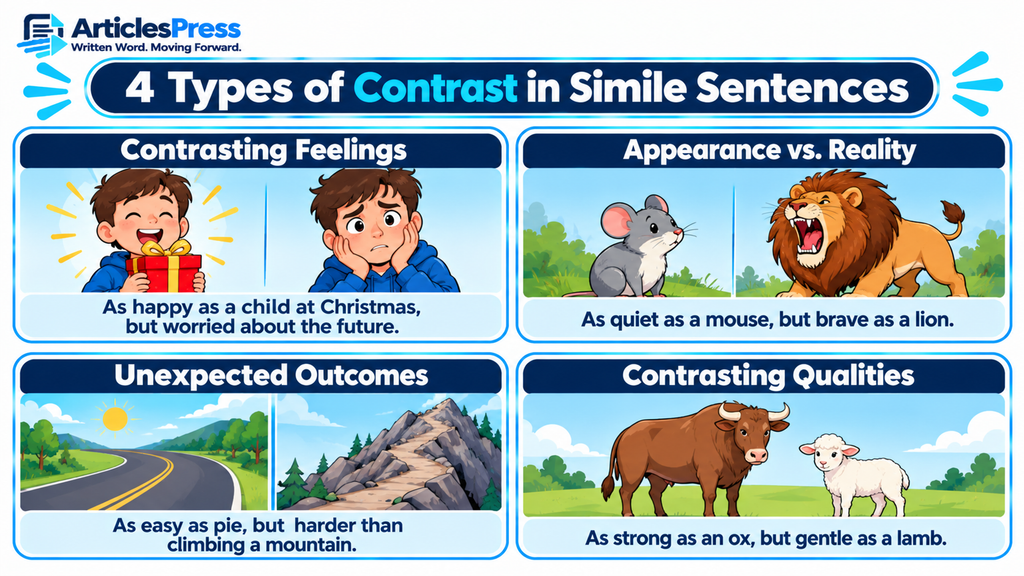
6. As quiet as a mouse, but brave as a lion
Meaning: Someone speaks little but shows great courage.
Example: Liam was as quiet as a mouse in class, but brave as a lion when he defended his friend.
7. Like a shining star, but grounded like an old tree
Meaning: Someone attracts attention without becoming arrogant.
Example: The young athlete shone like a star on the field, but remained grounded like an old tree.
8. As sweet as honey, but sharp as a thorn
Meaning: Someone speaks pleasantly but can also be cutting or critical.
Example: Her words were as sweet as honey, but her criticism was sharp as a thorn.
9. Like a glass vase, but strong as iron
Meaning: Someone appears delicate but has inner strength.
Example: She looked as fragile as a glass vase, but her determination was strong as iron.
10. As ordinary as a pebble, but precious as a diamond
Meaning: Something appears common but has great value.
Example: The little notebook looked as ordinary as a pebble, but its memories were precious as a diamond.
3. Similes for Unexpected Outcomes
11. As easy as pie, but harder than climbing a mountain
Meaning: Something seems simple but proves difficult.
Example: The assignment looked as easy as pie, but finishing it required more effort than climbing a mountain.
12. Like a walk in the park, but demanding as a marathon
Meaning: A task begins easily but requires considerable endurance.
Example: The first week of training felt like a walk in the park, but the final week was demanding as a marathon.
13. As bright as daylight, but confusing as a maze
Meaning: Something appears clear but remains difficult to understand.
Example: His explanation sounded as bright as daylight, but the instructions were confusing as a maze.
14. Like a smooth road, but full of bumps
Meaning: A plan seems straightforward but contains unexpected obstacles.
Example: Their business journey looked like a smooth road, but it was full of bumps along the way.
15. As light as a feather, but heavy on the heart
Meaning: Something weighs very little physically but causes emotional pain.
Example: The letter was as light as a feather, but its sad message felt heavy on my heart.
4. Similes for Contrasting Actions and Qualities
16. As fast as lightning, but careless as a rushing river
Meaning: Someone acts quickly but fails to pay attention to details.
Example: He finished the test as fast as lightning, but his careless mistakes cost him several points.
17. Like a bird in flight, but rooted like a tree
Meaning: Someone enjoys freedom while remaining connected to their home or values.
Example: She traveled the world like a bird in flight, but stayed rooted like a tree in her family traditions.
18. As strong as an ox, but gentle as a lamb
Meaning: Someone has great physical strength and a kind personality.
Example: The farmer was as strong as an ox, but gentle as a lamb with the animals.
19. Like a roaring engine, but quiet as falling snow
Meaning: Someone or something can be powerful yet peaceful in another setting.
Example: The machine roared like an engine during work, but the workshop was quiet as falling snow after closing time.
20. As stubborn as a mule, but flexible as a willow branch
Meaning: Someone holds firm beliefs but can adapt when necessary.
Example: Nina was as stubborn as a mule about her goals, but flexible as a willow branch when plans changed.
Quick Reference: Similes With “But”
| Simile phrase | Contrast expressed | Best use |
|---|---|---|
| As quiet as a mouse, but brave as a lion | Shyness and courage | Character descriptions |
| As cold as ice, but warm at heart | Appearance and kindness | Stories |
| As light as a feather, but heavy on the heart | Physical lightness and sadness | Poetry |
| As fast as lightning, but careless | Speed and accuracy | School writing |
| As strong as an ox, but gentle as a lamb | Strength and kindness | Descriptive writing |
| As easy as pie, but harder than climbing a mountain | Expectations and reality | Essays and stories |
How to Use Similes With “But” in Writing
A useful contrast sentence lets the reader notice a difference between two ideas. Follow these steps to make your sentence natural.
1. Choose the first quality
Decide what you want to describe, such as confidence, speed, kindness, fear, or difficulty.
2. Add a clear simile
Compare that quality to something familiar.
Example: “Her voice was as soft as silk.”
3. Introduce a meaningful contrast
Use but to reveal a different quality or unexpected outcome.
Improved sentence: “Her voice was as soft as silk, but her words carried the force of a thunderstorm.”
4. Check that both ideas make sense
The contrast should add meaning rather than confuse the reader. Avoid combining unrelated images just to make the sentence sound creative.
Writing tip: You do not need to use but after every simile. Sometimes a single comparison creates a stronger image. Use contrast when it reveals something important about the person, object, or situation.
Common Mistakes to Avoid
- Confusing a conjunction with a simile: But connects ideas; it is not itself a comparison.
- Creating an unclear contrast: Make sure readers understand how the two ideas differ.
- Overloading a sentence: One strong simile is often more effective than several competing comparisons.
- Using unnatural expressions: Choose familiar or clearly understandable comparisons.
- Ignoring punctuation: When joining two complete clauses with but, place a comma before the conjunction in standard writing.
Conclusion
Similes and the word but can work together to express surprising differences, mixed emotions, and contrasting qualities. A phrase such as “as quiet as a mouse, but brave as a lion” communicates more than either comparison might convey alone. To write your own examples, begin with a clear quality, choose an understandable comparison, and use but to introduce a meaningful contrast. This approach can make descriptive sentences more vivid in stories, poems, school assignments, and everyday communication.

The ArticlesPress editorial team writes and reviews every guide on similes and figurative language, with clear meanings and example sentences for students, teachers and writers.