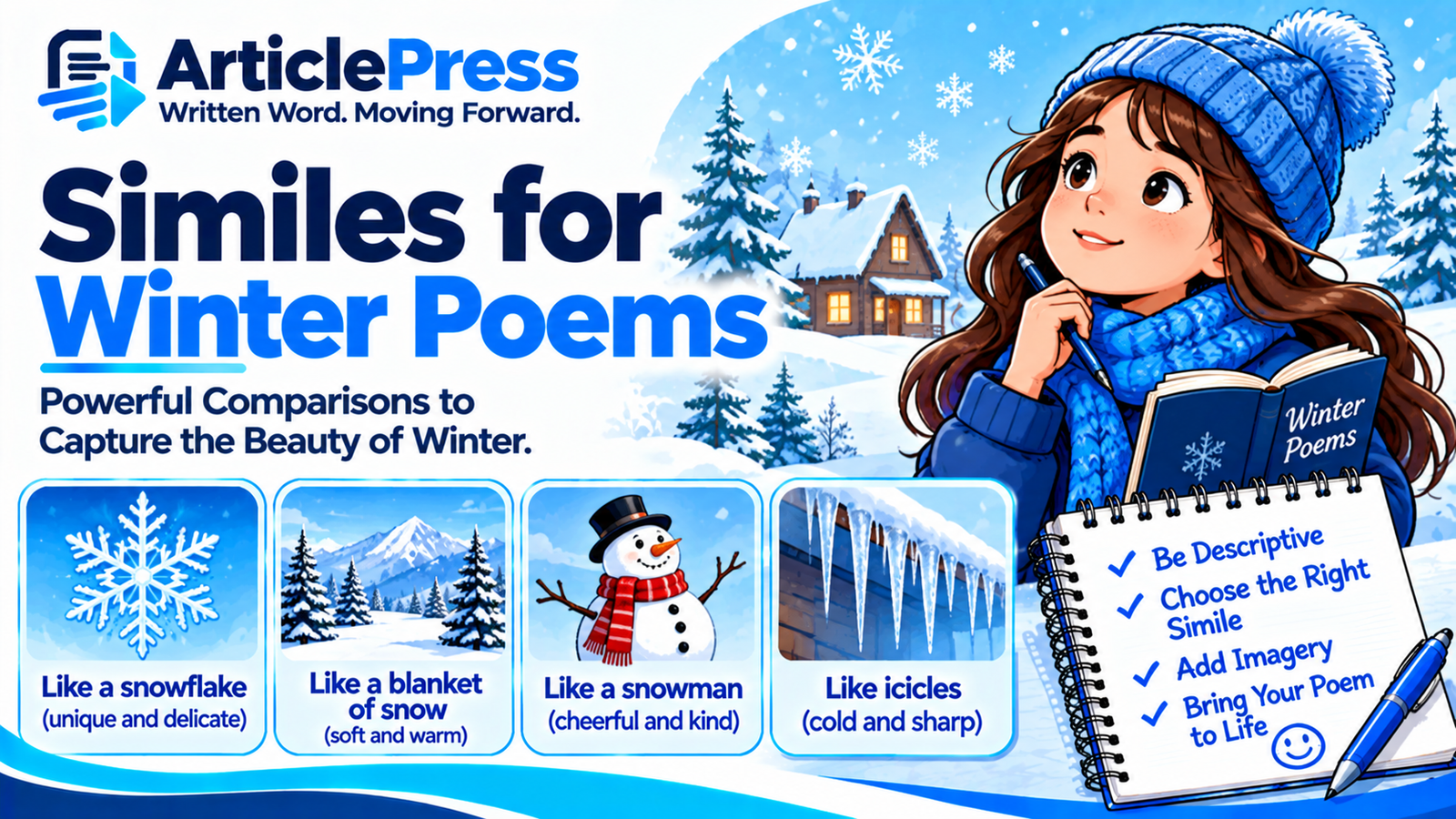
The best similes for winter poems compare snow to feathers, frost to delicate lace, icy winds to sharp whispers, and silent landscapes to sleeping worlds. These comparisons help poets turn cold weather into vivid imagery, create peaceful or mysterious moods, and describe the beauty of winter in memorable language.
Whether you’re writing a short poem for school, a reflective piece about a snowy morning, or a lyrical description of a freezing night, the following winter similes offer inspiration. Each example includes its meaning and a sentence showing how to use it naturally in poetry or descriptive writing.
What Is a Simile in a Winter Poem?
A simile compares two different things using like or as. In winter poetry, it helps readers imagine the appearance, sound, temperature, or mood of a cold-weather scene.
For example, “The snow fell like feathers from the sky” compares falling snow to soft feathers. This creates a gentle image of snow drifting slowly toward the ground.
A winter simile can describe more than the weather. It can also express loneliness, comfort, wonder, stillness, or the feeling of being surrounded by a frozen landscape.
35 Best Similes for Winter Poems
The examples below range from simple comparisons for school assignments to more imaginative expressions for creative poetry.
1. Beautiful Similes for Snow in Winter Poems
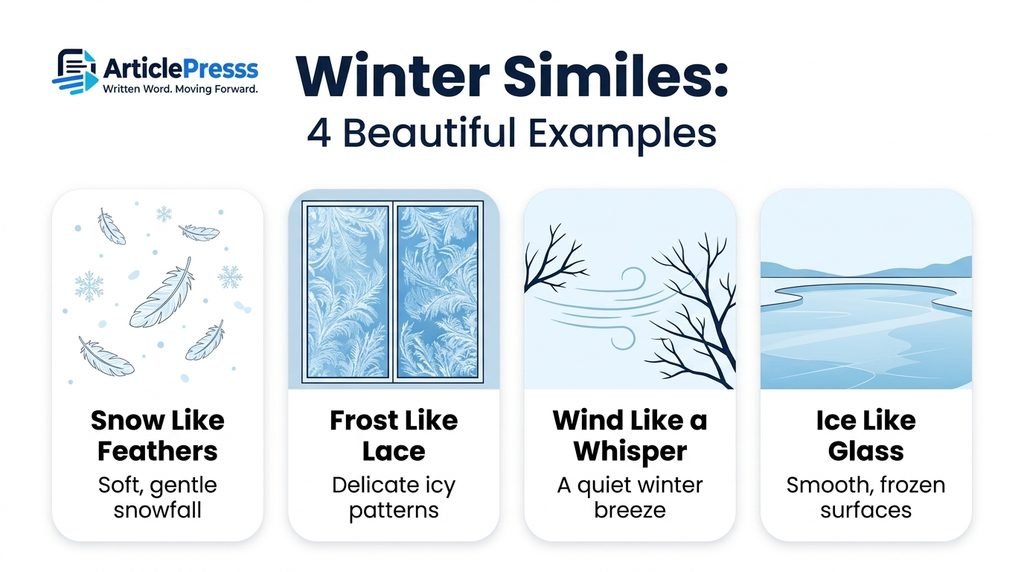
Snow offers poets a natural way to create images of softness, purity, silence, and transformation.
1. Snow fell like feathers from the sky
Meaning: Snowflakes drift gently downward, resembling soft feathers.
Example: Snow fell like feathers from the sky, covering the sleeping village in white.
Best for: Gentle snowfall and peaceful scenes.
2. The snow was as white as a sheet of paper
Meaning: The fresh snow looks bright, clean, and unmarked.
Example: The meadow was as white as a sheet of paper, waiting for the first footprints of morning.
Best for: Fresh snow and blank, untouched landscapes.
3. Snowflakes danced like tiny ballerinas
Meaning: Snowflakes move gracefully through the air.
Example: Snowflakes danced like tiny ballerinas beneath the golden streetlights.
Best for: Playful or magical winter poems.
4. The snow-covered trees stood like silent guards
Meaning: Snow-laden trees appear still and watchful.
Example: The snow-covered trees stood like silent guards along the road to the frozen lake.
Best for: Forest imagery and mysterious settings.
5. The snow sparkled like diamonds in the sunlight
Meaning: Sunlight makes the snow glimmer with tiny points of light.
Example: The morning snow sparkled like diamonds scattered across the sleeping field.
Best for: Bright, beautiful winter scenes.
2. Similes for Frost and Ice

Frost and ice give winter poetry sharper textures and more delicate details. These comparisons work especially well when describing windows, frozen lakes, branches, and grass.
6. Frost spread like lace across the window
Meaning: Frost forms delicate, intricate patterns on glass.
Example: Frost spread like lace across the window, hiding the garden beyond its silver threads.
Best for: Indoor winter scenes and delicate imagery.
7. The frozen lake was as smooth as glass
Meaning: The lake’s icy surface appears flat, clear, and polished.
Example: The frozen lake was as smooth as glass beneath the pale December sky.
Best for: Still landscapes and quiet poems.
8. Icicles hung like crystal swords
Meaning: Long, pointed icicles resemble sharp, transparent blades.
Example: Icicles hung like crystal swords from the roof, catching the cold afternoon light.
Best for: Dramatic or powerful winter imagery.
9. The frosted branches glittered like silver threads
Meaning: Frost gives bare branches a fine, silvery appearance.
Example: The frosted branches glittered like silver threads woven into the gray morning.
Best for: Elegant descriptions of winter trees.
10. The icy path was as slippery as a wet mirror
Meaning: The path is dangerously slick and difficult to walk on.
Example: The icy path was as slippery as a wet mirror, reflecting the dim light of dawn.
Best for: Realistic winter scenes and moments of tension.
3. Similes for Cold Winter Winds
Winter winds can feel gentle, restless, biting, or powerful. Choose a comparison that matches the intensity of the weather and the mood of your poem.
11. The wind howled like a lonely wolf
Meaning: The wind makes a long, mournful sound.
Example: The wind howled like a lonely wolf beyond the farmhouse door.
Best for: Lonely nights and stormy settings.
12. The cold air was as sharp as a knife
Meaning: The freezing air feels painfully biting against the skin.
Example: The cold air was as sharp as a knife, cutting through my scarf as I crossed the empty street.
Best for: Harsh weather and intense descriptions of cold.
13. The breeze whispered like a secret
Meaning: A gentle wind makes a soft, quiet sound.
Example: The breeze whispered like a secret through the bare branches of the old oak tree.
Best for: Gentle, mysterious, or reflective poems.
14. The blizzard roared like a hungry beast
Meaning: The storm sounds fierce and powerful.
Example: The blizzard roared like a hungry beast, swallowing the road beneath swirling snow.
Best for: Dramatic winter storms.
15. The wind moved like a restless ghost
Meaning: The wind seems to drift silently and eerily through the landscape.
Example: The wind moved like a restless ghost through the abandoned winter garden.
Best for: Gothic, eerie, or atmospheric poetry.
4. Similes for Winter Nights and Winter Skies
Winter skies can create feelings of wonder, loneliness, mystery, and calm. Use these comparisons to bring the sky, moon, stars, and darkness into your poem.
16. The moon shone like a silver coin
Meaning: The moon appears bright, round, and silvery.
Example: The moon shone like a silver coin above the snow-covered rooftops.
Best for: Moonlit winter scenes.
17. The stars glittered like scattered jewels
Meaning: The stars shine brightly across the dark sky.
Example: The stars glittered like scattered jewels in the deep blue winter night.
Best for: Beautiful nighttime imagery.
18. The winter sky was as pale as a pearl
Meaning: The sky has a soft, muted, silvery-white color.
Example: The winter sky was as pale as a pearl when dawn touched the distant hills.
Best for: Subtle colors and peaceful morning poems.
19. The darkness spread like spilled ink
Meaning: Night gradually covers the landscape in darkness.
Example: The darkness spread like spilled ink across the frozen fields.
Best for: Mysterious or somber poetry.
20. The sunset glowed like an ember in the snow
Meaning: The fading sunlight creates a small, warm-looking glow against the cold landscape.
Example: The sunset glowed like an ember in the snow, painting the horizon with fading orange light.
Best for: Contrasts between warmth and cold.
5. Similes for Winter Trees and Landscapes
Bare branches, frozen fields, and snow-covered hills can make winter landscapes seem quiet, ancient, or dreamlike.
21. The bare trees looked like skeletons against the sky
Meaning: Leafless branches resemble the thin, branching structure of skeletons.
Example: The bare trees looked like skeletons against the sky, their dark limbs reaching into the mist.
Best for: Stark, dramatic imagery. This comparison creates a slightly eerie mood.
22. The snow-covered hills rolled like waves across the land
Meaning: The rounded hills resemble waves frozen in place.
Example: The snow-covered hills rolled like waves across the land beneath the cloudy horizon.
Best for: Wide, sweeping landscapes.
23. The frozen meadow lay as quiet as a sleeping child
Meaning: The meadow seems peaceful, still, and undisturbed.
Example: The frozen meadow lay as quiet as a sleeping child beneath its blanket of snow.
Best for: Gentle poems about stillness and rest.
24. The pine trees stood like green islands in a white sea
Meaning: Dark evergreen trees rise above a broad expanse of snow.
Example: The pine trees stood like green islands in a white sea, breaking the silence of the valley.
Best for: Describing forests surrounded by snow.
25. The winter fields stretched like an endless blanket
Meaning: Snow-covered fields appear to extend far into the distance.
Example: The winter fields stretched like an endless blanket toward the mountains.
Best for: Vast, open countryside.
6. Emotional and Poetic Similes for Winter
Winter often represents more than a season. Poets use it to explore solitude, memory, hope, rest, and the promise of change.
26. Winter wrapped the world like a quiet blanket
Meaning: Winter covers the landscape in a way that feels soft and still.
Example: Winter wrapped the world like a quiet blanket, muffling every sound beneath the snow.
Best for: Comforting and peaceful poems.
27. The cold settled in my heart like a stone
Meaning: Coldness becomes a metaphor for emotional heaviness or sadness.
Example: The cold settled in my heart like a stone when your footsteps disappeared into the snow.
Best for: Poems about grief, separation, or loneliness.
28. Hope glimmered like a candle in a snowstorm
Meaning: Hope remains alive even in difficult circumstances.
Example: Hope glimmered like a candle in a snowstorm, small but steady against the darkness.
Best for: Resilience and hopeful endings.
29. Memories returned like snowflakes on the wind
Meaning: Memories arrive unexpectedly, one after another, like drifting snowflakes.
Example: Memories returned like snowflakes on the wind as I walked past our childhood home.
Best for: Nostalgic and reflective poetry.
30. Silence filled the valley like a held breath
Meaning: The landscape feels completely still, as though everything is waiting.
Example: Silence filled the valley like a held breath before the first flakes began to fall.
Best for: Suspenseful, meditative, or atmospheric poems.
7. Simple Winter Similes for Kids and School Poems
These easy comparisons use familiar images, making them suitable for elementary school poems, classroom activities, and beginner writers.
31. Snow is as soft as cotton
Meaning: Snow can look fluffy and soft.
Example: The fresh snow was as soft as cotton on the garden wall.
32. My hands were as cold as ice
Meaning: The hands felt extremely cold.
Example: After building a snowman, my hands were as cold as ice.
33. The snowman stood like a friendly giant
Meaning: The snowman looked large and welcoming.
Example: The snowman stood like a friendly giant beside our front door.
34. The snowflakes floated like tiny clouds
Meaning: Snowflakes drift slowly and lightly through the air.
Example: The snowflakes floated like tiny clouds above the playground.
35. The fireplace glowed like a little sun
Meaning: The fire produced a warm, bright light inside the house.
Example: The fireplace glowed like a little sun while winter winds rattled the windows.
These simple similes work particularly well in children’s poems because their images are easy to picture and their meanings are clear.
Quick-Reference Table: Winter Similes and Their Best Uses
Use this table to choose a comparison based on the image or mood you want to create.
| Simile | Main image | Best use |
| Snow fell like feathers | Softness | Gentle snowfall |
| Frost spread like lace | Delicate patterns | Winter windows |
| The wind howled like a lonely wolf | Loneliness | Stormy nights |
| The moon shone like a silver coin | Silver light | Night poems |
| Bare trees looked like skeletons | Stark shapes | Eerie landscapes |
| Silence filled the valley like a held breath | Stillness | Suspense |
| Hope glimmered like a candle in a snowstorm | Resilience | Hopeful endings |
| Winter wrapped the world like a quiet blanket | Comfort | Peaceful poems |
| The snow-covered hills rolled like waves | Curved landscapes | Nature poetry |
| The fireplace glowed like a little sun | Warmth | Cozy winter scenes |
How to Use Winter Similes in a Poem
A strong simile does more than describe what winter looks like. It helps readers experience the scene and feel its mood.
1. Choose the mood before choosing the simile
Decide what you want your reader to feel.
- Peaceful: “The snow fell like feathers from the sky.”
- Frightening: “The blizzard roared like a hungry beast.”
- Lonely: “The wind howled like a lonely wolf.”
- Hopeful: “Hope glimmered like a candle in a snowstorm.”
The same winter setting can feel comforting or threatening depending on the comparison you choose.
2. Replace plain descriptions with vivid comparisons
Compare these sentences:
Plain: The wind blew through the trees.
More poetic: The wind whispered like a secret through the bare branches.
The second sentence adds sound, movement, and mystery. Instead of simply telling readers what happened, it gives them an image to imagine.
3. Use sensory details
Winter poetry becomes more vivid when you describe what someone might see, hear, or feel.
- Sight: The frozen lake shone like a sheet of silver.
- Sound: The wind whistled like a distant flute.
- Touch: The air felt as sharp as a blade.
- Movement: Snowflakes swirled like dancers beneath the streetlights.
Choose details that fit your particular scene instead of adding several unrelated comparisons to one line.
4. Avoid overcrowding your poem
One carefully chosen simile can be more powerful than four comparisons competing for attention.
For example:
The moon shone like a silver coin above the sleeping town.
This single image establishes the light, setting, and quiet mood. You could weaken it by adding too many unrelated comparisons to the same line.
5. Create your own winter similes
| Winter detail | Possible comparison |
| Falling snow | White petals drifting from the clouds |
| Frost | Tiny feathers of glass |
| A frozen river | A ribbon of polished steel |
| A winter sunset | A fading coal beneath gray ashes |
| Bare branches | Fingers reaching toward the clouds |
Start with an ordinary winter detail and ask what it resembles.These are starting points for original writing. Adjust each comparison to match the rhythm, tone, and meaning of your poem.
Frequently Asked Questions
1. What is a good simile for winter?
“Winter wrapped the world like a quiet blanket” is a good simile for a peaceful winter scene. It suggests that snow and cold weather cover the landscape while creating a feeling of silence and rest.
2. What is a beautiful simile for snow?
“Snow fell like feathers from the sky” is a beautiful simile because it emphasizes the softness and gentle movement of falling snow. It works particularly well in lyrical poems about peaceful winter mornings.
3. What is a creative simile for winter?
“Frost spread like lace across the window” is a creative simile that compares delicate frost patterns to intricate fabric. It is especially effective in poems about winter mornings, old houses, or quiet indoor scenes.
4. How do you describe cold weather using a simile?
Compare cold weather with something that communicates its intensity or sensation. For example, “The air was as sharp as a knife” conveys biting cold, while “The breeze whispered like a secret” describes a softer, gentler wind.
5. What are some easy winter similes for students?
Simple examples include:
- Snow is as soft as cotton.
- My hands were as cold as ice.
- Snowflakes floated like tiny clouds.
- The fireplace glowed like a little sun.
These comparisons use familiar objects and clear imagery, making them suitable for school poems.
6. Can I use winter similes in free verse?
Yes. Similes work well in free verse because they do not require a fixed rhyme scheme or meter. You can use a comparison in a single line, spread its imagery across several lines, or make it the central image of the poem.
Suggested Internal Links for ArticlesPress
These related topics can help build a useful internal-linking cluster around seasonal imagery and figurative language.
| Suggested anchor text | Why it fits |
| Similes for Snow | Explores snow-specific comparisons in greater depth. |
| Similes for Cold | Covers the physical sensation of cold weather. |
| Similes for Wind | Expands on wind sounds, movement, and intensity. |
| Similes for Spring | Provides a contrasting seasonal topic. |
| Similes for Nature | Connects winter imagery to broader nature writing. |
Use these links only if the corresponding articles exist or are planned for publication. Add the links naturally where they help readers.
Potential Keyword-Cluster or Cannibalization Notes
- Similes for Winter Poems should focus on poetic imagery, mood, rhythm, and creative expression.
- Similes for Winter can cover a broader range of winter descriptions, including weather, clothing, activities, and everyday writing.
- Similes for Snow can focus specifically on snowfall, snow texture, snow-covered landscapes, and related imagery.
- Similes for Cold should emphasize the sensation of cold and its physical or emotional effects.
These topics have overlapping vocabulary but different potential search intents. Keep separate pages only when each provides enough distinctive value; otherwise, consider combining closely overlapping content.
Want more ideas? Try similes for liquid, similes for high or similes for spring.
Final Thoughts
The best similes for winter poems transform familiar scenes into images readers can see, hear, and feel. Snow can drift like feathers, frost can spread like lace, and winter winds can howl like lonely wolves. Each comparison creates a different atmosphere, from peaceful and comforting to mysterious and dramatic.
When choosing a simile, consider the emotion you want to express, the details of your setting, and the sound of the line when read aloud. You can also create original comparisons by connecting winter details with familiar objects, natural patterns, or human experiences. A thoughtful simile can make even a simple winter scene memorable.

The ArticlesPress editorial team writes and reviews every guide on similes and figurative language, with clear meanings and example sentences for students, teachers and writers.