
Business can be as competitive as a race, as connected as a spider’s web, and as unpredictable as the weather. Similes help describe how companies operate, how teams work together, and how businesses respond to challenges. These comparisons make business writing more engaging and easier to understand.
In this guide, you’ll find 45 similes for business, each with a meaning and an example sentence. Some describe leadership and teamwork, while others capture growth, competition, risk, and success. You can use them in business essays, presentations, speeches, stories, and everyday professional conversations.
What Is a Simile in Business?
A business simile compares a business, workplace, strategy, or professional situation to something else using words such as like or as. It helps readers picture an idea instead of simply reading an abstract description.
For example, “The startup grew like a weed” compares rapid business growth to the quick growth of a plant. Similarly, “The team was as coordinated as a well-rehearsed orchestra” describes employees working together smoothly.
Business similes can make complex ideas more relatable, but the comparison should match the message and tone.
45 Best Similes for Business With Meanings
The following examples cover common business situations, from launching a startup to managing employees and competing in a crowded market.
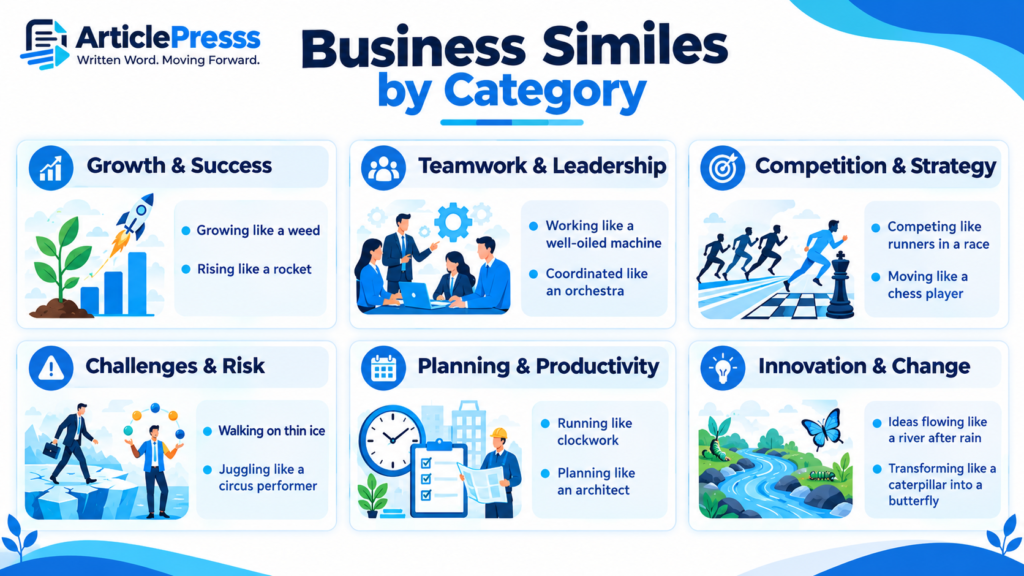
Similes for Business Growth and Success
These comparisons help describe progress, expansion, achievement, and positive business results.
1. Growing like a weed
Meaning: Expanding very quickly.
Example: The small online store was growing like a weed after its products went viral.
Best used for: Rapid growth in customers, sales, or business activity.
2. Rising like a rocket
Meaning: Increasing or improving at an extremely fast rate.
Example: After launching its new product, the company’s revenue rose like a rocket.
Best used for: Fast sales growth, rising demand, or sudden business success.
3. Thriving like a garden in spring
Meaning: Developing successfully under favorable conditions.
Example: With supportive leadership and clear goals, the new department thrived like a garden in spring.
Best used for: Healthy business development and a positive workplace culture.
4. Spreading like wildfire
Meaning: Growing or becoming known very quickly.
Example: News of the company’s innovative service spread like wildfire across the industry.
Best used for: Rapid publicity, brand awareness, or word-of-mouth marketing.
Quick tip: This simile emphasizes speed and widespread reach. It can also suggest that growth is difficult to control, so consider the context.
5. Shining like a beacon
Meaning: Standing out as a clear example of success or excellence.
Example: The company shone like a beacon of innovation in an industry full of outdated products.
Best used for: Describing a respected business, successful brand, or inspiring leader.
6. Building momentum like a rolling snowball
Meaning: Becoming increasingly successful as progress accumulates.
Example: Each satisfied customer brought new referrals, and the business gained momentum like a rolling snowball.
Best used for: Referral growth, customer loyalty, and compounding progress.
Similes for Teamwork and Leadership
These similes illustrate cooperation, leadership, coordination, and the relationships that help a business function.
7. Working like a well-oiled machine
Meaning: Operating smoothly and efficiently.
Example: After improving its workflow, the customer support department worked like a well-oiled machine.
Best used for: Efficient teams and organized operations.
8. Coordinated like an orchestra
Meaning: Working together in harmony, with each person contributing a different skill.
Example: The marketing, design, and sales teams collaborated like an orchestra performing a carefully rehearsed piece.
Best used for: Cross-functional teamwork and coordinated projects.
9. Connected like links in a chain
Meaning: Depending on one another to achieve a shared goal.
Example: Every department was connected like links in a chain, so a delay in one area affected the others.
Best used for: Explaining interdependence between teams or business processes.
10. Leading like a captain in a storm
Meaning: Guiding a team through uncertainty and difficult conditions.
Example: During the financial downturn, the CEO led like a captain in a storm, keeping employees focused on the recovery plan.
Best used for: Crisis leadership, resilience, and decision-making under pressure.
11. As steady as a lighthouse
Meaning: Remaining dependable and calm during uncertain situations.
Example: The manager was as steady as a lighthouse when the team faced an unexpected deadline.
Best used for: Reliable leadership and consistent guidance.
12. Supporting one another like the legs of a table
Meaning: Providing essential support that helps a group remain stable.
Example: The founders supported one another like the legs of a table, with each person bringing a different strength to the company.
Best used for: Business partnerships and complementary skills.
13. Communicating like an open book
Meaning: Sharing information clearly and honestly.
Example: The director communicated like an open book, explaining the budget changes and answering employees’ questions.
Best used for: Transparency, trust, and honest leadership.
Similes for Business Competition and Strategy
Use these comparisons when writing about competitors, market positioning, planning, and the pressure to perform.
14. Competing like runners in a race
Meaning: Trying to outperform others to reach a goal.
Example: Several technology companies competed like runners in a race to release the most advanced product.
Best used for: Market competition and product launches.
15. Moving like a chess player
Meaning: Acting carefully and strategically, while considering future consequences.
Example: The business owner moved like a chess player, anticipating competitors’ responses before changing prices.
Best used for: Strategic planning, negotiations, and calculated decisions.
16. Hunting for opportunities like a hawk
Meaning: Watching carefully for promising opportunities.
Example: The sales team searched for new markets like hawks scanning the landscape for movement.
Best used for: Sales prospecting, market research, and business development.
17. Standing out like a diamond in the rough
Meaning: Showing exceptional potential despite an ordinary or imperfect appearance.
Example: The small agency stood out like a diamond in the rough because of its creative ideas and personal service.
Best used for: Describing promising startups or overlooked businesses.
18. Fighting for market share like boxers in a ring
Meaning: Competing intensely for customers and sales.
Example: The two brands fought for market share like boxers in a ring, using promotions and product improvements to attract buyers.
Best used for: Aggressive competition and crowded industries.
19. Adapting like a chameleon
Meaning: Changing strategies to fit new circumstances.
Example: The retailer adapted like a chameleon when customer preferences shifted toward online shopping.
Best used for: Business flexibility and responding to market changes.
20. Navigating the market like a sailor at sea
Meaning: Making decisions while dealing with changing conditions and uncertainty.
Example: The founder navigated the market like a sailor at sea, adjusting the company’s plans as demand changed.
Best used for: Market analysis, uncertainty, and long-term planning.
Similes for Business Challenges and Risk
Business rarely follows a perfect plan. These comparisons help describe setbacks, uncertainty, pressure, and the effort required to solve problems.
21. Walking on thin ice
Meaning: Being in a risky or delicate situation.
Example: The company was walking on thin ice after missing several loan payments.
Best used for: Financial risk, fragile partnerships, or uncertain decisions.
22. Juggling like a circus performer
Meaning: Managing several responsibilities at the same time.
Example: The small-business owner was juggling like a circus performer, handling payroll, customer service, and marketing in one afternoon.
Best used for: Workload management and multitasking.
23. Facing a mountain of obstacles
Meaning: Dealing with many difficult challenges.
Example: The startup faced a mountain of obstacles, from limited funding to strict industry regulations.
Best used for: Business difficulties and complicated projects.
24. Stuck like a car in mud
Meaning: Unable to make progress despite continued effort.
Example: The project was stuck like a car in mud because the team lacked clear instructions.
Best used for: Delays, inefficient processes, and stalled projects.
25. Balancing like a tightrope walker
Meaning: Managing competing priorities without losing control.
Example: The manager balanced customer satisfaction and operating costs like a tightrope walker.
Best used for: Budget decisions, resource allocation, and work-life balance.
26. Under pressure like a boiling kettle
Meaning: Experiencing increasing stress that may soon become difficult to manage.
Example: The finance team was under pressure like a boiling kettle as the reporting deadline approached.
Best used for: Intense deadlines and mounting workplace stress.
27. Changing direction like a ship in rough seas
Meaning: Adjusting plans in response to difficult or unpredictable conditions.
Example: The company changed direction like a ship in rough seas when its main supplier suddenly closed.
Best used for: Unexpected setbacks and business restructuring.
Similes for Business Planning and Productivity
These comparisons describe organization, execution, priorities, and the systems that keep work moving.
28. Running like clockwork
Meaning: Operating with excellent timing and organization.
Example: Once the new scheduling system was introduced, daily operations ran like clockwork.
Best used for: Efficient routines and reliable processes.
29. Working like a beaver building a dam
Meaning: Working diligently to construct something useful over time.
Example: The development team worked like beavers building a dam, steadily creating the company’s new platform.
Best used for: Persistent effort and long-term projects.
30. Planning like an architect
Meaning: Designing a detailed plan before starting a project.
Example: The operations manager planned like an architect, mapping each stage before the expansion began.
Best used for: Project planning, business strategy, and organizational design.
31. Moving through tasks like a train on tracks
Meaning: Following an organized process with steady progress.
Example: With clearly assigned responsibilities, the team moved through its tasks like a train on tracks.
Best used for: Workflow management and meeting deadlines.
32. As precise as a Swiss watch
Meaning: Extremely accurate and carefully organized.
Example: The accounting department was as precise as a Swiss watch when preparing the quarterly reports.
Best used for: Accuracy, financial records, and quality control.
33. Cutting through red tape like a knife through butter
Meaning: Overcoming unnecessary bureaucracy with little difficulty.
Example: The experienced consultant cut through red tape like a knife through butter and helped the company complete its paperwork.
Best used for: Simplifying administrative tasks and removing obstacles.
34. Saving time like a shortcut through a crowded city
Meaning: Reducing the time needed to complete a task.
Example: The automated booking system saved time like a shortcut through a crowded city.
Best used for: Automation, productivity improvements, and efficient systems.
Similes for Business Relationships and Customer Service
Strong relationships can build trust, improve communication, and encourage customers to return. These comparisons help describe those connections.
35. As loyal as a faithful friend
Meaning: Remaining supportive and committed over time.
Example: The company treated its long-term customers like faithful friends, rewarding their loyalty with thoughtful service.
Best used for: Customer retention and lasting business relationships.
36. Spreading trust like roots through soil
Meaning: Building trust gradually until it supports the entire relationship.
Example: Through honest communication and dependable service, the agency spread trust like roots through soil.
Best used for: Client relationships, brand reputation, and partnerships.
37. Listening like a doctor examining a patient
Meaning: Paying close attention to understand a problem before offering a solution.
Example: The consultant listened like a doctor examining a patient before recommending changes to the client’s business.
Best used for: Client discovery, customer support, and needs analysis.
38. Connecting with customers like old friends
Meaning: Building warm, comfortable, and familiar relationships.
Example: The neighborhood café connected with customers like old friends by remembering their preferences and welcoming them personally.
Best used for: Personalized service and community-based businesses.
39. Resolving complaints like a firefighter putting out flames
Meaning: Responding quickly to stop a problem from becoming worse.
Example: The support team handled complaints like firefighters putting out flames, addressing urgent issues before they spread.
Best used for: Customer service recovery and reputation management.
40. Building partnerships like bridges between islands
Meaning: Connecting people or organizations that would otherwise remain separate.
Example: The trade agreement built partnerships like bridges between islands, helping businesses reach new customers.
Best used for: Networking, collaboration, and business development.
Creative Similes for Innovation and Business Change
These more imaginative comparisons are useful for describing new ideas, transformation, and the impact of technology.
41. Ideas flowing like a river after rain
Meaning: Producing a steady stream of ideas, often with increasing energy.
Example: During the brainstorming session, ideas flowed like a river after rain, giving the team several new product concepts.
Best used for: Innovation meetings and creative problem-solving.
42. Innovation spreading like ripples in a pond
Meaning: One new idea creating effects that reach many other areas.
Example: The company’s new payment system created ripples like a stone dropped into a pond, inspiring other departments to improve their processes.
Best used for: Organizational change and the wider impact of innovation.
43. Transforming like a caterpillar into a butterfly
Meaning: Changing significantly into a stronger or more developed version.
Example: After modernizing its services, the traditional retailer transformed like a caterpillar into a butterfly.
Best used for: Digital transformation, rebranding, and business recovery.
44. Spreading knowledge like seeds in fertile soil
Meaning: Sharing information that can grow into future skills and opportunities.
Example: The training program spread knowledge like seeds in fertile soil, helping employees develop new abilities.
Best used for: Staff training, mentoring, and professional development.
45. Breaking new ground like an explorer in unknown territory
Meaning: Doing something innovative that has not been attempted before.
Example: The small technology company broke new ground like an explorer in unknown territory by developing a fresh solution to an old problem.
Best used for: Entrepreneurship, research, and pioneering products.
Quick-Reference Table: Business Similes and Their Meanings
Use this table to find a comparison that matches your message.
| Simile | Meaning | Best Used For |
|---|---|---|
| Growing like a weed | Expanding quickly | Business growth |
| Rising like a rocket | Increasing rapidly | Sales and revenue |
| Working like a well-oiled machine | Operating efficiently | Teamwork |
| Coordinated like an orchestra | Working in harmony | Collaboration |
| Moving like a chess player | Acting strategically | Planning |
| Walking on thin ice | Facing risk | Financial decisions |
| Juggling like a circus performer | Managing many tasks | Workload |
| Running like clockwork | Operating smoothly | Productivity |
| As precise as a Swiss watch | Being highly accurate | Quality control |
| Adapting like a chameleon | Responding to change | Flexibility |
| As steady as a lighthouse | Remaining dependable | Leadership |
| Ideas flowing like a river after rain | Generating many ideas | Innovation |
| Transforming like a caterpillar into a butterfly | Changing significantly | Business transformation |
| Connecting like links in a chain | Depending on one another | Business processes |
| Building partnerships like bridges between islands | Connecting separate groups | Networking |
How to Use Business Similes in Writing
The best simile makes a business idea easier to understand without distracting the reader. Choose a comparison that matches your audience, purpose, and tone.
1. In business presentations
Use familiar comparisons to make complex ideas more memorable.
Plain: Our operations became more efficient after automation.
With a simile: After automation, our operations ran like clockwork.
The second sentence gives the audience a clearer picture of smooth, reliable work.
2. In business essays and reports
Choose comparisons that explain your point rather than replace important facts.
Example: The startup was walking on thin ice because its expenses continued to exceed its income.
The simile communicates risk, while the explanation provides the reason behind it.
3. In creative writing
Use vivid comparisons to help readers imagine a company’s culture, a manager’s personality, or a difficult negotiation.
Example: The founder navigated the market like a sailor at sea, watching every shift in demand before changing course.
This creates a stronger image than simply saying the founder was cautious.
4. In marketing and brand storytelling
Positive similes can make a brand sound dependable, innovative, or customer-focused.
Example: Our support team works like a well-oiled machine, helping customers receive timely answers.
Only use a comparison when it accurately reflects the service you provide. Overstated claims can make marketing copy less credible.
5. In professional communication
Use similes sparingly in formal emails and reports. Expressions such as “running like clockwork” are usually clear and approachable, while elaborate comparisons may sound out of place in a short business message.
Tip: If the comparison draws more attention than the business point, simplify it.
Common Mistakes When Using Business Similes
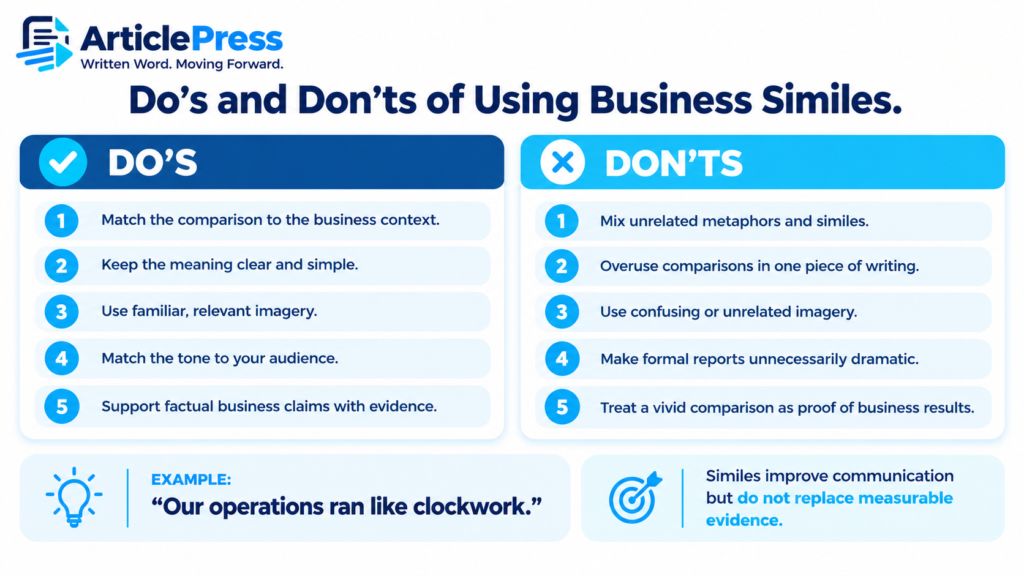
- Mixing metaphors and similes: “Our team is a well-oiled machine” is a metaphor. “Our team works like a well-oiled machine” is a simile.
- Choosing a mismatched comparison: A phrase about racing may not suit a paragraph about careful, patient relationship-building.
- Overusing familiar expressions: Common phrases can be useful, but too many make writing predictable.
- Using dramatic language in formal reports: A colorful comparison may distract readers who need precise information.
- Treating comparisons as evidence: Saying a company grew “like a rocket” sounds vivid, but actual sales figures are needed to demonstrate growth.
Frequently Asked Questions
1. What is a good simile for business?
“Business is like a race” is a simple, effective simile for competition. If you want to describe efficiency, “the team works like a well-oiled machine” is a stronger choice. The best comparison depends on whether you are discussing growth, teamwork, risk, leadership, or strategy.
2. What is a simile for business success?
“Growing like a weed” describes rapid expansion, while “shining like a beacon” describes a business that stands out as a model of excellence. Use the first for speed and the second for reputation or achievement.
3. What is a simile for teamwork in business?
“The team worked like a well-oiled machine” describes smooth cooperation and efficient performance. “The departments coordinated like an orchestra” emphasizes how people with different skills work together toward a common goal.
4. What is a creative simile for business growth?
“The business gained momentum like a rolling snowball” describes how early progress can lead to further growth. It works particularly well when new customers attract referrals and those referrals bring in additional customers.
5. Can business similes be used in professional writing?
Yes. Familiar similes can make presentations, articles, speeches, and reports more engaging. However, formal financial and analytical documents should prioritize precise language and evidence. Use figurative comparisons to clarify a point, not to replace measurable information.
6. How do I create my own business simile?
Identify the business quality you want to describe, such as speed, reliability, risk, or innovation. Then think of something that shares that quality. For example, if a company adjusts quickly to change, you might write, “The company adapted like a sailboat catching a new wind.” Make sure the comparison is clear and appropriate for your audience.
Practice Section: Test Your Understanding
Try these five questions to see how well you understand business similes.
1. Complete the simile: The accounting department was as precise as a ______.
2. Choose the best simile: A team manages several urgent responsibilities at once.
- A. Growing like a weed
- B. Juggling like a circus performer
- C. Shining like a beacon
3. What does “walking on thin ice” mean in a business context?
4. Identify the simile: “The manager planned like an architect before beginning the expansion.”
5. Create your own simile: Describe a business that changes its strategy quickly when customer needs change.
Practice Answers
- Swiss watch.
- B. Juggling like a circus performer.
- Being in a risky or delicate situation.
- “Like an architect” compares the manager’s planning to an architect’s careful design process.
- One possible answer: “The company adapted like a chameleon when customer preferences changed.”
Final Thoughts
Business similes help turn abstract ideas about growth, teamwork, leadership, competition, and innovation into vivid comparisons. Phrases such as “running like clockwork” communicate efficiency, while “walking on thin ice” signals risk. More creative expressions can help describe transformation, customer relationships, and new ideas.
Choose a simile that fits the message you want to convey. Simple comparisons often work best in presentations and professional communication, while more imaginative language can add depth to essays and creative writing. You can also create original similes by identifying a business quality and comparing it with something readers already understand. Used thoughtfully, these 45 similes can make business writing clearer, more memorable, and more engaging.

Emily Carter is an English vocabulary and synonyms writer at ArticlesPress. She creates helpful guides on synonyms, alternative phrases, word meanings, and everyday English communication. Her writing helps readers discover natural expressions, improve their vocabulary, and communicate more clearly in personal, academic, and professional situations.